

Home
Class 12
MATHS
A firm produced 2 different products A a...

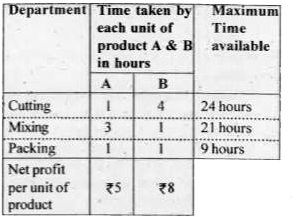
A firm produced 2 different products A and B. Each product has to undergo three operations before takes the shape. The profit per unit and time required per unit of each product in each operation is tabulated below.

To formulate a linear programming problems write
(i) the non-negativity constraints
(ii) Cutting constraints .
(iii) Mixing constraints
(iv) Packing constraints
(v) Objective function

Promotional Banner

Topper's Solved these Questions

  • LINEAR PROGRAMMING

    NEW JOYTHI PUBLICATION|Exercise NECERT TEXT BOOK EXERCISE 12.1|10 Videos
  • LINEAR PROGRAMMING

    NEW JOYTHI PUBLICATION|Exercise NECERT TEXT BOOK EXERCISE 12.2|10 Videos
  • LINEAR INEQUALITIES

    NEW JOYTHI PUBLICATION|Exercise QUESTIONS FROM COMPETITIVE EXAMS|38 Videos
  • MATHEMATICAL REASONING

    NEW JOYTHI PUBLICATION|Exercise QUESTION FROM COMPETITIVE EXAMS|23 Videos

Similar Questions

Explore conceptually related problems

A tyre manufactureing company produces tyres of cars and buses. Three machines A, B, C are to be used for the production of these typres. Machines A and C are available for operation atmost 11 hours, whereas B must be operated for atleast 6 hours a day. the time required for construction of one typre the three machines given in the following table. Comapy sells all the tyres and gets a profit of Rs. 100 Rs 150 on a tyre of a car and bus respectively. The company wants to know how many numbers of each item to be produced to maximise the profit. To formulate a linear programmining problem, (i) Write the objective function. (ii) Write all constraints.

A company manufactures two proudcts. A and B on which the profits erarned per unit areRs. 30 and Rs. 40 respectively. Each product is procced on two machines M_(1) and M_(2) . One unit of product A requires on hour of processing time on M_(1) and 2 hours on M_(2) While one unit of product B requires one hour each on M_(1) and M_(2) . Machines M_(1) and M_(2) are availabe atmost 10 hours and 12 hours respectivrely during working day. The company wants to know how many units of proudcts A and B should be produced to maximise the profit. to formulate a linearprogramming problem (i) Write the objective function. (ii) Write all contraints.

A bakery owner makes two types of cakes A and B. three machines are needed for this pupose. The time in (minutes) required for each type of cake in each machine is given below. Each machines is available for atmost 6 hours per day. Assume that all cakes will be sold out every day. The bakery owner wants to make maximum pforit per day by making Rs. 7.5 from type A and Rs. 5 from type B. a Write the objective function by defining suitable variables. b Write the constraints. c Find the maximum profit graphically.

A company produes two types of cricket ball A and B. the production time of one ball of type B is double the type A (Time in units) . The company has a time to produce a maximum 2000 balls per day. The supply of raw material is sufficient for the production of 1500 balls (both A and B) per day. the company wants to make maximum profit by making profit fo Rs 3 from a ball of tye A and Rs. 5 from a ball of type b. Then (i) By defining suitable variables, write the objective function. (ii) Write the constraints. (iii) How many balls should be produced in each type per day in order to get maximum profit ?

A manufacturer has 3 machines I, II and III installed in his factory. Machines I and II are capable of being operated for utmost 12 hours whereas machine III must be operated atleast for 5 hours a day. He produces only two items A and B each requiring the use of three machines. The number of hours required for producing 1 unit of each of the items A and B on the three machines are given below. He makes a profit of Rs 7600 on item A and Rs 400 on item B. Assume that he can sell all that he produces. (i) Formulate this as a linear programming problem. (ii) Solve the L.P.P by corner point method.

A furniture dealer sells only two items namely tables and chairs. He has Rs. 10,000 to invest and a space to store atmost 60 piecs. A table costs him Rs. 500 and a chair rs. 200 He can sell a table at a profit of Rs. 50 and a chair at a profit Rs 15. Assume that he can sell all the items that he buys. By defining suitable variables. i. write the objective function ii. write the cost constraint iii. write the space constraint iv write the non negative constraint

The graph of a linear programming problem is given below. The shaded region is the feasible region. The objective function is Max Z=px+qy (i) What are the coordinates of the corners of the feasible region. (ii) Write the constraints. (iii) If the Z occurs at A and B, what is the relation between p and q. (iv) If q=1 write the objective, function. (v) Find the Max Z.

A medicien company has factories at two places A and B. From these places, supply is made to each of its three agencies situated at P,Q and R. The monthly requirements of the agencies are respectively 40,40 50 packets of its medicines, while the production of the factories at A and B are 60 and 70 packets respectively. The transportation cost (in Rs) per packet from the factories to the agencies are given below. Formulate the linear programming problem so that the cost of transportation is minimum .

Condier the following problem. A manufacture produced tables and chairs. It takes 3 hours of work on machine A mind 1 hour of work on machine B to produce one table and 2 hours of work on machine A and 3 hours on machine B to produce 1 chair . He erars a profit fo Rs. 50 per table and Rs 40 per chair. Hoperates the machines a and B for atmost 12 hours hours respectively. how many tables and chairs should be produce each day to maximise his profit ? (i) Write the objective function. (ii) Write the constrains.

There is a factory located at each of the two places P and Q. From these locations a certain commodity is delivered to each of the three depots situated at A, B and C. The weekly requirements of the depots are respectively 5, 5 and 4 units of the commodity while the production capacity of the factories at P and Q are respectively 8 and 6 units. The cost of transportation per unit is given below. Formulate the above LPP mathematically in order thaet transportation const in minimum. Solve the I.P.P.