Home
Class 12
PHYSICS
Figure shows a metal rod PQ resting on t...

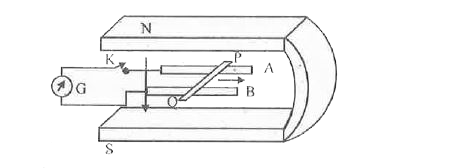
Figure shows a metal rod PQ resting on the smooth rails AB and positioned between the poles of a permanent magnet. The rails, the rod and the magnetic field are in three mutually perpendicular directions. A galvonometer G connects the rails through a switch K. Length of rod = 15 cm, B = 0.50 T, resistance of the closed loop containing the rod = `9.0mOmega`. Assume the field to be uniform.

a. Suppose K is open and the rod is moved with a speed of `12cms^(-1)` in the direction shown. Give the polarity and magnitude of the induced emf.
b. Is there an excess charge built up at the ends of the rods when K is open? What if K is closed?
c. With K open and the rod moving uniformly, there is no net force on the electrons in the rod PQ eventhough they do experience magnetic force due to the motion of the rod. Explain.
d. What is the retarding force on the rod when K is closed?
e. How much power is required (by an external agent) to keep the rod moving at the same speed `(=12cms^(-1))` when K is closed? How much power is required when K is open?
f. How much power is dissipated as heat in the closed circuit? What is the source of this power?
g. What is the induced emf in the moving rod if the magnetic field is parallel to the rails instead of being perpendicular?

Text Solution

Verified by Experts

a. `varepsilon=Blv=0.5xx15xx10^(-2)xx12xx10^(-2)=9.0mV`
P is the positive end and Q the negative end. [The conductor moves towards this end)
b. Yes. On closing K, current flows but the excess charge is maintained as long as the change continues.
c. Magnetic force on the charge is cancelled by the electric force set up due to the excess charge of opposite signs at the ends of the rod.
d. `F=BIl=75xx10^(-3)N`
e. Power = `E.v=9xx10^(-3)W`. No power is expended when K is open (no current)
f. `I^(2)R=9.0xx10^(-3)W`. Source of power is supplied by the external agent.
g. Zero. No change of flux.
Promotional Banner

Topper's Solved these Questions

  • ELECTROMAGNETIC INDUCTION

    NEW JOYTHI PUBLICATION|Exercise CONTINUOUS EVALUATION (ASSIGNMENTS)|2 Videos
  • ELECTROMAGNETIC INDUCTION

    NEW JOYTHI PUBLICATION|Exercise PREVIOUS YEAR QUESTIONS|2 Videos
  • ELECTROMAGNETIC INDUCTION

    NEW JOYTHI PUBLICATION|Exercise PRACTICE PROBLEMS FOR SELF ASSESSMENT|3 Videos
  • ELECTRIC CHARGES AND FIELDS

    NEW JOYTHI PUBLICATION|Exercise Competitive Exam Corner|20 Videos
  • ELECTROMAGNETIC WAVES

    NEW JOYTHI PUBLICATION|Exercise COMPETITIVE EXAM CORNER|16 Videos

Similar Questions

Explore conceptually related problems

Find the electric field at a point P on the perpendicular bisector of a uniformly charged rod. The lengthof the rod is L, the charge on it is Q and the distance of P from the centre of the rod is a.

Consider a situation similar to that of the previous problem except that the ends of the rod slide on a pair of thick metallic rails laid parallel to the wire. At one end the rails are connected by resistor of resistance R. (a) what force is needed ot keep the rod sliding at a constant speed v? (b) in this situation what is the current in the resistance R? (c) Find the rate of heat developed in the resistor. (d) find the power delivered by the external agent exerting the force on the rod.

Figure shows a square loop ABCD with edge length a. The resistance of the wire ABC is r and that of ADC is 2r. Find the magnetic field B at the centre of the loop assuming uniform wires.

A beam of electron posses undeflected through mutually perpendicular electric and magnetic fields. If the electric field is switched off and the same magnetic field is maintained, the electrons move,

Two identical uniform rods AB and CD, each of length L are jointed to form a T-shaped frame as shown in figure. Locate the centre of mass of the frame. The centre of mass of a uniform rod is at the middle point of the rod.
