Home
Class 12
PHYSICS
At what angle should a ray of light be i...

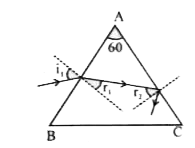
At what angle should a ray of light be incident on the face of a prism of refracting angle `60^(@)` so that it just suffers total internal reflection at the other face ? The refractive index of the material of the prism is 1.524

Text Solution

Verified by Experts

sin `i_(e) = (1)/(n) = (1)/(1.524) = 0.6562 " " therefore i_(e) = 41^(@)`
i.e., `r_(2) = i_(e) = 41^(@)`
`r_(1) + r_(2) = A `
`r_(1) = A - r_(2) = 60 - 41 = 19^(@)`
`(sin i_(1))/(sin r_(1)) = n " " therefore sin i_(1) = n sin r_(1) = 1.524 sin 19^(@) = 0.4962 `
`i_(1) = sin^(1) (0.4962) i_(1) = 29^(@) 45. approx 30^(@)` .
Promotional Banner

Topper's Solved these Questions

  • RAY OPTICS AND OPTICAL INSTRUMENTS

    NEW JOYTHI PUBLICATION|Exercise PRACTICE PROBLEMS FOR SELF ASSESSMENT|20 Videos
  • RAY OPTICS AND OPTICAL INSTRUMENTS

    NEW JOYTHI PUBLICATION|Exercise EVALUATION QUESTION AND ANSWERS|30 Videos
  • RAY OPTICS AND OPTICAL INSTRUMENTS

    NEW JOYTHI PUBLICATION|Exercise COMPETITIVE EXAM CORNER|26 Videos
  • NUCLEI

    NEW JOYTHI PUBLICATION|Exercise COMPETITIVE EXAM CORNER|23 Videos
  • SEMICONDUCTOR ELECTRONICS : MATERIALS , DEVICES AND SIMPLE CIRCUITS

    NEW JOYTHI PUBLICATION|Exercise COMPETITIVE EXAM CORNER|37 Videos

Similar Questions

Explore conceptually related problems

Light ray falls at normal incidence on the first face of an equilateral prism and emergres gracing the second face. What is the angle of deviation? What is the refractive indec of the material of the prism?

The critical angle for total internal reflection in diamond is 24.5^(@) . The refractive index of diamond is

A ray of light is incident at 60^(@) on one face of a prism of angle 30^(@) and the emergent ray makes 30^(@) with the incident ray.the refractive index of the prism is

A ray of light is incident normally on one refracting surface of an equilateral prism . If the refrctive index of a material of the prism is 1.5., then

The angle of incidence for a ray of light of a refracting surface of at prism is 45^@ . The angle of prism is 60^@ . If the ray suffers minimum deviation through the prism, the angle of minimum deviation and refractive index of the material of the prism respectively, are

A ray of light is incident at angle of incident ,I, on one face of a prism of angle A (assumed to be small) and emerges normally from the opposite face. If the refractive index of the prism is mu the angle of incidence i, is nearly equal to:

A ray of light is incident normally on one of the faces of a prism of apex angle 30^@ and refractive index sqrt2 . Find the angle of deviation for the ray of light.

A prism is made of glass of unknown refractive index. A parallel beam of light is incident on a face of the prism. The angle of minimum deviation is measured to be 40^(@) .What is the refrective index of the material of the prism? The refracting angle of the prism is 60^(@) . If the prism is placed in water (refractive index 1.33) , predict the new angle of minimum deviation of a parallel beam of light .

The angle of a prism is A , One of its refracting surface is slivered . Light rays falling at an angle of incidence 2A on the first surface returns back through the same pathe after suffering reflection at the silvered surface. The refractive index mu of the prism is:

Light traveling from a transparent medium to air undergoes that internal reflection at an angle of incident of 45^(@) . Then refractive index of the medium may be

NEW JOYTHI PUBLICATION-RAY OPTICS AND OPTICAL INSTRUMENTS -SOLUTIONS TO EXERCISES FROM NCERT TEXT
  1. a. Determine the 'effective focl length ' of the combination of the tw...

    Text Solution

    |

  2. An object 1.5 cm is size is placed on the side of the convex lens in t...

    Text Solution

    |

  3. At what angle should a ray of light be incident on the face of a prism...

    Text Solution

    |

  4. You are given prisms made of crown glass and flint glass with a wide v...

    Text Solution

    |

  5. For a normal eye, the far point is at infinity and the near point of d...

    Text Solution

    |

  6. A myopic person has been using spectacles of power -1.0 dioptre for di...

    Text Solution

    |

  7. A person looking at a person wearing a shirt with a pattern comprising...

    Text Solution

    |

  8. A man with normal near point (25 cm ) reads a book with small print us...

    Text Solution

    |

  9. A card sheet divided into squares each of size 1 mm^(3) viewed at a ...

    Text Solution

    |

  10. a. At what distance should the lens be held in Exercise 27 in order t...

    Text Solution

    |

  11. If the object is at (50/7)cm and the image produced is at distinct vis...

    Text Solution

    |

  12. Is the magnification equal to the magnifying power in this case ? Expl...

    Text Solution

    |

  13. What should be the distance between the object in Exercise 28 and the ...

    Text Solution

    |

  14. The angle subtended at the eye by an object is equal to the angle subt...

    Text Solution

    |

  15. In viewing through a magnifying glass, one usually positions one's eye...

    Text Solution

    |

  16. Magnifying power of a simple microscope is inversely proportional to t...

    Text Solution

    |

  17. Why must both the objective and the eyepiece of a compound microscope...

    Text Solution

    |

  18. When viewing through a compound microscope, our eyes should be positio...

    Text Solution

    |

  19. An angular magnification (magnifying power ) of 30x is desired using o...

    Text Solution

    |

  20. A small telescope has an objective lens of focal length 140 cm and eye...

    Text Solution

    |
