Home
Class 12
PHYSICS
Figure shows an equiconvex lens (of refr...

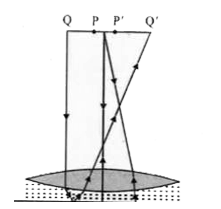
Figure shows an equiconvex lens (of refractive index 1.50 ) in contact with a liquid layer on top of a plane mirror. A small needle with its tip on the principal axis is moved along the axis until its inverted image is found at the position of the needle. The distance of the needle from the lens is measured to be 45.0 cm. The liquid is removed and the experiment is repeated . the new distance is measured to be 30.0 cm. What is the refractive index of the liquid ?

Text Solution

Verified by Experts

f = 45 cm , n = 1.5 , `f_(1) = 30`
`therefore (1)/(f_(1)) + (1)/(f_(2)) = (1)/(f) , (1)/(f_(2)) = (1)/(f) - (1)/(f_(1))`
`(1)/(f_(2)) = (1)/(45) - (1)/(30) = (30 - 45)/(45 xx 30) = (-1)/(90)`
`f_(2) = - 90 ` cm
but `(1)/(f_(1)) = (n - 1) [(1)/(R_(1)) - (1)/(R_(2)) ] , R_(1)= R_(2) " " therefore (1)/(f_(1)) = (n - 1) [ (2)/(R) ] `
`(1)/(30) = (1.5 - 1) xx (2)/(R) = (1)/(R) " " therefore R = 30 cm `
` f_(2) = - 90 cm , n = ? , R_(2) = infty , R_(1) = - 30 cm " " therefore (1)/(f_(2)) = (n - 1) [ (1)/(R_(1)) - (1)/(R_(2)) ]`
` (1)/(-90) = (n - 1) [(1)/(-30) - (1)/(infty) ] = (n - 1) xx (1)/(-30) " " therefore n - 1 = (30)/(90) = (1)/(3) = 0.33 `
`therefore n = 0.33 + 1 " " n = 1.33 `
Promotional Banner

Topper's Solved these Questions

  • RAY OPTICS AND OPTICAL INSTRUMENTS

    NEW JOYTHI PUBLICATION|Exercise PRACTICE PROBLEMS FOR SELF ASSESSMENT|20 Videos
  • RAY OPTICS AND OPTICAL INSTRUMENTS

    NEW JOYTHI PUBLICATION|Exercise EVALUATION QUESTION AND ANSWERS|30 Videos
  • RAY OPTICS AND OPTICAL INSTRUMENTS

    NEW JOYTHI PUBLICATION|Exercise COMPETITIVE EXAM CORNER|26 Videos
  • NUCLEI

    NEW JOYTHI PUBLICATION|Exercise COMPETITIVE EXAM CORNER|23 Videos
  • SEMICONDUCTOR ELECTRONICS : MATERIALS , DEVICES AND SIMPLE CIRCUITS

    NEW JOYTHI PUBLICATION|Exercise COMPETITIVE EXAM CORNER|37 Videos

Similar Questions

Explore conceptually related problems

The refractive index of eye lens is _________ .

An illuminated object is placed on the principal axis of a converging lens so that real image is formed on the other side of the lens. If the object is shifted a little,

A particle is moving at a constant speed V from a large distance towards a concave mirror of radius R along its principal axis. Find the speed of the image formed by the mirror as a function of the distance x of the particle from the mirror.

The radius of curvature of each surface of a convex lens of refractive index 1.5 is 40 cm. Calculate its power.

The point at which the principal axis meets the surface of the lens is ________.

Write a note on : Compass needle.

A convex mirror has its radius of curvature 20 cm. Find the position of the image of an object placed at a distance of 12 cm from the mirror.

A pin of length 2.0 cm lies along the principal axis of a converging lens, the centre being at a distance of 11 cm from the lens. The focal length of the lens is 6 cm. Find the size of the image.

A pin of length 2.00 cm is placed perpendicular to the principal axis of a converging lens. An inverted image of size 1.00 cm is formed at a distance of 40.0 cm from the pin. Find the focal length of the lens and its distance from the pin.

An object of length 2.0 cm is placed perpendicular to the principal axis of a convex lens of focal length 12 cm. Find the size of the image of the object is at a distance of 8.0 cm from the lens.

NEW JOYTHI PUBLICATION-RAY OPTICS AND OPTICAL INSTRUMENTS -SOLUTIONS TO EXERCISES FROM NCERT TEXT
  1. A person looking at a person wearing a shirt with a pattern comprising...

    Text Solution

    |

  2. A man with normal near point (25 cm ) reads a book with small print us...

    Text Solution

    |

  3. A card sheet divided into squares each of size 1 mm^(3) viewed at a ...

    Text Solution

    |

  4. a. At what distance should the lens be held in Exercise 27 in order t...

    Text Solution

    |

  5. If the object is at (50/7)cm and the image produced is at distinct vis...

    Text Solution

    |

  6. Is the magnification equal to the magnifying power in this case ? Expl...

    Text Solution

    |

  7. What should be the distance between the object in Exercise 28 and the ...

    Text Solution

    |

  8. The angle subtended at the eye by an object is equal to the angle subt...

    Text Solution

    |

  9. In viewing through a magnifying glass, one usually positions one's eye...

    Text Solution

    |

  10. Magnifying power of a simple microscope is inversely proportional to t...

    Text Solution

    |

  11. Why must both the objective and the eyepiece of a compound microscope...

    Text Solution

    |

  12. When viewing through a compound microscope, our eyes should be positio...

    Text Solution

    |

  13. An angular magnification (magnifying power ) of 30x is desired using o...

    Text Solution

    |

  14. A small telescope has an objective lens of focal length 140 cm and eye...

    Text Solution

    |

  15. For the telescope described in Exercise 32 (a ) , whet is the separati...

    Text Solution

    |

  16. Focal length of the Objective lens is 140 cm. Focal length of the eyep...

    Text Solution

    |

  17. A height of a tower formed by a objective lens of a telescope is 4.7 c...

    Text Solution

    |

  18. A Cassegrain telescope uses two mirrors. Such a telescope is bult with...

    Text Solution

    |

  19. Light incident normally on a plane mirror attached to a galanometer co...

    Text Solution

    |

  20. Figure shows an equiconvex lens (of refractive index 1.50 ) in contact...

    Text Solution

    |
