Home
Class 12
PHYSICS
You are given an equilateral glass prism...

You are given an equilateral glass prism of refractive index 'n'. A light rays is incident on one of its faces at an angle `'i_(1)'` .
a. What happens when you increase `'i_(l)'` gradually ?
b. What happens if `'i_(l)'` is increased beyond a certain value ?
c. Give the graphical representation of variation

Text Solution

Verified by Experts
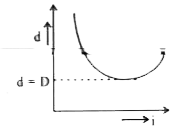
a. As `.i_(1).` increases gradually, the angle of deviation .d. decreases.
b. For a particaular value of `.i_(1).` , the angle .d. reaches a minimum value. If again we increase `.i_(1).`, then .d. also increases.
c.
Promotional Banner

Topper's Solved these Questions

  • RAY OPTICS AND OPTICAL INSTRUMENTS

    NEW JOYTHI PUBLICATION|Exercise CONTINUOUS EVALUATION|20 Videos
  • RAY OPTICS AND OPTICAL INSTRUMENTS

    NEW JOYTHI PUBLICATION|Exercise PREVIOUS YEAR QUESTIONS|2 Videos
  • RAY OPTICS AND OPTICAL INSTRUMENTS

    NEW JOYTHI PUBLICATION|Exercise PRACTICE PROBLEMS FOR SELF ASSESSMENT|20 Videos
  • NUCLEI

    NEW JOYTHI PUBLICATION|Exercise COMPETITIVE EXAM CORNER|23 Videos
  • SEMICONDUCTOR ELECTRONICS : MATERIALS , DEVICES AND SIMPLE CIRCUITS

    NEW JOYTHI PUBLICATION|Exercise COMPETITIVE EXAM CORNER|37 Videos

Similar Questions

Explore conceptually related problems

An equilateral glass prism has a refractive index of 1.5 Calculate the (a) angle of incidence for minimum deviation, (b) the minimum deviation, (c) the angle of emergence of the light at the maximum deviation .

A prism is made of glass of unknown refractive index. A parallel beam of light is incident on a face of the prism. The angle of minimum deviation is measured to be 40^(@) .What is the refrective index of the material of the prism? The refracting angle of the prism is 60^(@) . If the prism is placed in water (refractive index 1.33) , predict the new angle of minimum deviation of a parallel beam of light .

i. Light has several properties like reflection, refraction etc. When light travels from an optically denser medium to a rarer medium ? a. What happens to the light at the interface ? b. give a demonstration for total internal reflection. c. What are the technological applications of total internal reflection in nature? Briefly explain it.

a.Figure shows a cross-section of a 'light pipe' made of glass fibre of refractive index 1.68 The outer converting of the pipe is made of a material of refractive index 1.44. What is the range of the angles of the incident rays with the axis of the pipe for which total reflections insides the pipe take place as shown in the figure. b.What is the answer if there is no outer converting of the pipe ?

Read the passage and answer the following question: In, vacuum the velocity of light radiation with different wavelength is the same. But in a material medium, the velocity of different colour radiations is not the same and they travel with different paths. Due to this, the refractive index of the medium is different for different colours. If white beam of light is incident on a glass prism, the angle of refraction for different colours is different. When Sunlight is incident on a refracting surface, then it gets split into seven coloured spectrum and emerges out. The splitting of light into its component colours is called dispersion. Sir Isaac Newton was the first to use a glass prism to obtain the spectrum of Sunlight. A glass prism is transparent medium bounded by two plane surfaces inclined at an angle. When white light is dispersed into seven colours by a prism, different colours of light bend through different angles with respect to incident ray. Out of these seven colours, red light bends the least, while violet light bends the most. So, the rays of each colour emerge along different paths and becomes distinct. Hence, we get spectrum of seven - different colours. Q. What is dispersion ?

Read the passage and Answer the following question: In, vacuum the velocity of light radiation with different wavelength is the same. But in a material medium, the velocity of different colour radiations is not the same and they travel with different paths. Due to this, the refractive index of the medium is different for different colours. If white beam of light is incident on a glass prism, the angle of refraction for different colours is different. When Sunlight is incident on a refracting surface, then it gets split into seven coloured spectrum and emerges out. The splitting of light into its component colours is called dispersion. Sir Isaac Newton was the first to use a glass prism to obtain the spectrum of Sunlight. A glass prism is transparent medium bounded by two plane surfaces inclined at an angle. When white light is dispersed into seven colours by a prism, different colours of light bend through different angles with respect to incident ray. Out of these seven colours, red light bends the least, while violet light bends the most. So, the rays of each colour emerge along different paths and becomes distinct. Hence, we get spectrum of seven - different colours. Q. What is spectrum ?

Read the passage and Answer the following question: In, vacuum the velocity of light radiation with different wavelength is the same. But in a material medium, the velocity of different colour radiations is not the same and they travel with different paths. Due to this, the refractive index of the medium is different for different colours. If white beam of light is incident on a glass prism, the angle of refraction for different colours is different. When Sunlight is incident on a refracting surface, then it gets split into seven coloured spectrum and emerges out. The splitting of light into its component colours is called dispersion. Sir Isaac Newton was the first to use a glass prism to obtain the spectrum of Sunlight. A glass prism is transparent medium bounded by two plane surfaces inclined at an angle. When white light is dispersed into seven colours by a prism, different colours of light bend through different angles with respect to incident ray. Out of these seven colours, red light bends the least, while violet light bends the most. So, the rays of each colour emerge along different paths and becomes distinct. Hence, we get spectrum of seven - different colours. Q. Which light deviates the least and which one deviates the most ?

You are given a solenoid of length 'l', number of turns per unit length 'n' and area of cross-section A. When a current 'I' passes through it, a. What is the total magnetic flux through the solenoid? b. What is the self inductance of the solenoid? c. How does the value of self inductance get affected if some material of high relative permeability is filled inside the solenoid?

A ray of light is incident at angle of incident ,I, on one face of a prism of angle A (assumed to be small) and emerges normally from the opposite face. If the refractive index of the prism is mu the angle of incidence i, is nearly equal to:

At what angle should a ray of light be incident on the face of a prism of refracting angle 60^(@) so that it just suffers total internal reflection at the other face ? The refractive index of the material of the prism is 1.524

NEW JOYTHI PUBLICATION-RAY OPTICS AND OPTICAL INSTRUMENTS -EVALUATION QUESTION AND ANSWERS
  1. A beaker is placed on the top of a coin. The top of the beaker is clos...

    Text Solution

    |

  2. A beam of light passing from one transparent medium to another oblique...

    Text Solution

    |

  3. You are given an equilateral glass prism of refractive index 'n'. A li...

    Text Solution

    |

  4. a. What is the principle used in optical fibres ? b. Explain brief...

    Text Solution

    |

  5. If the tumbler is suitably tilted and viewed at a suitable angle. a....

    Text Solution

    |

  6. A ray of light passes from denser medium to rarer medium a. What hap...

    Text Solution

    |

  7. A candle is placed in front of a concave lens. a. Draw the course of...

    Text Solution

    |

  8. a. What is meant by magnification 'm' ? b. Give the mathematical re...

    Text Solution

    |

  9. The power of a lens is +2D. a . What do you mean by this ? b How i...

    Text Solution

    |

  10. You are given two convex lenses. a. What is the focal length of the ...

    Text Solution

    |

  11. Why do stars twinkle ?

    Text Solution

    |

  12. Why does a diamond sparkle with great brilliance?

    Text Solution

    |

  13. When a solar spectrum is viewed, we can see a number of dark lines. ...

    Text Solution

    |

  14. I prop (1)/(lambda^(4)) where I is the intensity of light and lambda i...

    Text Solution

    |

  15. a. What is scattering of light? b. Explain Rayleigh scattering. ...

    Text Solution

    |

  16. A plano-convex lens fits exactly into a plano-concave lens. Their surf...

    Text Solution

    |

  17. The teacher shows a thin lens and a thick lens. a. Which of these le...

    Text Solution

    |

  18. a. Is there any difference between fluorescence and phosphorescence ? ...

    Text Solution

    |

  19. It can be seen that no rainbow is seen during the middle of the day. G...

    Text Solution

    |

  20. How could a blue object appear under sodium lamp light ?

    Text Solution

    |

