Home
Class 12
BIOLOGY
Diagram of a double stranded polynucleot...

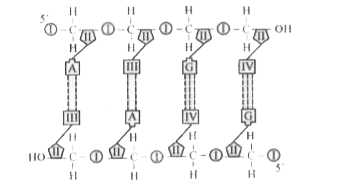
Diagram of a double stranded polynucleotide chain is shown below.

What do the numbers I, II, III and IV indicate?

Text Solution

Verified by Experts

I - Phosphorus II - Pentose sugar III - Thymine IV - Cytosine
Promotional Banner

Topper's Solved these Questions

  • MOLECULAR BASIS OF INHERITANCE

    NEW JOYTHI PUBLICATION|Exercise PREVIOUS YEAR COMPETITIVE EXAM QUESTIONS|72 Videos
  • MOLECULAR BASIS OF INHERITANCE

    NEW JOYTHI PUBLICATION|Exercise QUESTIONS FROM EDUMATE|4 Videos
  • MICROBES IN HUMAN WELFARE

    NEW JOYTHI PUBLICATION|Exercise PREVIOUS YEAR COMPETITIVE EXAM QUESTIONS|5 Videos
  • ORGANISMS AND POPULATIONS

    NEW JOYTHI PUBLICATION|Exercise CBSE Corner|6 Videos

Similar Questions

Explore conceptually related problems

Polypeptide chains of two haemoglobin molecules are shown below. One of the chains shows an abnormality. Observe the diagram and answer the following questions. a. Which of the polypeptide chain in haemoglobin is abnormal leading to a disease? b. What is the reason for this abnormality? c. What will be the effect of this change in polypeptide chain?

Read the following statements and select the correct ones. (i) Electrophoresis is a technique used for the separation of molecules based on their size and charge. (ii) Plasmids are extra-chromosomal, self-replicating, usually circular, double stranded DNA molecules found naturally in many bacteria and also in some yeast,. (iii) It is not advisable to use an exonuclease enzyme while producing a recombinant DNA molecule. (iv) In EcoRl, the roman numberal I indicates that it was the first enzyme isolated from E.coli A) (i) and (ii) B) (iii) and (iv) C) (i),(ii) and (iv) D) (i),(ii),(iii) and (iv)

Study the following statements regarding food chains and select the correct ones. (i) Removal of 80% tigers from an area resulted in greatly increased growth of vegetation. (ii) Removal of most of the carnivores resulted in an increased population of deers. (iii) The lenght of food chains is generally limited to 3-4 trophic levels due to energy loss. (iv) The lenght of food chains may vary from 2 to 8 trophic levels. A) i and ii B) ii and iii C) i and iii D) iii and iv

A_(3)-_(5)B C_(5)-_(3)D AB and CD represent two strands of a DNA molecule. When this molecule undergoes replication, a replication fork is formed between A and C in the above. i. Name the template strands for replication. ii. Using which strand as the template, will there be continuous synthesis of a complementary DNA strand? iii. Complementary to which strand will Okazaki segments get synthesised. iv. What are template strands and Okazaki pieces? v. In which direction is a new strand synthesised?
