Home
Class 11
PHYSICS
The following velocity-time graph repres...

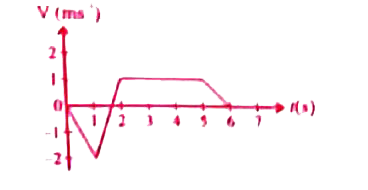
The following velocity-time graph represents a particle moving in the positive x-direction . Analyse its motion from 0 to 7s . Calculate the displacement covered and distance travelled by the particle from 0 to 2s

Text Solution

Verified by Experts

As per graph,
(a) From 0 to 1.5s the particle is moving in a opposite direction.
From 1.5s to 2s the particle is moving with increasing velocity.
From 2s to 5s velocity of the particle is constant of magnitude `1ms^(-1)`
From 5 to 6s velocity of the particle is decreasing.
From 6s to 7s the particle is at rest.
(b) Distance covered by the particle - Arca covered under (v-t) graph
`=(1)/(2)xx2xx1.5+(1)/(2)xx1xx0.5=1.5m+0.25m=1.75m`
Displacement of the particle `=-(1)/(2)xx2xx1.5+(1)/(2)xx1xx0.5`
`=-1.5m` to `0.25m=-1.25`
Promotional Banner

Topper's Solved these Questions

  • KINEMATICS

    FULL MARKS|Exercise ADDITIONAL QUESTIONS SOLVED (SHORT ANSWER QUESTIONS (1 MARK))|102 Videos
  • KINEMATICS

    FULL MARKS|Exercise ADDITIONAL QUESTIONS SOLVED (SHORT ANSWER QUESTIONS - 1 (3 MARKS))|14 Videos
  • KINEMATICS

    FULL MARKS|Exercise ADDITIONAL QUESTIONS SOLVED (NUMERICAL QUESTIONS)|42 Videos
  • HEAT AND THERMODYNAMICS

    FULL MARKS|Exercise ADDITIONAL QUESTIONS SOLVED (Numerical Problems)|16 Videos
  • KINETIC THEORY OF GASES

    FULL MARKS|Exercise Addtional Numerical Problems|10 Videos

Similar Questions

Explore conceptually related problems

Figure shows the speed versus time graph for a particle. Find the distance travelled by the particle during the time t=0 to t=3s.

From the veloicty time graph of a particle given in figure describe the motion of the particle qualitively int eh interval 0 to 4s. Find a. the distance travelled during first two seconds, b. during the time 2s to 4s, c. during the time 0 to 4s d. displacement during 0 to 4 s. e. acceleration at t=1/2 and f. acceleration at t=2s .

The following graphs represent velocity- time graph. Identify what kind of motion a particle undergoes in each graph

The following graphs represent velocity- time graph. Identify what kind of motion a particle undergoes in each graph

Find the distance travelled by the particle during the time t = 0 to t = 3 second from the figure .

A particle executes simple harmonic motion with an amplitude of 10 cm and time period 6s. At t=0 it is at position x=5 cm going towards positive x-direction. Write the equation for the displacement x at time t. Find the magnitude of the acceleration of the particle at t=4s.

In the given figure , a= 15m//s^2 represent the total acceleration of a particle moving in the clockwise direction in a circle of radius R=2.5m at a given instant of time . The speed of the particle is , .

A particle starts with an initial velocity 2.5 m/s along the positive x direction and it accelerates uniformly at the rate 0.50 m/s^2 . A. Find the distance travelled by it in the first two seconds. b.How much time does it take to reach the velocity 7.5 m/s ? c. How much distance will it cover in reaching the velocity 7.5 m/s?

A particle moves along a line according to the law s(t)=2t^(3)-9t^(2)+12t-4 , where tge0 . Find the total distance travelled by the particle in the first 4 seconds.

A particle starting from rest moves with constant acceleration. If it takes 5.0 s to reash the speed 18.0 km/h find a. the average velocity during this period, and b. the distance travelled by the particle during this period.

FULL MARKS-KINEMATICS-TEXTUAL QUESTIONS SOLVED (NUMERICAL QUESTIONS)
  1. An object at an angle such that the horizontal range is 4 time of the ...

    Text Solution

    |

  2. The following graphs represent velocity- time graph. Identify what kin...

    Text Solution

    |

  3. The following velocity-time graph represents a particle moving in the ...

    Text Solution

    |

  4. A particle is projected at an angle of theta with respect to the horiz...

    Text Solution

    |

  5. A water fountain on the ground sprinkles water all around it. If the s...

    Text Solution

    |

  6. Complete the table.

    Text Solution

    |

  7. The resultant of two vectors A and B is perpendicular to vector A and ...

    Text Solution

    |

  8. Compare the components for the following vector equations (a) Thatj-...

    Text Solution

    |

  9. Calculate the area of the triangle for which two of its sides are give...

    Text Solution

    |

  10. If Earth completes one revolution in 24 hours, what is the angular dis...

    Text Solution

    |

  11. An object is thrown with initial speed 5ms^(-1) with an angle of proje...

    Text Solution

    |

  12. A foot - ball player hits tha ball with speed 20ms^(-1) with angle 30...

    Text Solution

    |

  13. If an object is thrown horizontally with an initial speed "10 ms"^(-1)...

    Text Solution

    |

  14. An object is executing uniform circular motion with an angular speed o...

    Text Solution

    |

  15. Consider the x-axis as representing east, the y-axis as north and z-ax...

    Text Solution

    |

  16. The moon is orbiting the Earth approximately in 27 days, what is the a...

    Text Solution

    |

  17. An object of mass m has angular acceleration alpha =0.2" rad s"^(-2). ...

    Text Solution

    |

  18. The position vector of the particle has length 1 m and makes 30^(@) wi...

    Text Solution

    |

  19. A particle has its position moved from vecr(1)=3hati+4hatj to vecr(2)=...

    Text Solution

    |

  20. Calculate the average velocity of the particle whose position vector c...

    Text Solution

    |
