Home
Class 11
PHYSICS
A disc rotating about its axis with angu...

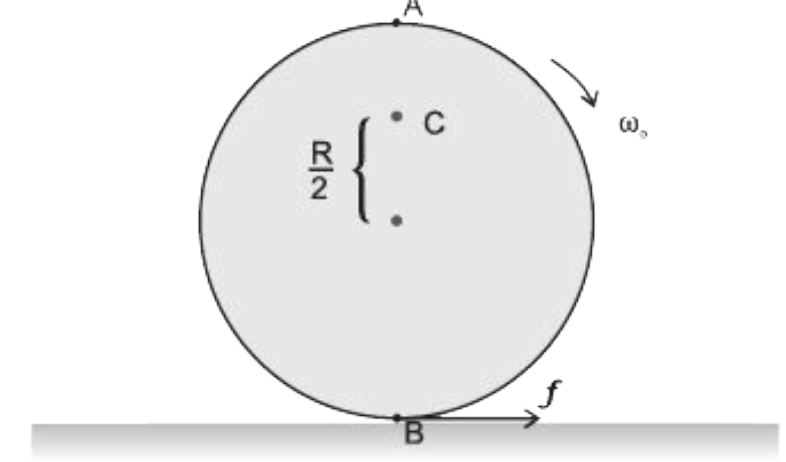
A disc rotating about its axis with angular speed `ω_(o)` is placed lightly (without any translational push) on a perfectly frictionless table. The radius of the disc is R. What are the linear velocities of the points A, B and C on the disc shown in Fig. 7.41? Will the disc roll in the direction indicated ?

Text Solution

Verified by Experts

For `A=VB_(A)= Romega_(0)` in forward direction.
For `B=V_(B)= Romega_(0)` in backward direction.
For `C=V_(C)= (R)/(2)omega_(0)` in forward direction disc will not roll.
Promotional Banner

Topper's Solved these Questions

  • MOTION OF SYSTEM OF PARTICLES AND RIGID BODIES

    FULL MARKS|Exercise ADDITIONAL QUESTIONS SOLVED - III (NUMERICALS)|12 Videos
  • MOTION OF SYSTEM OF PARTICLES AND RIGID BODIES

    FULL MARKS|Exercise ADDITIONAL QUESTIONS SOLVED - III (LONG ANSWER QUESTIONS (5 MARKS))|6 Videos
  • MOTION OF SYSTEM OF PARTICLES AND RIGID BODIES

    FULL MARKS|Exercise ADDITIONAL QUESTIONS SOLVED - III ( SHORT ANSWER QUESTIONS (2 MARKS))|12 Videos
  • LAW OF MOTION

    FULL MARKS|Exercise ADDITIONAL QUESTIONS SOLVED (SHORT ANSWER QUESTIONS (3 MARKS & NUMERICALS))|16 Videos
  • NATURE OF PHYSICAL WORLD AND MEASUREMENT

    FULL MARKS|Exercise ADDITIONAL QUESTIONS SOLVED ( SHORT ANSWER QUESTIONS (2 MARK))|20 Videos

Similar Questions

Explore conceptually related problems

A disc of radius 10 cm is rotating about its axis at an angular speed of 20 rad/s. Find the linear speed of a. a point on the rim, b. the middle point of the radius.

A thin horizontal circular disc is rotating about a vertical axis passing through its centre. An insect is at rest at a point near the rim of the disc. The insect now moves along the diameter of the disc to reach its other end. During the journey of the insect. The angular speed of the disc:

A disc of moment of inertia la is rotating in a horizontal plane about its symmetry axis with constant angular speed co. Another discinitially at rest of moment of inertia I, is dropped coaxially on to the rotating disc. Then, both the discs rotate with same constant angular speed The loss of kinetic energy due to friction in this process is,

The magnetic field B shown in is directed into the plane of the paper. ACDA is a semicircular conducting loop of radius r with the centre at O. The loop is now made ot rotate clockwise with a constant angular velocity omega about on axis passing through O and perpendicular to the plane of the paper. The resistance of the loop is R. Obtain an expression for the magnitude of the induced current in the loop. Plot a graph between the induced current i and omegat , for two periods of rotation.

shows a conducting disc rotating about its axis in a perpendicular magnetic field B. A resistor of resistance R is connected between the centre and the rim. Calculate the current in the resistor. Does it enter the disc or leave it at the centre? The radius of hte disc is 5.0 cm , angular speed omega = 10 rad/s, B = 0.40 T and R = 10 Omega .

A circular disc made of iron is rotated about its axis at a constant velocity Omega. Calculate the percentage change in the linear speed of a particle of the rim as the disc is slowly heated from 20^@C to 50^@C keeping the angular velocity constant. Coefficient of linear expansion of iron =1.2 xx 10^(-5)C^(-1) .

Two small balls A and B each of mass m, are joined rigidly to the ends of a light rod of length L figure. The system translates on a frictionless horizontal surface with a velocity v_0 in a direction perpendicular to the rod. A particle P of mass kept at rest on the surface sticks to the ball A as the ball collides with it . Find a. the linear speeds of the balls A and B after the collision, b. the velocity of the centre of mass C of the system A+B+P and c. the angular speed of the system about C after the collision.
