Home
Class 12
PHYSICS
A thin semi-circular conducting ring (PQ...

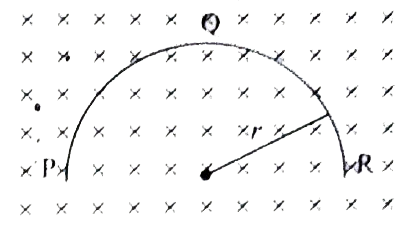
A thin semi-circular conducting ring (PQR) of radius r is falling with its plane vertical in a horizontal magnetic field B, as shown in the figure. The potential difference developed across the ring when its speed v, is

A

Zero

B

`(Bvpir^(2))/(2)` and P is at higher potential

C

`pi r BV and R ` is at higher potential

D

2rBv and R is at higher potential

Text Solution

Verified by Experts

The correct Answer is:

D

2rBv and R is at higher potential
Promotional Banner

Topper's Solved these Questions

  • SAMPLE PAPER-16 (UNSOLVED)

    FULL MARKS|Exercise PART-II|9 Videos
  • SAMPLE PAPER-16 (UNSOLVED)

    FULL MARKS|Exercise PART-III|9 Videos
  • SAMPLE PAPER-1 (SOLVED)

    FULL MARKS|Exercise Questions|28 Videos
  • SAMPLE PAPER-2 (SOLVED)

    FULL MARKS|Exercise Part -IV|10 Videos

Similar Questions

Explore conceptually related problems

A thin semicircular conducting ring (PQR) of radius r is falling with its plane vertical in a horizontal magnetic field B, as shown in figure. The potential difference developed across the ring when its speed is v, is:

A circular copper ring of radius r translates in its plane with a constant velocity v. A uniform magnetic field B exists in the space in a direction perpendicular of the plane o the ring. Consider different pairs of diametrically opposite points on the ring. (a) Between which pair of points is the emf? (b) Between which pair of points is the emf minimum? What is the value of this minimum emf?

A,B and C are voltmetres of resistance R, 1.5R and 3R as shown in the figure. When some potential difference is applied between X and Y the voltmetre readings are V_A , V_B and V_C respectively , Then:

A wire ab of length l, mass m and resistance R slides on a smooth, thick pair of metallic rails joined at the bottom as shown in the figure . The plane of the the rails makes an angle theta with the horizontal. A vertical magnetic field B exists in the region. if the wire slides on the rails at a constant speed v, show that B = sqrt (mg R sin theta)/ sqrt (vl^2 cos^2theta) .

A long, straight wire of radius r carries a current i and is placed horizontally in a uniform magnetic field B pointing vertically upward. The current is uniformly distributed over its cross section. (a) At what points will the resultantant magnetic field have maximum magnitude? What will be the maximum magnitude? (b) What will be the minimum magnitude of the resultant magnetic field?

A conducting circular loop of radius a is connected to two long, straight wires . The straight wires carry a current I as shown in figure . Find the magnetic field B at the centre of the loop.

The system containing the rails and the wire of the previous problem is kept vertically in a uniform horizontal magnetic field B that is perpendicular to the plane of the rails. It is found that the wire stays in equilibrium. If the wire ab is replaced by another of double its mass, how long will it take in falling through a distance equal ot its length?

A copper wire bent in the shape of a semicircle of radius r translates in its plane with a constant velocity v. A uniform magnetic field B exists in the direction perpendicular to the plane of the wire. Find the emf induced between the ends of the wire if (a) the velocity is perpendicular ot the diameter joining free ends, (b) the velocity is parallel to this diameter.

A currrent I is passed through a silver strip of width d and area of cross section A. The number of free electrons per unit volume is n. (a) Find the drift velocity v of the electrons. (b) If a magnetic field B exists in the region as shown in what is the average magnetic force on the free electrons? (c) Due to the magnetic force, the free electrons get accumulated on one side of the conductor along its length. This produces a transverse electric field in the conductor which opposes the magnetic force on the electrons. Find the magnitude of the electric field which will be the potential diference developed across the width of the conductor due to the electron- accumulation? The appearance of a transverse emf, when a current-carrying wire is placed in a magnetic field, is called hall effect.

6.A straight wire carrying a current of 12 A is bent into a semi-circular arc of radius 2.0 cm as shown in Fig. (a). Consider the magnetic field B at the centre of the arc. a . What is the magnetic field due to the straight segments? b. In what way the contribution to B from the semicircle differs from that of a circular loop and in what way does it resemble? c. Would your answer be different if the wire were bent into a semi-circular arc of the same radius but in the opposite way as shown in Fig. (b)?
