Home
Class 11
BIOLOGY
Explain Ganong's Potometer experiment an...

Explain Ganong's Potometer experiment and its purpose.

Text Solution

Verified by Experts

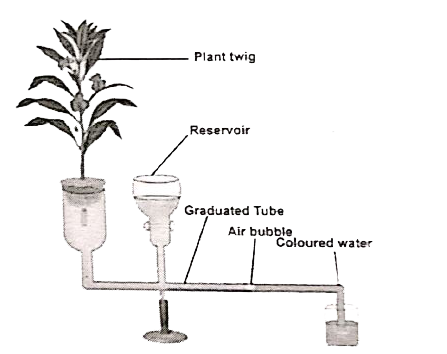
Ganongs potometer is used to measure the rate of transpiration indirectly. In this the amount of water absorbed is measured and assumed that this amount is equal to the amount of water transpired.
Apparatus consists of a horizontal graduated tube which is bent in opposite directions at the ends. one end is wide and the other is narrow. A reservoir is fixed to the horizontal tube near the wider end. the reservoir has a stopcock to regulate water flow. The apparatus is filled with water from reservoir . A twig or a small plant is fixed to the wider arm through a split cock. The other bent end of the horizontal tube is dipped into a beaker containing coloured water. an air bubble is introduced into the graduated tube at the narrow end kep this apparatus in bright sunlight and observe. As transpiration takes place, the air bobble will move towards the twig. the loss is compensated by water absorption through the xylem protion of the twig. Thus, the rate of water absorption is equal to the rate of transpiration.
OR
Promotional Banner

Topper's Solved these Questions

  • SAMPLE PAPER -2 (SOLVED)

    FULL MARKS|Exercise BIO-ZOOLOGY (PART -I)|7 Videos
  • SAMPLE PAPER -2 (SOLVED)

    FULL MARKS|Exercise BIO-ZOOLOGY (PART -II)|6 Videos
  • SAMPLE PAPER -2 (SOLVED)

    FULL MARKS|Exercise BIO-BOTANY (PART-III)|5 Videos
  • SAMPLE PAPER - 8 (SOLVED)

    FULL MARKS|Exercise BIO - ZOOLOGY (PART - IV)|2 Videos
  • SAMPLE PAPER -3 (SOLVED)

    FULL MARKS|Exercise Bio -Zoology Part - IV|4 Videos

Similar Questions

Explore conceptually related problems

Explain Kuhne's fermentation experiment.

Explain the uses of Ganongs potometer.

Ganongs potometer is used to measure:

Draw a Ganong's potometer and label the parts.

Explain Kuhne's experiment and the action of enzyme zymase.

Potometer works on the principle of

Explain Urey & Miller's experiment.

Explain transformation in bacteria as experimented by Griffith.

