Home
Class 11
BIOLOGY
(a) Ingestion - intake of food (b) D...

(a) Ingestion - intake of food
(b) Digestion - absorption
("c") Assimillation - breakdown of food
(d) Egestion - Elimination of digested substances

Text Solution

Verified by Experts
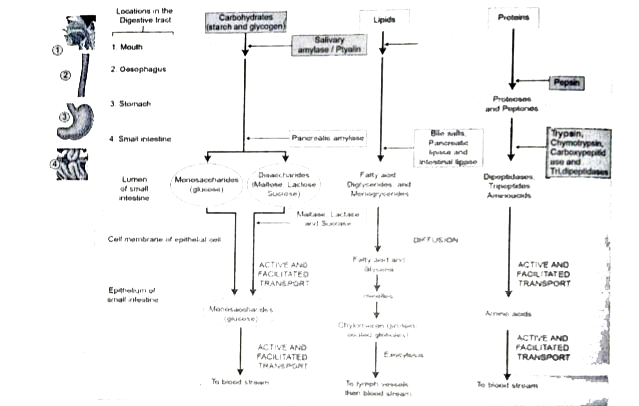
Absorption is a process by which the end product of digestion passes through the intestinal mucosa into the blood and lymph. The villi in the lumen of ileum are the absorbing units, consisting of a lacteal duct in the middle surrounded by fine network of blood capillaries The process of absorption involves active, passive and facilitated transport Small amounts of glucose, amino acids and electrolytes like chloride ions are generally absorbed by simple diffusion. The passage of these substances into the blood depends upon concentration gradients. However, some of the substances like fructose are absorbed with the help of the carrier ions like `Na^(+)`. This mechanism is called facilitated transport. Nutrients like amino acids, glucose and electrolytes like `Na^(+)` are absorbed into the blood against the concentration gradient by active transport. The insoluble substances like fatty acids, glycerol and fat soluble vitamins are first incorporated into small, spherical water soluble droplets called micelles and are absorbed into the intestinal mucosa where they are re-synthesized into protein coated fat globules called chylomicrons which are then transported into the lacteals within the intestinal villi and eventually empty into lymphatic duct. The lymphatic ducts ultimately release the absorbed substances into the blood stream. While the fatty acids are absorbed by the lymph duct, other materials are absorbed either actively or passively by the capillaries of the villi (Figure). Water soluble vitamins are absorbed by simple diffusion or active transpor Transport of water depends upon the osmotic gradient.
Absorption of substances in the alimentary canal takes place in mouth, stomach, small intestine and large intestine. However maximum absorption takes place in the small intestine Absorption of simple sugars, alcohol and medicines takes place in the stomach. Certain drup are absorbed by blood capillaries in the lower side of the tongue and mucosa of mouth. Later intestine is also involved in absorption of more amounts of water, vitamins, some minerals and certain drugs.
Promotional Banner

Topper's Solved these Questions

  • DIGESTION AND ABSORPTION

    FULL MARKS|Exercise ADDITIONAL QUESTIONS SOLVED ( II. Fill in the Blanks )|43 Videos
  • CHEMICAL COORDINATION AND INTEGRATION

    FULL MARKS|Exercise Additional Questions Solved III ( Answer the following questions:)|28 Videos
  • EXAMINATION QUESTION PAPER - JUNE 2019

    FULL MARKS|Exercise Bio - Zoology (PART - IV)|4 Videos

Similar Questions

Explore conceptually related problems

Digestion of food is a chemical change.

Most of the nutrients from food are digested and absorved in the small intestine why?

How does butter in your food gets digested and absorbed in the body?

Digestion of which component of food will be affected if the pH of stomach is made 7?

Which of the following statements is/are incorrect? (i) Absorption of simple sugar, alcohol, some water and medicines takes place in stomach. (ii) Maximum water absorption occurs in large intestine. (iii) Small intestine is the major site of digestion and absorption of food. (iv) Fatty acid and glycerol are absorbed by lacteals. (v) Nothing is absorbed in mouth and large intestine.

