Home
Class 11
BIOLOGY
Explain the human respiratory system....

Explain the human respiratory system.

Text Solution

Verified by Experts
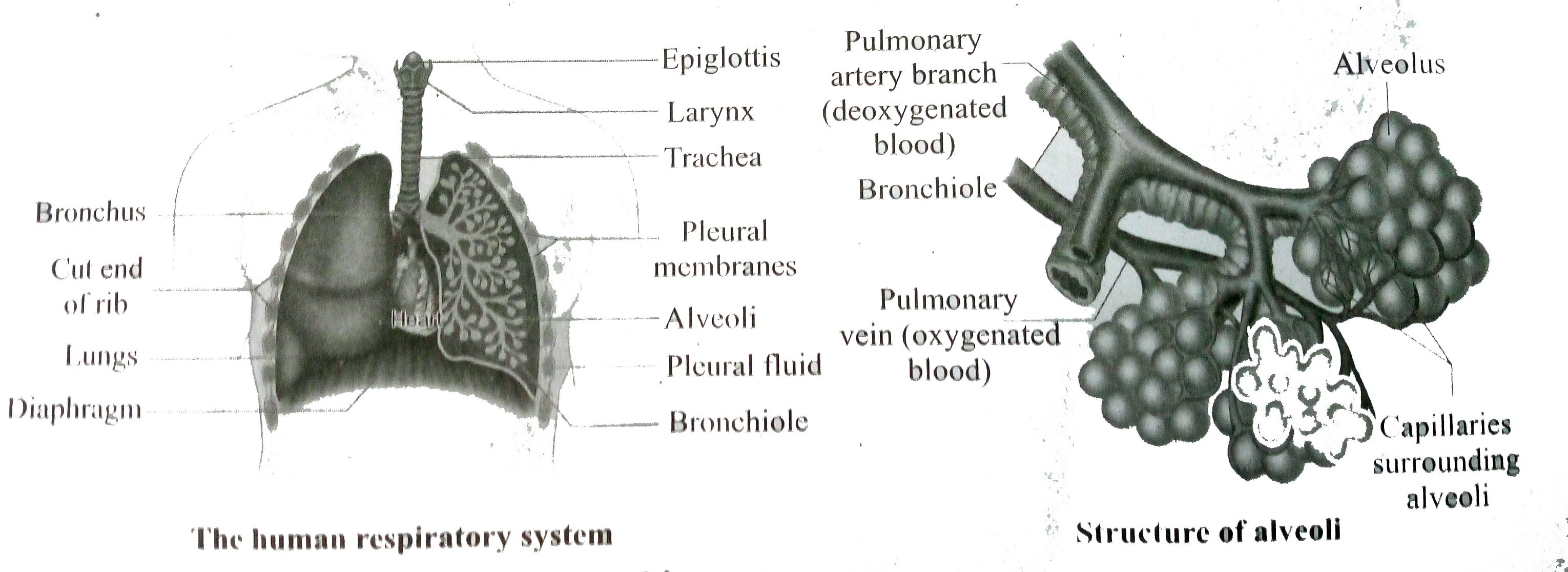
The human respiratory system constitutes the conducting zone and the respiratory zone. The conducting zone includes the external nostril, nasal cavity, pharynx, larynx, trachea, bronchi, bronchioles and the lungs which contain alveoli. The parts from the external nostrils up to the bronchioles conduct the air and hence they are called the conducting zone. This zone humidifies and warms the incoming air. The nasal cavity has fine hairs and mucus which filter dust particles in the incoming air.
At the junction of the pharynx and larynx there is a flap called epiglottis. This closes the respiratory tract while swallowing thus preventing the entry of food particles into the trachea and choking. The ciliated epithelial cells of trachea, bronchi and bronchioles secrete mucus rich in glycoprotein. Microorganism and dust particles attach in the mucus films and are carried upwards to pass down the gullet during normal swallowing. The trachea is a semi-flexible tube supported by multiple cartilaginous rings which expands upto the mid thoracic cavity. And the level of the `5^(th)` theoretic vertebra, it divides into right and left bronchi which divide into secondary and tertiary bronchi and further divide into terminal bronchioles and respiratory bronchioles. Bronchi have 'c' shaped curved Cartilage plates to ensure that the air passage does not collapse as air pressure changes during breathing. The bronchioles do not have cartilaginous rings but they have rigidity to prevent them from collapsing but are surrounded by smooth muscle which contracts or relaxes to adjust the diameter of these airways.
The fine respiratory bronchioles terminate into highly vascularised thin-walled-pouch like air sacs called alveoli. It is made up of thin squamous epithelial cells, the endothelium of the alveolar capillaries and the basement substance are found in between them. The thin squamous epithelial cells of the alveoli, the endothelium of the alveolar capillaries and the basement substance found in between them. The thin squamous epithelial cells of the alveoli are composed of Type I and Type II cells. Type I cells are very thin so that gases can diffuse rapidly through them. Type II cells are thicker, synthesize and secrete a substancecalled Surfactant. The lungs are light spongy tissues endorsed in the thoracic cavity bound dorsally by the vertebral column and ventrally by the sternum, laterally by the ribs and on the lower side by the dome shaped diaphragm. The lungs are covered by double walled pleural membrane containing several layers of elastic connective tissues and capillaries. It encloses the pleural fluid. It reduces friction when the lungs expand and contract.
Promotional Banner

Topper's Solved these Questions

  • RESPIRATION

    FULL MARKS|Exercise ADDITIONAL QUESTIONS SOLVED(Fill in the Blanks)|45 Videos
  • REPRODUCTIVE MORPHOLOGY

    FULL MARKS|Exercise V. Higher Order Thinking Skills (HOTS)|12 Videos
  • SAMPLE PAPER - 1

    FULL MARKS|Exercise Bio-Zoology (PART - IV)|4 Videos

Similar Questions

Explore conceptually related problems

Explain the respiratory system of Rana hexadactyla .

Explain the structure of human respiratory system.

The figure shows a diagrammatic view of human respiratory system with labels A, B, C and D. Select the option which gives correct identification and main function and // or characteristic .

Explain the RQ of respiratory substrates in case of anaerobic respiration.

Draw a neat labelled diagram of Human respiratory system.

Polluted___affects skin, eyes and respiratory system.

Explain the male reproductive system of frog.

Explain the male reproductive system of cockroach.

