Home
Class 11
BIOLOGY
Explain the structure of blood vessels....

Explain the structure of blood vessels.

Text Solution

Verified by Experts
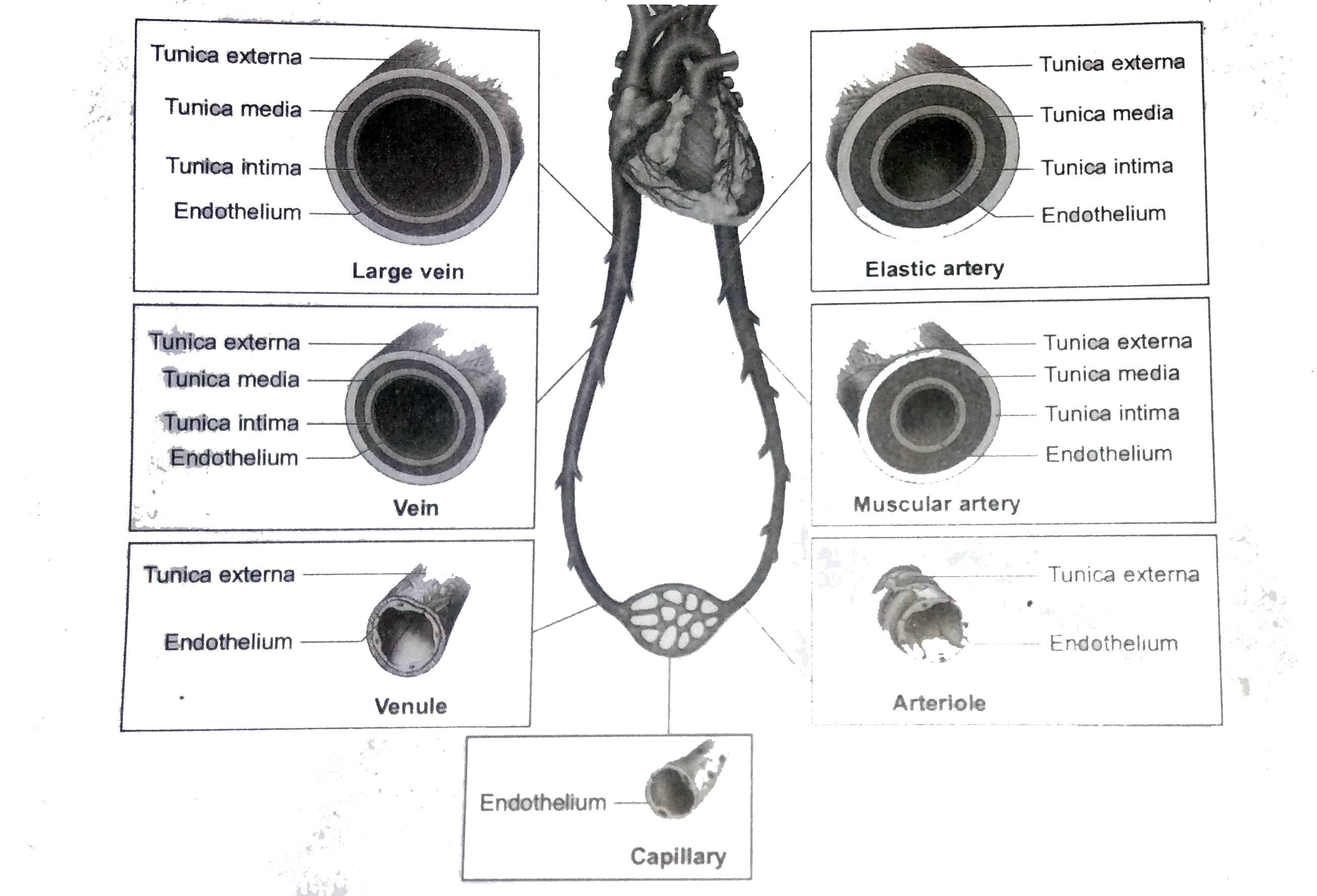
The vessels carrying the blood are of three types, they are the arteries, veins and capillaries. These vessels are hollow structures and have complex walls surrounding the lumen. The blood vessels in humans are composed of three layers, tunica intima, tunica media and tunica externa. The inner layer, tunica intima or tunica interna supports the vascular endothelium, The middle layer, tunica media is composed of smooth muscles and an extra cellular matrix wcn contains a protein, elastin. The contraction and relaxation of the smooth muscles results vsoconstriction and vasodilation. The outer layer, tunica externa or tunica adventitia is composed of collagen fibres.
Arteries: The blood vessels that carry blood away from the heart are called arteries. T he aiCs usualy lhe deep inside the body. The walls of the arteries are thick, non-collapsible to withstand high pressure. Valves are absent and have a narrow lumen. All arteries carry Oxygenated blood, except the pulmonary artery. The largest artery, the aorta (2.5 cm in damere and 2 mm thick) branch into smaller arteries and culminates into the tissues as TeCed arci n the tissues the arteries branches into arterioles. As blood enters an arteriole it may have a pressure of 85 mm Hg (11.3 KPa) but as it leaves and flows into the capilary, the pressure drops to 35 mm Hg (4.7 KPa). (Note 1 mm Hg = 0.13 KPa. SI unit of mm Hg is KiloPascal (KPa)). Arterioles are small, narrow, and thin walled which are connected to the capillaries. A Small sphincter lies at the junction between the arterioles and capillaries to regulate the blood supply. Arteries do not always branch into arterioles, they can also form anastomoses.

Capillaries: Capillary beds are made up of fine networks of capillaries. The capillaries are thin walled and consist of single layer of squamous epithelium. Tunica media and elastin fibres are absent. The capillary beds are the site for exchange of materials between blood and tissues. The walls of the capillaries are guarded by semilunar valves. The blood volume in the capillaries is high but the flow of blood is slow. Mixed blood (oxygenated and deoxygenated) is present in the capillaries. The capillary bed may be fiooded with blood or may be completely bypassed depending on the body conditions in a particular organ. Veins: Veins have thinner walls and a larger lumen and hence can be easily stretched. They carry deoxygenated blood except, the pulmonary vein. The blood pressure is low and the lumen has a wide wall which is collapsible. Tunica media is thinner in veins than in arteries. Unidirectional flow of blood in veins is due to the presence of semilunar valves that prevents backflow of blood. Blood samples are usually taken from the veins rather than artery because of low pressure in the veins.
Promotional Banner

Topper's Solved these Questions

  • BODY FLUIDS AND CIRCULATION

    FULL MARKS|Exercise ADDITIONAL QUESTIONS SOLVED ( Fill in the Blanks)|76 Videos
  • BIOMOLECULES

    FULL MARKS|Exercise ADDITIONAL QUESTIONS SOLVED (Higher Order Thinking Skills)|16 Videos
  • CELL CYCLE

    FULL MARKS|Exercise ADDITIONAL QUESTIONS SOLVED (Higher Order Thinking Skills)|12 Videos

Similar Questions

Explore conceptually related problems

Explain the structure of cochlea.

Explain the structure of penis.

Explain the structure of a bee hive?

