Home
Class 12
BIOLOGY
When two different genes came from same ...

When two different genes came from same parent they tend to remain together.
What is the name of this phenomenon?

Text Solution

Verified by Experts
(i) Linkage
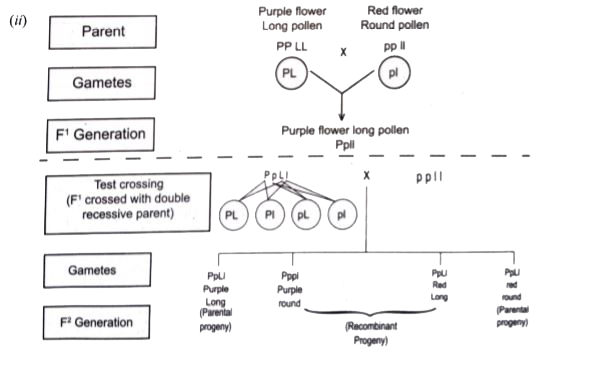
(ii)
(iii) Observed Pherotypic ratio 7 : 1 : 1 : 7
Promotional Banner

Topper's Solved these Questions

  • CHROMOSOMAL BASIS OF INHERITANCE

    FULL MARKS|Exercise Additional Questions (1- Mark Questios)|38 Videos
  • CHROMOSOMAL BASIS OF INHERITANCE

    FULL MARKS|Exercise Additional Questions (2- Mark Questios)|33 Videos
  • BIODIVERSITY AND ITS CONSERVATION

    FULL MARKS|Exercise Higher Order Thinking Skills (HOT) Questions|5 Videos
  • CLASSICAL GENETICS

    FULL MARKS|Exercise Higher Order Thinking Skills (HOTs) Questions|5 Videos

Similar Questions

Explore conceptually related problems

When two different genes came from same parent they tend to remain together. (i) What is the name of this phenomenon? (ii) Draw the cross with suitable example. (iii) Write the observed phenotypic ratio.

When two different genes came from same parent they tend to remain together. Write the observed phenotypic ratio.

When two different genes came from same parent they tend to remain together. Draw the cross with suitable example.

What two different genes came from same parent, they tend to remain together. Draw the cross with suitable example.

When a few individuals go away from a population, the population loses some genes. What is the name of this phenomenon. Explain?

When closely placed genes on the same chromosome are inherited together the phenomenon is called

What happens when two different in compatible bloods are mixed? What is the reason for this?

Two wires of different densities but same area of cross section are soldered together at one end and are stretched to a tension T. The velocity of a transverse wave in the first wire is double of that in the second wire. Find the ration of the denstiy of the first wire to that of the second wire.

Two satellite A and B of the same mass are revolving around the Earth in circular orbits such that the distance of B from the centre of the Earth is thrice as compared to the distance of A from the centre. What will be the ratio of centripetal force on B to that on A.

