Observe the motion of a car as shown in the figure and answer the following questions :
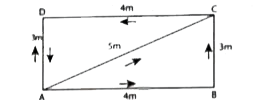
Compare the distance covered by the car through the path ABC and AC. What do you observe? Which path gives the shortest distance to reach D from A? Is it the path ABCD or the path ACD or the path AD?
Observe the motion of a car as shown in the figure and answer the following questions :
Compare the distance covered by the car through the path ABC and AC. What do you observe? Which path gives the shortest distance to reach D from A? Is it the path ABCD or the path ACD or the path AD?
Compare the distance covered by the car through the path ABC and AC. What do you observe? Which path gives the shortest distance to reach D from A? Is it the path ABCD or the path ACD or the path AD?
Text Solution
Verified by Experts
1.AB+BC
ABC=4m+3m=7m
AC=5 m
2.AB+BC+CD
ABCD=4 m + 3m + 4m =11 m
ACD=AC+CD=5 m +4m =9 m
AD=3 m
`therefore` The shortest distance to reach D from A will be AD, that is 3 m .
ABC=4m+3m=7m
AC=5 m
2.AB+BC+CD
ABCD=4 m + 3m + 4m =11 m
ACD=AC+CD=5 m +4m =9 m
AD=3 m
`therefore` The shortest distance to reach D from A will be AD, that is 3 m .



Topper's Solved these Questions
Similar Questions
Explore conceptually related problems
A boy moves along the path ABCD. What is the total distance covered by the boy ? What is his net displacement ?
Answer the following questions . a. The earth's magnetic field varies from point is space. Does it also change with time ? It so , on what time scate does it change appreciably ? b. The earth's core is known to contain iron. Yet geologists do not regard this as a source of the earth's magnetism why ? c. The charged currents in the outer conducting regions of the earth's core are thought to be responsible for earth's magnetism . What might be the ' battery ' (i.e., the source of energy) to sustain these currents ? d. The earth may have even reversed the direction of its field several times during its history of 4 to 5 billion years. How can geologists know about the earth's field in such distant past ? e. The earth's field departs from its dipole substantially at large distances (greater than about 30,000 km) what agencies may be responsible for this distortion ? f. Interstellar space has an extremely weak magnetic field of the order of 10^(-12) T, Can such a weak field be of any significant consequence ? Explain. [Note : Exercise 2 is meant mainly to arouse your curiosity . Answers to some question above are tentative or unknown . Brief answers wherever possible are given at the end . For details , you should consult a good text on geomagnetism.]
. In which of the following cases of motions, the distance moved and the magnitude of the displacement are equal? i. If the car is moving on a straight road ii. If the car is moving in circular path iii. The pendulum is moving to and fro iv. The earth is moving around the sun
The equations of motion of a rocket are x=2t ,y=-4ta n dz=4t , where time t is given in seconds, and the coordinates of a moving points in kilometers. What is the path of the rocket? At what distance will be the rocket from the starting point O(0,0,0) in 10 s ?
Read the passage and Answer the following question: In, vacuum the velocity of light radiation with different wavelength is the same. But in a material medium, the velocity of different colour radiations is not the same and they travel with different paths. Due to this, the refractive index of the medium is different for different colours. If white beam of light is incident on a glass prism, the angle of refraction for different colours is different. When Sunlight is incident on a refracting surface, then it gets split into seven coloured spectrum and emerges out. The splitting of light into its component colours is called dispersion. Sir Isaac Newton was the first to use a glass prism to obtain the spectrum of Sunlight. A glass prism is transparent medium bounded by two plane surfaces inclined at an angle. When white light is dispersed into seven colours by a prism, different colours of light bend through different angles with respect to incident ray. Out of these seven colours, red light bends the least, while violet light bends the most. So, the rays of each colour emerge along different paths and becomes distinct. Hence, we get spectrum of seven - different colours. Q. How do emergent rays appear ?
Read the passage and Answer the following question: In, vacuum the velocity of light radiation with different wavelength is the same. But in a material medium, the velocity of different colour radiations is not the same and they travel with different paths. Due to this, the refractive index of the medium is different for different colours. If white beam of light is incident on a glass prism, the angle of refraction for different colours is different. When Sunlight is incident on a refracting surface, then it gets split into seven coloured spectrum and emerges out. The splitting of light into its component colours is called dispersion. Sir Isaac Newton was the first to use a glass prism to obtain the spectrum of Sunlight. A glass prism is transparent medium bounded by two plane surfaces inclined at an angle. When white light is dispersed into seven colours by a prism, different colours of light bend through different angles with respect to incident ray. Out of these seven colours, red light bends the least, while violet light bends the most. So, the rays of each colour emerge along different paths and becomes distinct. Hence, we get spectrum of seven - different colours. Q. Which light deviates the least and which one deviates the most ?
Read the passage and answer the following question: In, vacuum the velocity of light radiation with different wavelength is the same. But in a material medium, the velocity of different colour radiations is not the same and they travel with different paths. Due to this, the refractive index of the medium is different for different colours. If white beam of light is incident on a glass prism, the angle of refraction for different colours is different. When Sunlight is incident on a refracting surface, then it gets split into seven coloured spectrum and emerges out. The splitting of light into its component colours is called dispersion. Sir Isaac Newton was the first to use a glass prism to obtain the spectrum of Sunlight. A glass prism is transparent medium bounded by two plane surfaces inclined at an angle. When white light is dispersed into seven colours by a prism, different colours of light bend through different angles with respect to incident ray. Out of these seven colours, red light bends the least, while violet light bends the most. So, the rays of each colour emerge along different paths and becomes distinct. Hence, we get spectrum of seven - different colours. Q. What is dispersion ?
Read the passage and Answer the following question: In, vacuum the velocity of light radiation with different wavelength is the same. But in a material medium, the velocity of different colour radiations is not the same and they travel with different paths. Due to this, the refractive index of the medium is different for different colours. If white beam of light is incident on a glass prism, the angle of refraction for different colours is different. When Sunlight is incident on a refracting surface, then it gets split into seven coloured spectrum and emerges out. The splitting of light into its component colours is called dispersion. Sir Isaac Newton was the first to use a glass prism to obtain the spectrum of Sunlight. A glass prism is transparent medium bounded by two plane surfaces inclined at an angle. When white light is dispersed into seven colours by a prism, different colours of light bend through different angles with respect to incident ray. Out of these seven colours, red light bends the least, while violet light bends the most. So, the rays of each colour emerge along different paths and becomes distinct. Hence, we get spectrum of seven - different colours. Q. What is spectrum ?
In a T20 match, Chennai Super Kings needed just 6 runs to win with 1 ball left to go in the last over. The last ball was bowled and the batsman at the crease hit it high up. The ball traversed along a path in a vertical plane and the equation of the path is y=ax^(2)+bx+c with respect to a xy-coordinate system in the vertical plane and the ball traversed through the points (10,8),(20,16), (30,18) can you conclude that Chennai Super Kings won the match? Justify your answer. (All distances are measured in metres and the meeting point of the plane of the path with the farthest boundary line is (70,0).
In a T20 match, Chennai Super Kings needed just 6 runs to win with 1 ball left to go in the last over. The last ball was bowled and the batsman at the crease hit it high up. The ball traversed along a path in a vertical plane and the equation of the path is y=ax^(2)+bx+c with respect to a xy -coordinate system in the vertical plane and the ball traversed through the points (10,8),(20,16),(40,22), can you conclude that Chennai Super Kings won the match? Justify your answer. (All distances are measured in metres and the meeting point of the plane of the path with the farthest boundary line is (70,0).)
FULL MARKS-MOTION-Activity
- When a body like earth is moving in a circular path the work done in t...
Text Solution
|
- A car is accelerated on a leveled road and attains a velocity 4 times ...
Text Solution
|
- Observe the motion of a car as shown in the figure and answer the foll...
Text Solution
|
- energy possessed by a eagle flying in air is:
Text Solution
|
- In the dams water is stored in the high reservoirs and then made to fa...
Text Solution
|
- The type of energy possessed by a simple pendulum, when it is at the m...
Text Solution
|