

Home
Class 12
PHYSICS
Two non-conducting spheres of radii R1 a...

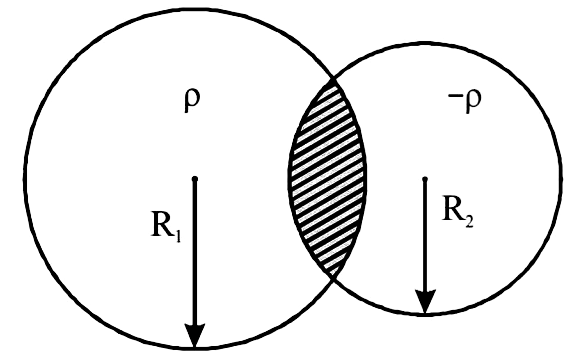
Two non-conducting spheres of radii `R_1` and `R_2` and carrying uniform volume charge densities `+rho` and `-rho`, respectively, are placed such that they partially overlap, as shown in the figure. At all points in the overlapping region

Promotional Banner

Similar Questions

Explore conceptually related problems

Two non-conducting spheres of radii R_(1) and R_(2) and carrying uniform volume charge densities +rho and - rho respectively are placed such that they partially overlapping region.

Two non-conducting solid spheres of radii R and 2R, having uniform volume charge densities rho_1 and rho_2 respectively, touch each other. The net electric field at a distance 2R from the centre of the smaller sphere, along the line joining the centres of the spheres, is zero. The ratio rho_1/rho_2 can be

Two non-conducting solid spheres of radii R and 2R, having uniform volume charge densities rho_1 and rho_2 respectively, touch each other. The net electric field at a distance 2R from the centre of the smaller sphere, along the line joining the centres of the spheres, is zero. The ratio rho_1/rho_2 can be

Two non-conducting solid spheres of radii R and 2R, having uniform volume charge densities rho_1 and rho_2 respectively, touch each other. The net electric field at a distance 2R from the centre of the smaller sphere, along the line joining the centres of the spheres, is zero. The ratio rho_1/rho_2 can be

There are two nonconducting spheres having uniform volume charge densities rho and - rho . Both spheres have equal radius R . The spheres are now laid down such that they overlap as shown in Fig.2.125. Take vec(d) = O_(1) vec(O_(2)) . The electric field vec(E) in the overlapped region is

There are two nonconducting spheres having uniform volume charge densities rho and - rho . Both spheres have equal radius R . The spheres are now laid down such that they overlap as shown in Fig.2.125. Take vec(d) = O_(1) vec(O_(2)) . The electric field vec(E) in the overlapped region is

There are two nonconducting spheres having uniform volume charge densities rho and - rho . Both spheres have equal radius R . The spheres are now laid down such that they overlap as shown in Fig.2.125. Take vec(d) = O_(1) vec(O_(2)) . The electric field vec(E) in the overlapped region is

There are two nonconducting spheres having uniform volume charge densities rho and - rho . Both spheres have equal radius R . The spheres are now laid down such that they overlap as shown in Fig.2.125. Take vec(d) = O_(1) vec(O_(2)) . The potential difference Delta V between the centres of the two spheres for d = R is

There are two nonconducting spheres having uniform volume charge densities rho and - rho . Both spheres have equal radius R . The spheres are now laid down such that they overlap as shown in Fig.2.125. Take vec(d) = O_(1) vec(O_(2)) . The potential difference Delta V between the centres of the two spheres for d = R is

A solid non-conducting sphere of radius R is charged with a uniform volume charge density rho . Inside the sphere a cavity of radius r is made as shown in the figure. The distance between the centres of the sphere and the cavity is a. An electron of charge 'e' and mass 'm' is kept at point P inside the cavity at angle theta = 45^(@) as shown. If at t = 0 this electron is released from point P, calculate the time it will take to touch the sphere on inner wall of cavity again.