

Home
Class 12
PHYSICS
There are two concentric cylinders of ra...


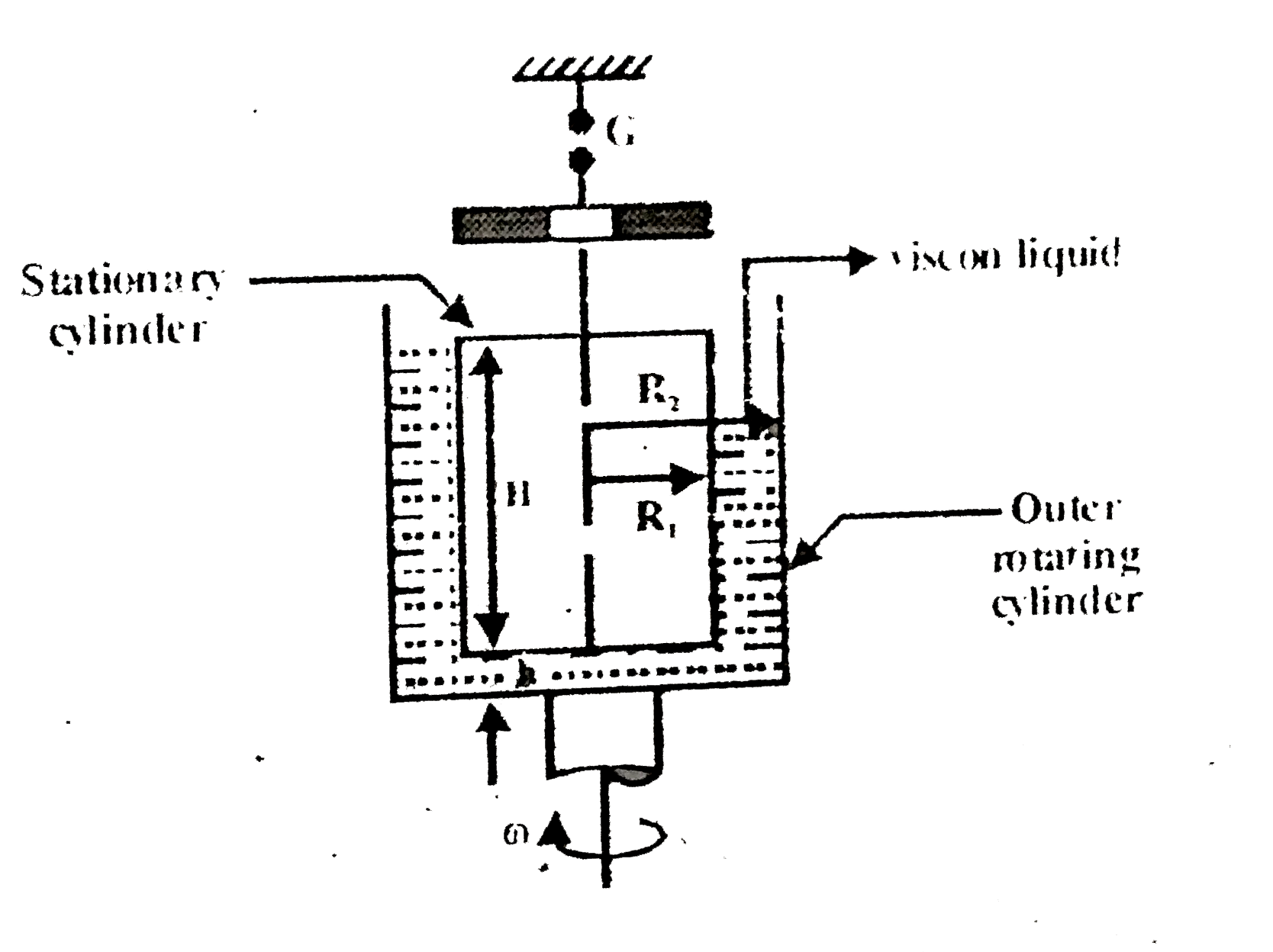
There are two concentric cylinders of radii `R_(1)` and `R_(2)` as shown. The narrow space between the two cylinders is filled with liquid of viscosity `mu`. The inner cylinder is held stationary by means of a torsional spring of stiffness G. the outer cylinder is rotated with constant angular speed `omega`. The torque acting on the inner cylinder due to shearing action of thhe liquid:

Promotional Banner

Similar Questions

Explore conceptually related problems

A cylinder of mass M, radius r_(1) and lenglth l is kept inside another cylinder of radius r_(2) and length l. The space between them is filled with a liquid of viscosity eta . The inner cylinder starts rotating with angular velocity omega while the other cylinder is at rest. Find time when inner cylinder stops.

A gas fills up the space between two long coaxial cylinders of radii R_1 and R_2 , with R_1 lt R_2 . The outer cylinder rotates with a fairly low angular velocity omega about the stationary inner cylinder. The moment of friction forces acting on a unit length of the inner cylinder is equal to N_1 . Find the viscosity coefficient eta of the gas taking into account that the friction force acting on a unit area of the cylindrical surface of radius r is determined by the formule sigma = eta r(del omega//del r) .

A fluid with viscosity eta fills the space between two long co-axial cylinders of radii R_1 and R_2 , with R_1 lt R_2 . The inner cylinder is stationary while the outer one is rotated with a constant angular velocity omega_2 . The fluid flow is laminar. Taking into account that the friction force acting on a unit area of a cylindrical surface of radius r is defined by the formula sigma=etar(delomega//delr) , find: (a) the angular velocity of the rotating fluid is as a function of radius r, (b) the moment of the friction forces acting on a unit length of the outer cylinder.

A long, hollow insulating cylinder of radius R and negligible thickness has a uniform surface charge density sigma . The cylinder rotates about its central axis at a constant angular speed omega . Choose the correct option(s):

A long, hollow insulating cylinder of radius R and negligible thickness has a uniform surface charge density sigma . The cylinder rotates about its central axis at a constant angular speed omega . Choose the correct option(s):

Find the temperature distribution in the space between two coaxial cylinders of radii R_1 and R_2 filled with a uniform heat conducting substance if the temperatures of the cylinders are constant and are equal to T_1 and T_2 respectively.

Under standard conditions helium fills up the space between two long coaxial cylinders. The mean radius of the cylinders is equal to R , the gap between them is equal to Delta R , with Delta R lt lt R . The outer cylinder rotates with a fairly low angular velocity omega about the stationary inner cylinder. Down to what magnitude should the helium pressure be lowered (keeping the temperature constant) to decrease the sought moment of friction forces n = 10 times if Delta R = 6 mm ?

Two cylinders having radiii R_(1) and R_(2) and rotational inertia I_(1) and I_(2) respectively, are supported by fixed axes perpendicular to the plane of figure-5.52. The large cylinder is initially rotating with angular velocity omega_(0) . The small cylinder is moved to the right until it touches the large cylinder and is caused to rotate by the frictional force between the two. Eventually, slipping ceases, and the two cylinders rotate at constant rates in opposite directions, (a) Find the final angular velocity omega_(2) of the small cylinder in terms of I_(1) , I_(2) , R_(1) , R_(2) and omega_(0) . (b) Is total angular momentum conserved in this case ?