

Home
Class 12
PHYSICS
Figure 3.188 shows two parallel and coax...

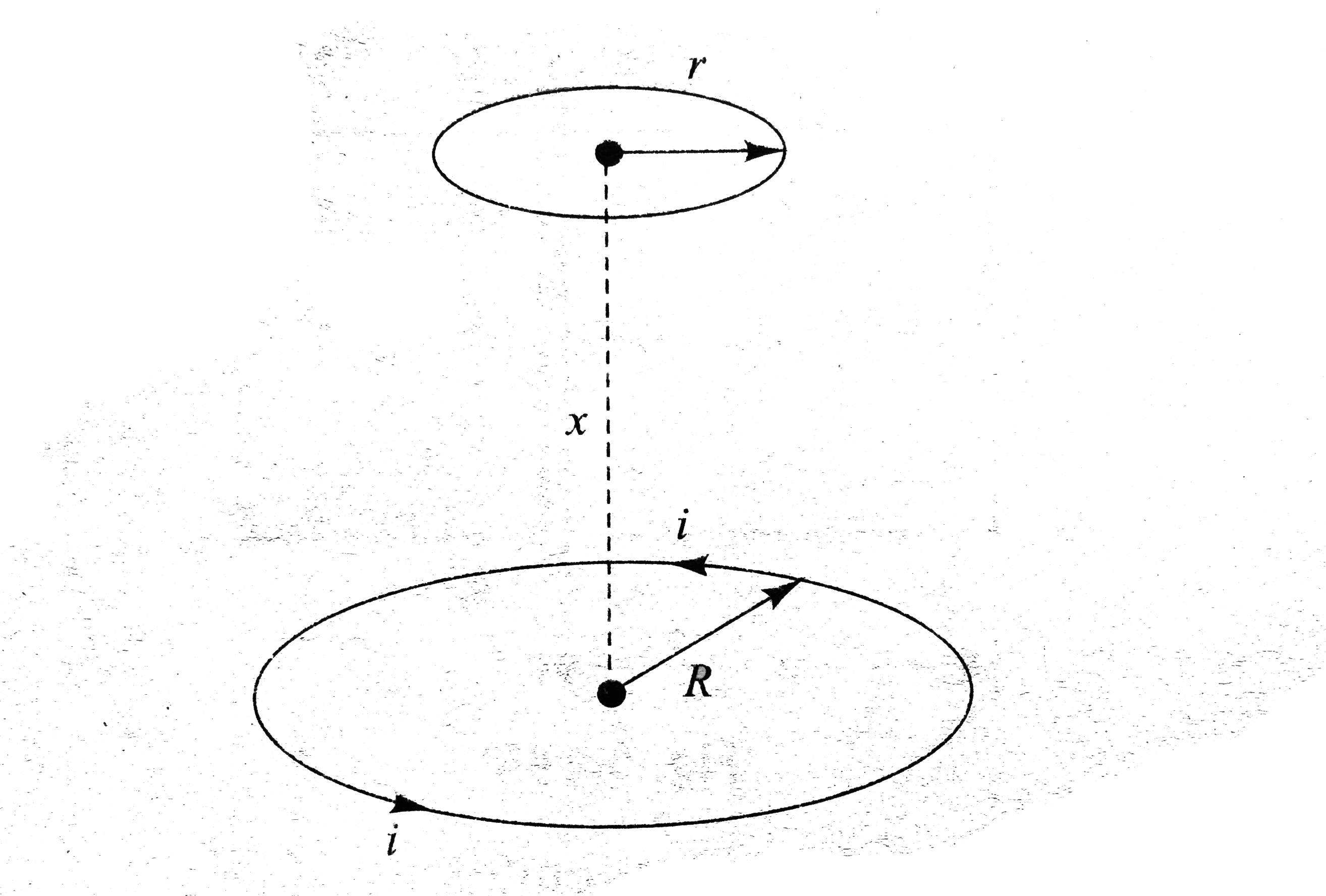
Figure 3.188 shows two parallel and coaxial loops. The smaller loop (radius r) is above the larger loop (radius R), by distance `x gtgt R`. The magnetic field due to current `i` in the larger loop is nearly constant throughout the smaller loop. Suppose that `x` is increasing at a constant rate of `dx//dt = v`.

The induced emf in the smaller loop is

Promotional Banner

Similar Questions

Explore conceptually related problems

Figure. shows two parallel and coaxial loops. The smaller loop (radius r) is above the larger loop (radius R), by distance x gtgt R . The magnetic field due to current i in the larger loop is nearly constant throughout the smaller loop. Suppose that x is increasing at a constant rate of dx//dt = v . Determine the magneitc flux through the smaller loop as a function of x .

Figure. shows two parallel and coaxial loops. The smaller loop (radius r) is above the larger loop (radius R), by distance x gtgt R . The magnetic field due to current i in the larger loop is nearly constant throughout the smaller loop. Suppose that x is increasing at a constant rate of dx//dt = v . Determine the magneitc flux through the smaller loop as a function of x .

A very small circular loop of radius a is initially (at t = 0) coplaner and concentric with a much larger fixed circular loop of radius b. A constant I flows in the larger loop. The smaller loop is rotated with a constant angular speed omega about the common diameter. The emf induced in the smaller loop as a function of time t is

A circular loop of radius R carries a current I. Another circular loop of radius r(ltltR) carries a current I. The plane of the smaller loop makes an angle of 30^@ with that of the larger loop. The planes of the two circles are at right angle to each other. Find the torque acting on the smaller loop.

A circular loop of radius R carries a current I. Another circular loop of radius r(ltltR) carries a current I. The plane of the smaller loop makes an angle of 90^@ with that of the larger loop. The planes of the two circles are at right angle to each other. Find the torque acting on the smaller loop.

A circular loop of radius R carries a current I. Another circular loop of radius r(ltltR) carries a current I. The plane of the smaller loop makes an angle of 90^@ with that of the larger loop. The planes of the two circles are at right angle to each other. Find the torque acting on the smaller loop.

A very small circular loop of radius a is initially (at t = 0) coplanar and concentric with a much larger fixed circular loop of radius b. A constant current I flows in the larger loop. The smaller loop is rotated with a constant angular speed omega about the common diameter. The emf induced in the smaller loop as a function of time t is

A very small circular loop of radius a is initially (at t = 0) coplanar and concentric with a much larger fixed circular loop of radius b. A constant current I flows in the larger loop. The smaller loop is rotated with a constant angular speed omega about the common diameter. The emf induced in the smaller loop as a function of time t is

A very small circular loop of radius a is initially (at t = 0) coplanar and concentric with a much larger fixed circular loop of radius b. A constant current I flows in the larger loop. The smaller loop is rotated with a constant angular speed omega about the common diameter. The emf induced in the smaller loop as a function of time t is