

Home
Class 12
PHYSICS
A conducting disc of radius r spins abou...

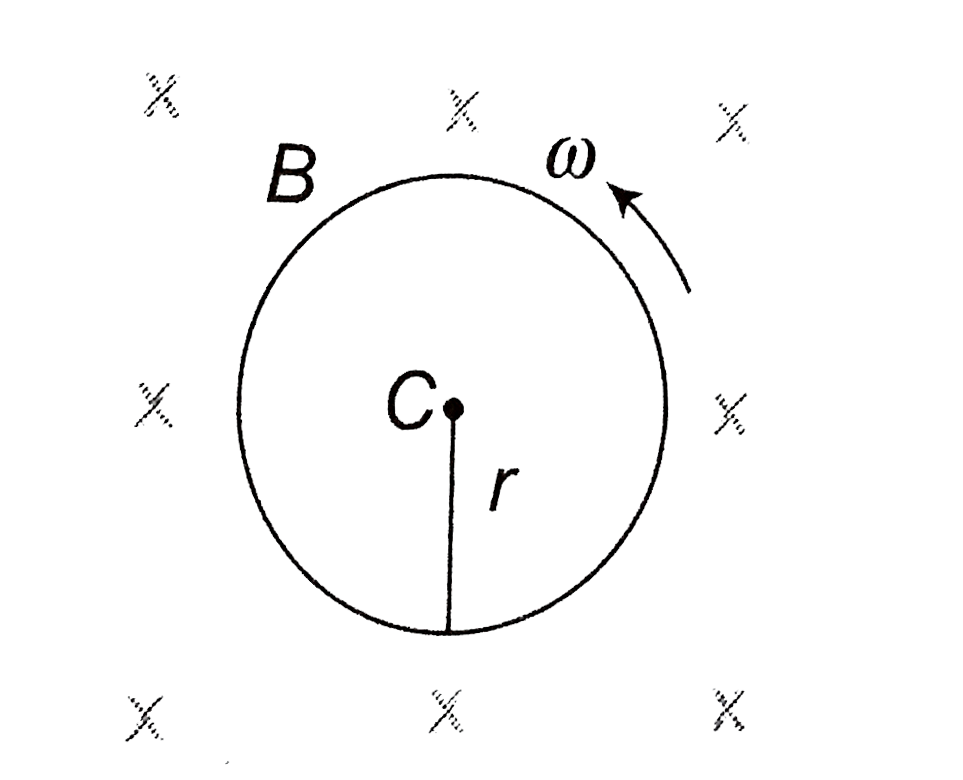
A conducting disc of radius `r` spins about its axis an angular velocity `omega` . There is a uniform magnetic field of magnitude `B` perpendicular to the plane of the disc `C` is the centre of the disc.
(i) No emf is induced in the disc
(ii) The potential difference between `C` and the rim is `1//2Br^(2)omega`
`C` is at a higher potential than the rim
(iv) Current flows between `C` and the rim

Promotional Banner

Similar Questions

Explore conceptually related problems

A horizontal ring of radius r spins about its axis with an angular velocity omega in a uniform vertical magnetic field of magnitude B . The emf induced in the ring is

A copper disc of radius Im is rotated about its natural axis with an angular velocity 2 rad/sec in a uniform magnetic field of 5 tesla with its plane perpendicular to the field. Find the emf induced between the centre of the disc and its rim.

A copper disc of radius 1 m is rotated about its natural axis with an angular velocity 2 rad/sec in a uniform magnetic field of 5 tesla with its plane perpendicular to the field. Find the emf induced between the centre of the disc and its rim.

A copper disc of radius 1m is rotated about its natural axis with an angular velocity 2 "rad"//"sec" in a uniform magnetic field 5 telsa with its plane perpendicular to the field. Find the emf induced between the centre of the disc and its rim.

A non-conducting disk of radius R is rotating about its own axis with constant angular velocity omega in a perpendicular uniform magnetic field B as shown in figure. The emf induced between centre and rim of disk is

A conducting disc of radius r rotaes with a small but constant angular velocity omega about its axis. A uniform magnetic field B exists parallel to the axis of rotation. Find the motional emf between the centre and the periphery of the disc.

A conducting disc of radius r rotaes with a small but constant angular velocity omega about its axis. A uniform magnetic field B exists parallel to the axis of rotation. Find the motional emf between the centre and the periphery of the disc.

A conducting disc of radius r rotaes with a small but constant angular velocity omega about its axis. A uniform magnetic field B exists parallel to the axis of rotation. Find the motional emf between the centre and the periphery of the disc.