

Home
Class 11
PHYSICS
An observed and a vehicle, both starts m...

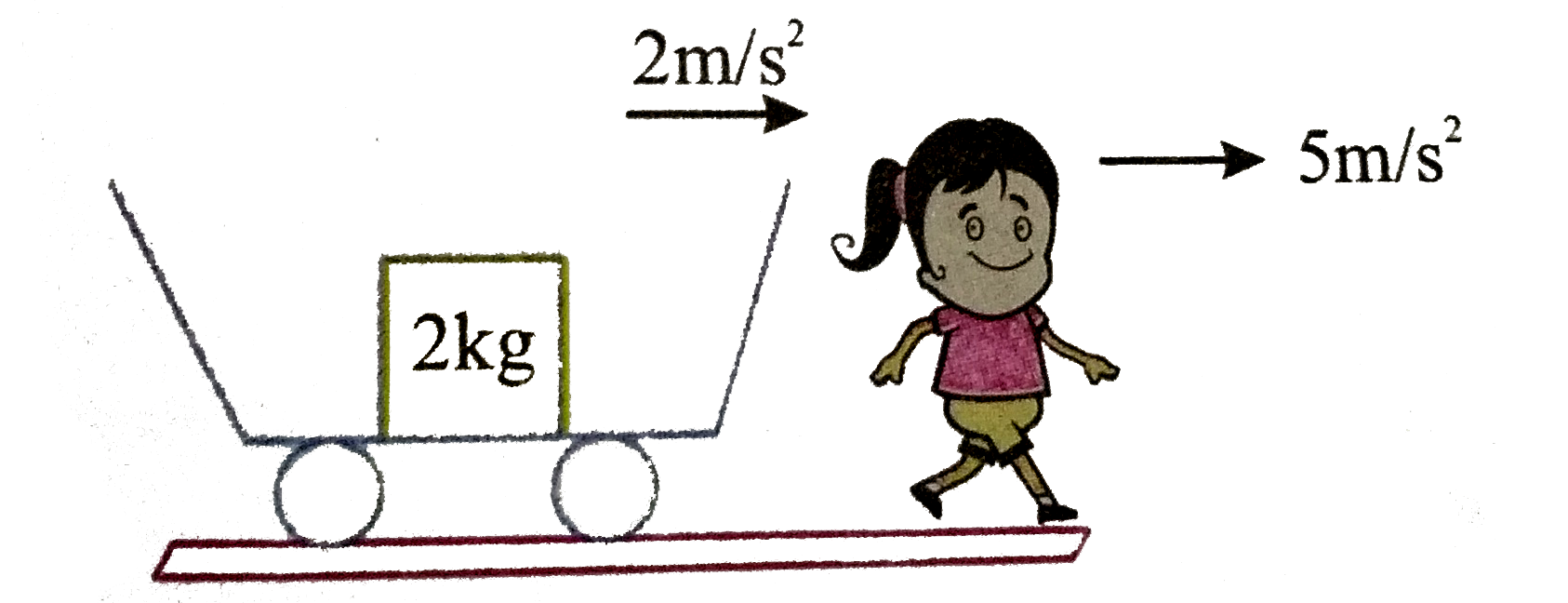
An observed and a vehicle, both starts moving together from rest with accelerations `5 m//s^(2)` and `2 m//s^(2)`, respectively. There is a `2 kg` block on the floor of the vehicle, and `mu = 0.3` between their surfaces. Find the work done by the running observer, during first `2` seconds of the motion.
.

Promotional Banner

Similar Questions

Explore conceptually related problems

An observed and a vehicle, both starts moving together from rest with accelerations 5 m//s^(2) and 2 m//s^(2) , respectively. There is a 2 kg block on the floor of the vehicle, and mu = 0.3 between their surfaces. Find the work done by friction on the block with respect to the running observer, during first 2 seconds of the motion. .

The distance travelled by a particle starting from rest and moving with an acceleration 4/3m/s2 ,in the third-second is

A body starting from rest is moving with a uniform acceleration of 8m/s^(2) . Then the distance travelled by it in 5th second will be

A body starting from rest is moving with a uniform acceleration of 8m/s^(2) . Then the distance travelled by it in 5th second will be

The three blocks in figure are released from rest and accelerate at the rate of 2 m/s^(2) . If M = 5 kg , what is the coefficient of friction between the surface and the block B ?

A vehicle is moving on a road with an acceleration a=20 m//s^(2) as shown in figure. The frictional coefficient between the block of mass (m) and the vehicle so that block is does not fall downward is (g=10m//s^(2))

A vehicle is moving on a road with an acceleration a=20 m//s^(2) as shown in figure. The frictional coefficient between the block of mass (m) and the vehicle so that block is does not fall downward is (g=10m//s^(2))

A block of mass 2.0 kg is pushed down an inclined plane of inclination 37^0 with a force of 20N acting parallel to the incline. It is found that the block moves on the incline with an acceleration of 10 m/s^2 . If the block started from rest, find the work done a. by the applied force in the first second b. by the weight of the block in the first second and c. by the frictional force acting on the block in the first second. Take g=10 m/s^2 .

A man moves on a straight horizontal road with a block of mass 2 kg in his hand. If he covers a distance of 40 m with an acceleration of 0.5 m/s^2 find the work done by the man on the block during the motion.