

Home
Class 11
PHYSICS
An inclined plane makes an angle 30^(@) ...

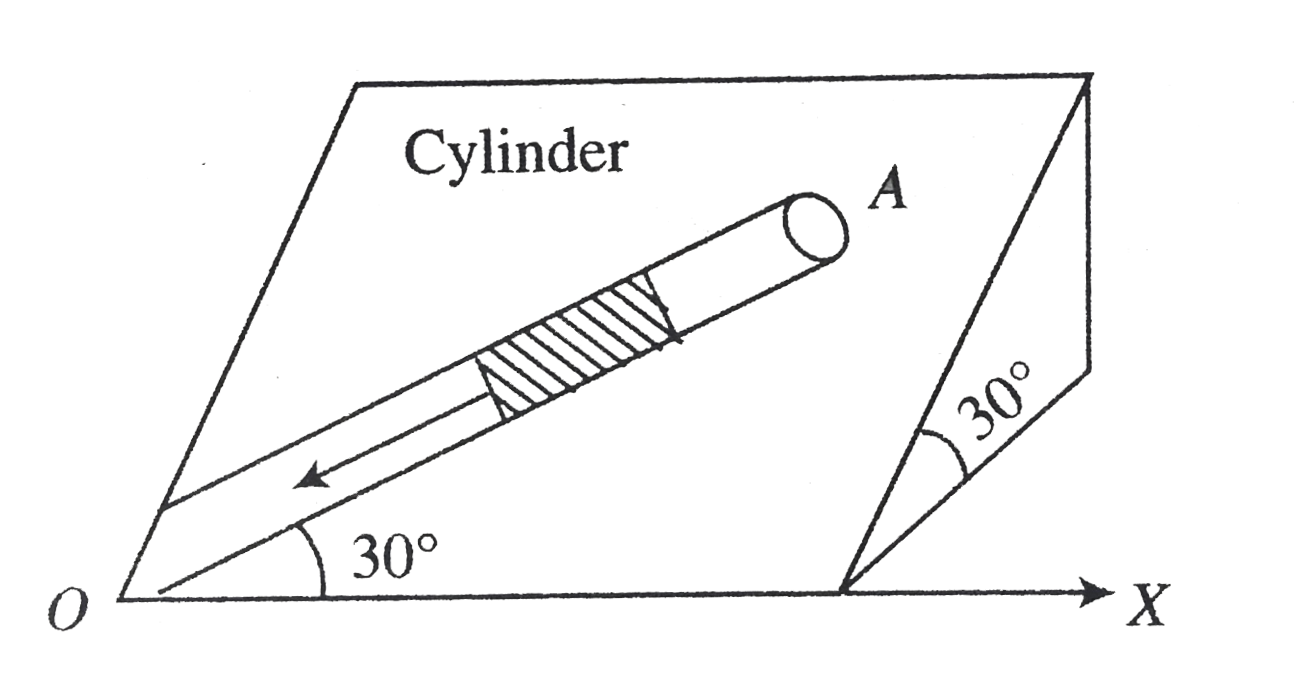
An inclined plane makes an angle `30^(@)` with the horizontal. A groove (OA) of length 5m cut in the plane makes an angle `30^(@)` with OX. A short smooth cylinder is free to slide down under the influence of gravity. The time taken by the cylinder to reach from A to O is `(g=10ms^(-2))`.

Promotional Banner

Similar Questions

Explore conceptually related problems

An inclined plane makes an angle 30° with the horizontal. A solid sphere rolling down this inclined plane from rest without slipping has a linear acceleration equal to

An inclined plane makes an angle 30° with the horizontal. A solid sphere rolling down this inclined plane from rest without slipping has a linear acceleration equal to

An inclined plane makes an angle 30° with the horizontal. A solid sphere rolling down this inclined plane from rest without slipping has a linear acceleration equal to

A smooth inclined plane is inclined at an angle theta with the horizontal. A body starts from rest and slides down the inclined surface. The time taken by the body to reach the bottom is

An inclined plane makes angle of 30^@ with horizontal.A solid sphere rolls down this inclined plane from rest without slipping .the acceleration of the sphere is :

A spinning cylinder of mass m and radius R is lowered on a rough inclined plane of angle 30^(@) with the horizontal and mu=1sqrt(3) . The cylinder is released at a height of 3R from horizontal. Find the total time taken by the cylinder to reach the bottom of the incline.

A particle is thrown at time t=0 with a velocity of 10 m/s at an angle of 60^(@) with the horizontal from a point on an incline plane, making an angle of 30^(@) with the horizontal. The time when the velocity of the projectile becomes parallel to the incline is :

A cylinder is released from the top of an incline making angle theta=45^(@) with the horizontal. The length of the incline is 2.82m and mass of cylinder is 1kg . The coefficient of friciton is 0.2 between the cylinder and the incline. When the cylinder reaches the bottom of the incline, its total kinetic energy is (g=10m//s^(2))