

Home
Class 11
PHYSICS
A bead can slide on a smooth straight wi...

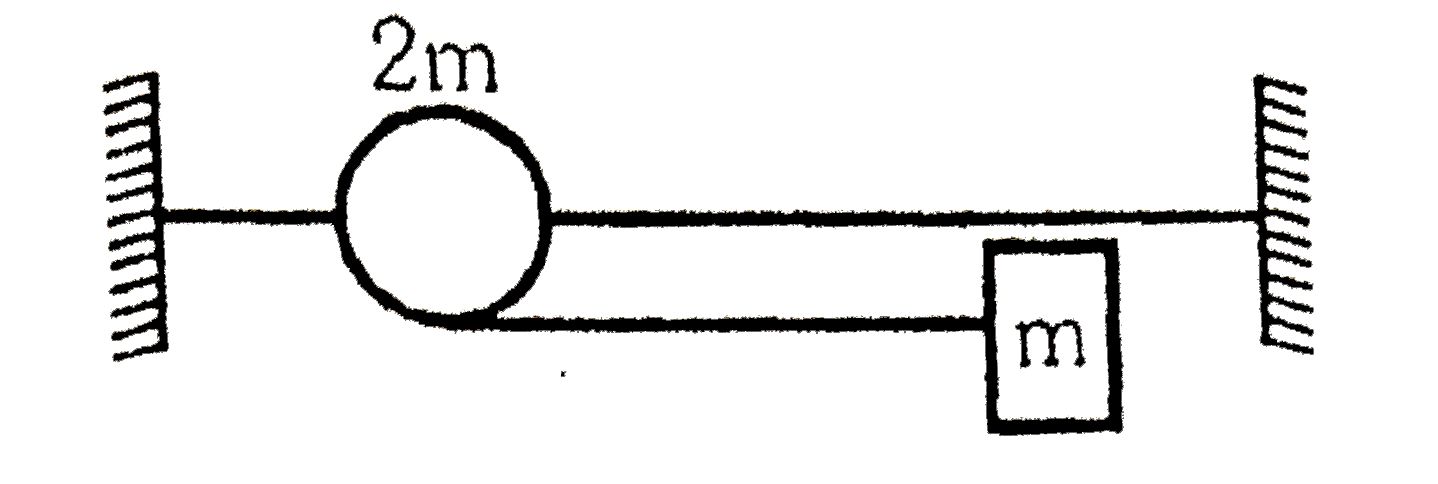
A bead can slide on a smooth straight wire and a particle of mass `m` attached to the bead by a light string of length `L`. The particle is held in contact with the wire and with the string taut and is then let fall. If the bead has mass `2m` then when the string makes an angle `theta` with the wire, the bead will have slipped a distance.

Promotional Banner

Similar Questions

Explore conceptually related problems

A bead can slide on asmooth straight wire and a particle of mass m attached to the bead by a light string of length L. The particle is held in contact with the wire and with the string taut and is then let fall. If the bead has mass 2m then when the string makes an angle theta with the wire, the bead will have slipped a dsitance.

A bead can slide on asmooth straight wire and a particle of mass m attached to the bead by a light string of length L. The particle is held in contact with the wire and with the string taut and is then let fall. If the bead has mass 2m then when the string makes an angle theta with the wire, the bead will have slipped a dsitance.

A particle of mass m is attached to the celling of a cabin with an inextensible light string of length l . The cabin is moving upward with an acceleration a . The particle is taken to a position such that string makes an angle theta with vertical. When string becomes vertical, find the tension in the string.

A particle of mass m is attached to the celling of a cabin with an inextensible light string of length l . The cabin is moving upward with an acceleration a . The particle is taken to a position such that string makes an angle theta with vertical. When string becomes vertical, find the tension in the string.

A particle of mass m suspended by a string of length l revolves in a horizontal circle ( theta is the angle the string makes with vertical). Which of the following statement(s) is // are correct?

A ring A which can slide on a smooth wire is connected to one end of a string as shown in fig. Other end of the string is connected to a hanging mass B. Find the speed of the ring when the string makes an angle theta with the wire and mass B is going down with a velocity v.

A ring A which can slide on a smooth wire is connected to one end of a string as shown in fig. Other end of the string is connected to a hanging mass B. Find the speed of the ring when the string makes an angle theta with the wire and mass B is going down with a velocity v.

A small bead of mass M slides on a smooth wire that is bent in a circle of radius R. It is released at the top of the circular part of the wire (point A in the figure) with a negligibly small velocity. Find the height H where the bead will reverse direction

A small bead of mass M slides on a smooth wire that is bent in a circle of radius R. It is released at the top of the circular part of the wire (point A in the figure) with a negligibly small velocity. Find the height H where the bead will reverse direction

A bead can slide on a smooth circular wire frame of radius R which is fixed in a vartical plane. The bead is displaced slightly from the highest point of the wire frame. The speed of the bead subsequently as a function of the angle theta made by the bead with the vertical line is