

Home
Class 11
PHYSICS
A uniform rod AB of mass m = 2 kg and le...

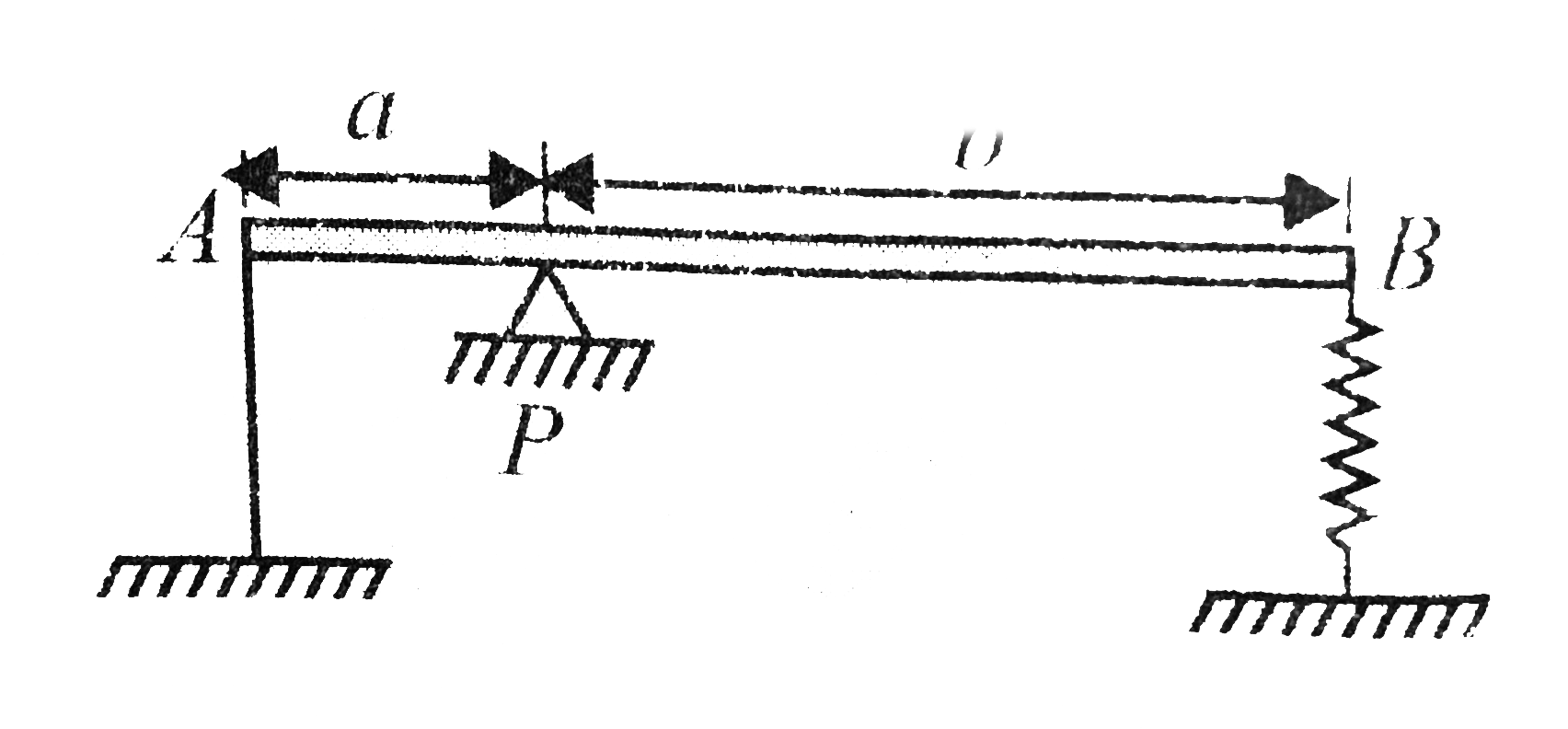
A uniform rod `AB` of mass `m = 2 kg` and length `l = 1.0 m` is placed on a sharp support `P` such that `a = 0.4 m` and `b = 0.6 m`. A. spring of force constant `k= 600 N//m` is attached to end `B` as shown in Fig. To keep the rod horizontal, its end `A` is tied with a thread such that the spring is `B` elongated by `1 CM`. Calculate reaction of support `P` when the thread is burnt.

Promotional Banner

Similar Questions

Explore conceptually related problems

A uniform rod of mass 2m and length L is hinged at one end and carries a particle of mass m at the other end.Two springs each of force constant k are installed at distances as shown.The whole arrangement rests on a smooth horizontal surface.The frequency of small oscillations will be?

A horizontal rod of mass m=(3k)/(pi^2) kg and length L is pivoted at one end . The rod at the other end is supported by a spring of force constant k. The rod is displaced by a small angle theta from its horizontal equilibrium position and released . The time period (in second) of the subsequent simple harmonic motion is

A horizontal rod of mass m=(3k)/(pi^2) kg and length L is pivoted at one end . The rod at the other end is supported by a spring of force constant k. The rod is displaced by a small angle theta from its horizontal equilibrium position and released . The time period (in second) of the subsequent simple harmonic motion is

A horizontal rod of mass m and length L is pivoted at one end The rod's other end is supported by a spring of force constant k. The rod is displaced by a small angle theta from its horizontal equilibrium position and released. The angular frequency of the subsequent simple harmonic motion is

A horizontal rod of mass m and length L is pivoted at one end The rod's other end is supported by a spring of force constant k. The rod is displaced by a small angle theta from its horizontal equilibrium position and released. The angular frequency of the subsequent simple harmonic motion is

A 10 kg mass is connected at one end of a massless spring with force constant k = 1000 N/m, keeping other end fixed in a horizontal plane as shown in the fig. 15.6 If the sytem is displaced by 0.01 m from its equilibrium position A to a point B, then the acceleration of the system is

A long uniform rod of length L, mass M is free to rotate in a horizontal plane about a vertical axis through its end. Two springs of constant K each are connected as shown. On equilibrium, the rod was horizontal. The frequency will be –

The ends of a rod of length l and mass m are attached to two identical springs as shown in the figure. The rod is free to rotate about its centre O . The rod is depressed slightly at end A and released . The time period of the oscillation is

A uniform rod AB of mass m and length l is at rest on a smooth horizontal surface. An impulse J is applied to the end B , perpendicular to the rod in the horizontal direction. Speed of particlem P at a distance (l)/(6) from the centre towards A of the rod after time t = (pi m l)/(12 J) is.