Home
Class 11
PHYSICS
A man can swim in still water with a spe...

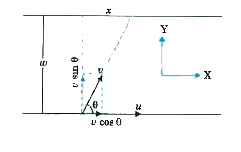
A man can swim in still water with a speed v . River flows at a speed u which is greater than the swimming speed (v) of the man . Explain that the man cannot move perpendicular to the flow . If man swims at an angle `theta` with the river flow , then find drift along the flow by the time he crosses the river . Also find the minimum value of the drift along the flow x by the time he crosses the river .

Text Solution

Verified by Experts

Resultant of v and u will give the net velocity of the man with respect to the ground . Velocity of the man with respect to the ground can be written as follows:
`vecv_(m)=(u+v cos theta ) hati +(u sin theta)hatj`
Time taken to cross the river can be calculated using Y-component of velocity .
`t=(w)/(v sin theta)`
Drift in this time interval can be calculated using X-component of velocity .
`x=(u+v cos theta)t`
Substituting from equation (i) we get the following:
`x=(u+v cos theta)((w)/(v sin theta)) rArr x=w (u+v cos theta)/(u sin theta)`
We can use differentation to calculate the minimum value of x , but for now let us make use of quadratic equation. On squaring and rearranging the equation (ii) , we get the following :
`v^(2)x^(2) sin^(2) theta =w^(2) u^(2) cos ^(2) theta +2u uw^(2) cos theta`
`rArr v^(2)x^(2) (1- cos ^(2) theta ) =w^(2) u^(2) +w^(2) v^(2) cos ^(2) theta+ 2u u w^(2) cos theta`
`rArr (w^(2) v^(2) +v^(2) x^(2)) cos ^(2) theta +2u u w^(2) cos theta +(w^(2)u^(2)-v^(2)x^(2))=0`
For real solution of `cos, theta` , discriminate of the above equation must be greater than zero . Hence we can write the following :
`Delta ge 0`
`B^(2)-4 AC ge 0`
`rArr 4u^(2) v^(2) w^(2) -4(w^(2)v^(2)+v^(2)x^(2))(w^(2) u^(2)-v^(2)x^(2)) ge 0`
`rArr u^(2)w^(2)-(w^(2)+x^(2))(w^(2)u^(2)-v^(2)x^(2)) ge 0`
`rArr u^(2)w^(2)-w^(2)u^(2)-x^(2)w^(2)u^(2)+w^(2)v^(2)x^(2)+v^(2)x^(4) ge 0`
`rArr -x^(2)w^(2) u^(2)+w^(2)v^(2)u^(2)+w^(2)v^(2)x^(2)+v^(2)x^(4) ge 0`
`rArr v^(2)x^(2) ge w^(2) (u^(2)-v^(2))`
`rArr x^(2) ge (w^(2))/(v^(2))(u^(2)-v^(2))`
`rArr x ge (w)/(v) sqrt((u^(2)-v^(2))`
From the above result we can write the maximum value of x.
`rArr x_("min")=(w)/(v) sqrt((u^(2)-v^(2))`
Promotional Banner

Topper's Solved these Questions

  • MOTION IN A PLANE

    MODERN PUBLICATION|Exercise Revision Exercises (very Short Answer Questions)|46 Videos
  • MOTION IN A PLANE

    MODERN PUBLICATION|Exercise Revision Exercises (Additional Questions)|4 Videos
  • MOTION IN A PLANE

    MODERN PUBLICATION|Exercise NCERT FILE (Solved) (NCERT (Exemplar Problems Subjective Questions) Very short nswer type questions)|13 Videos
  • MECHANICAL PROPERTIES OF FLUIDS

    MODERN PUBLICATION|Exercise Chapter Practise Test|16 Videos
  • MOTION IN A STRAIGHT LINE

    MODERN PUBLICATION|Exercise CHAPTER PRACTICE TEST|16 Videos
