Home
Class 12
PHYSICS
A fine pencil of beta-particles, moving ...

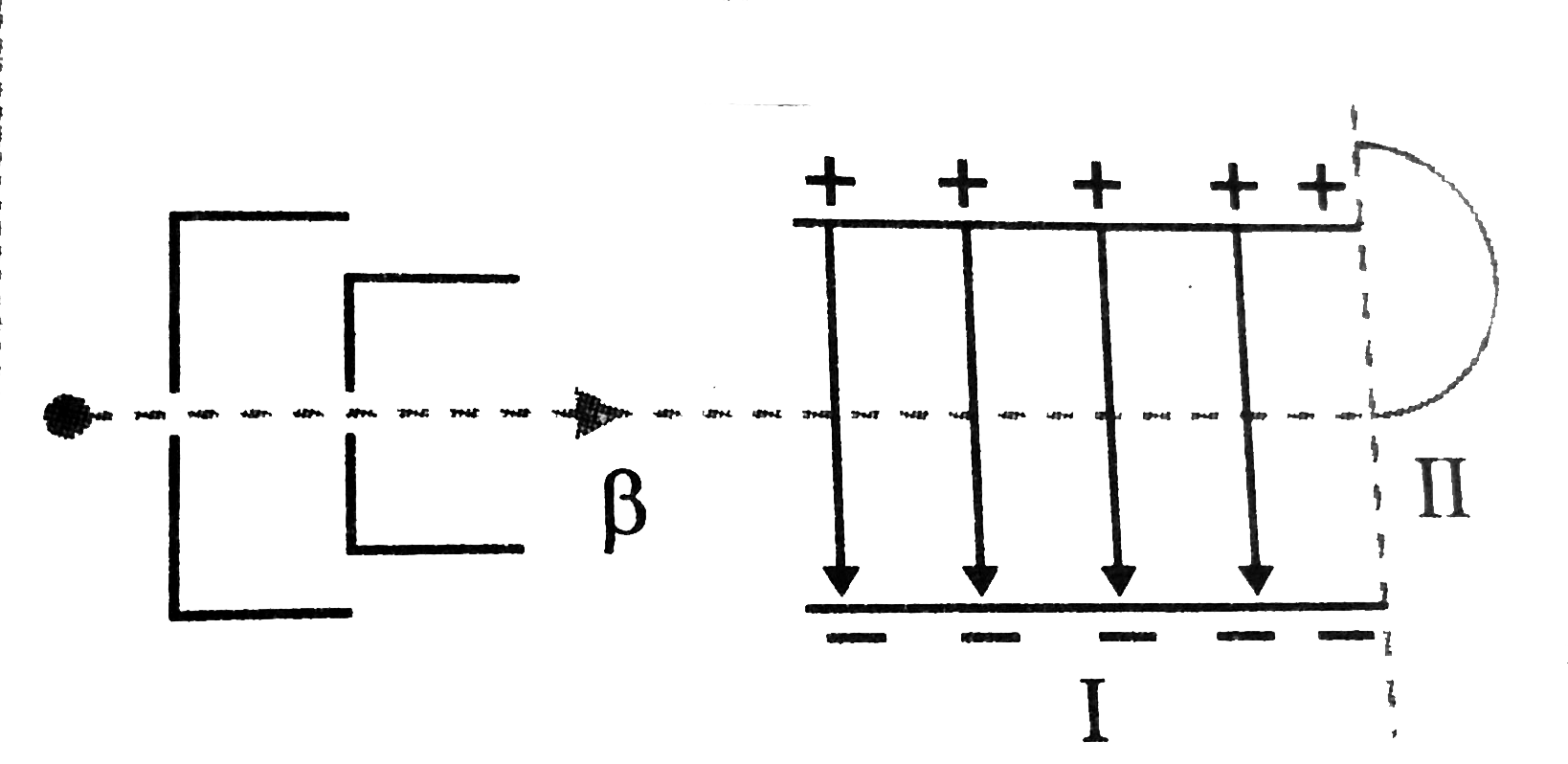
A fine pencil of `beta`-particles, moving with a speed v, enters a region (region I), where a uniform electric field and a uniform magnetic field are both present. These `beta`-particles then move into region II where only the magnetic field, (out of the two fields present in region I) exists. The path of the `beta`-particles, in the two regions is as shown in the figure.

(i) state the direction of magnetic field.
(ii) state the relation between E and B in region I.
(iii) Drive the expression for the radius of the circular path of the `beta`-particle in region II.
(iv) If the magnitude of magnetic field, in region II is changed to n times its earlier value, (without changing the magnetic field in region I) find the factor by which the radius of this circular path would change.

Text Solution

Verified by Experts

(i) The `beta` - particle is passing through both electric and magnetic fields and suffers no deviation i.e., it goes straight through region I where both `vec E " and " vec B` are present. It means that the force on `beta` particle due to electric field `( - e vec E )`, acting upwards is equal and opposite to the force due to magnetic field which is `- e (vec v xx vec B)` , acting downwards.
Using Fleming.s left hand rule, the direction of magnetic field `(vec B)` is perpendicular to the plane of paper and inward.
(ii) Force due to electric field = Force due to magnetic field
`eE = evB sin 90^(@)`
` eE = evB`
`v = E/B`
(iii) Let r be the radius of circular path of `beta` particle in region II.
Then ` evB = (mv^(2))/r`
` r = (mv)/(eB)`
If magnetic field is maden times i.e.
` B. = nB`
The new radius , `r. = (mv)/(enB) = 1/n (mv)/(eB)`
`rArr " " r. = 1/n r`
Promotional Banner

Topper's Solved these Questions

  • MOVING CHARGES AND MAGNETISM

    MODERN PUBLICATION|Exercise Revision Exercises (Long Answer Questions )|12 Videos
  • MOVING CHARGES AND MAGNETISM

    MODERN PUBLICATION|Exercise Revision Exercises (Numerical Problems )|18 Videos
  • MOVING CHARGES AND MAGNETISM

    MODERN PUBLICATION|Exercise Revision Exercises (Fill in the Blanks )|10 Videos
  • MAGNETISM AND MATTER

    MODERN PUBLICATION|Exercise CHAPTER PRACTICE TEST FOR BOARD EXAMINATION|16 Videos
  • NUCLEI

    MODERN PUBLICATION|Exercise CHAPTER PRACTICE TEST FOR BOARD EXAMINATION|15 Videos

Similar Questions

Explore conceptually related problems

In a region where both non-zero uniform electric field and magnetic field coexist, the path of a charged particle

A charge particle travels along a straight line with a speed v in region where both electric field E and magnetic field b are present.It follows that

A charge q moves region in a electric field E and the magnetic field B both exist, then the force on its is

A particle of mass m and charge q is thrown in a region where uniform gravitational field and electric field are present. The path of particle:

Protons are shot in a region perpendicular to a uniform magnetic field in a region :

A particel of mass m and charfe q is throun in a region wihere unirfrom gravittional field and electric field are present . The path of particle -

Force acting on a moving charged particle in a region of electric and magnetic fields is called

MODERN PUBLICATION-MOVING CHARGES AND MAGNETISM-Revision Exercises (Short Answer Questions )
  1. A charged particle q is moving in the presence of a magnetic field B w...

    Text Solution

    |

  2. State the Biot-Savart law. Use it to obtain an expression for magnetic...

    Text Solution

    |

  3. A fine pencil of beta-particles, moving with a speed v, enters a regio...

    Text Solution

    |

  4. Two parallel wires carrying current in the same direction attract each...

    Text Solution

    |

  5. Explain the principle and working of a cyclotron with the help of a sc...

    Text Solution

    |

  6. A cyclotron is not suitable to accelerate electrons. Why?

    Text Solution

    |

  7. Using Biot-Savart’s law, derive an expression for magnetic field at an...

    Text Solution

    |

  8. A current I flows in a conductor placed perpendicular to the plate of ...

    Text Solution

    |

  9. Two small circular loops, marked (1) and (2), carrying equal currents ...

    Text Solution

    |

  10. A wire of length L is bent around in the form of a coil having N turns...

    Text Solution

    |

  11. Two identical coils P and Q each of radius R are lying in perpendicula...

    Text Solution

    |

  12. A rectangular coil of sides l and b carrying a current I is subjected ...

    Text Solution

    |

  13. Define electric dipole moment. Is it a scalar or a vector? Derive the ...

    Text Solution

    |

  14. Increasing the current sensitivity of a galvanometer may not necessari...

    Text Solution

    |

  15. What is the function of the radial magnetic field in the moving coil g...

    Text Solution

    |

  16. Two protons P and Q moving with the same speed enter magnetic field B(...

    Text Solution

    |

  17. (a) How does a voltmeter differ from ammeter? (b) What is the main ...

    Text Solution

    |

  18. State Ampere's circuital law. By using it derive an expression for mag...

    Text Solution

    |

  19. (a) State the principle of working of a galvanometer. (b) Agalvanome...

    Text Solution

    |

  20. A galvanometer of resistance G can be converted into a voltmeter of ra...

    Text Solution

    |
