Home
Class 12
CHEMISTRY
Identity A, B, C, D, E, R and R' in the ...

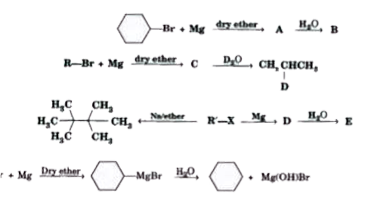
Identity A, B, C, D, E, R and R' in the following:

Text Solution

Verified by Experts
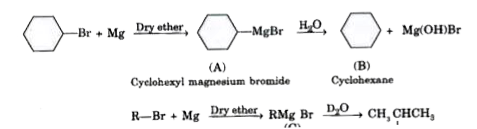

`R-Br+Mg overset("Dry ether")to underset((C))(RMgBr) overset(D_(2)O)to CH_(3)underset(D)underset(|)CHCH_(3)`
Since D geta attached to mame C-atom on which MgBr or Br was present so that
`R-Br: CH_(3)overset(Br)overset(|)CHCH_(3)` or `R : CH_(3)-overset(H)overset(|)CH-CH_(3)` and `C : CH_(3)-underset(CH_(3))underset(|)CH-MgBr`
Tert-alkyl halidea donot undergo Wurtz reaction. Therefore, the question is not correct. They undergo dehydrohalogenation to give alienes. Hence, `R.=(CH_(3))_(3)CH`
`CH_(3)-overset(CH_(3))overset(|)C=CH_(3) underset(-HBr)overset(Na, "ether")larr underset(underset((R.Br))("tert-butylbromide"))(CH_(3)-underset(CH_(3))underset(|) overset(CH_(3))overset(|)C-Br) overset(Mg)to underset((D))(CH_(3)-underset(CH_(3))underset(|) overset(CH_(3))overset(|)C-MgBr) overset(H_(2)O)to underset("2-Methylpropane")(CH_(3)-underset(CH_(3))underset(|) overset(CH_(3))overset(|)C-H)`
Promotional Banner

Topper's Solved these Questions

  • HALOALKANES AND HALOARENES

    MODERN PUBLICATION|Exercise NCERT Textbooks Exercises|1 Videos
  • HALOALKANES AND HALOARENES

    MODERN PUBLICATION|Exercise NCERT Textbooks Exercise|21 Videos
  • HALOALKANES AND HALOARENES

    MODERN PUBLICATION|Exercise CONCEPTUAL QUESTIONS|25 Videos
  • GENERAL PRINCIPLES AND PROCESSES OF ISOLATION OF ELEMENTS

    MODERN PUBLICATION|Exercise COMPETION FILE (Integer Type Numerical Value Type Questions)|5 Videos
  • ORGANIC COMPOUNDS CONTAINING NITROGEN

    MODERN PUBLICATION|Exercise UNIT PRACTICE TEST|5 Videos

Similar Questions

Explore conceptually related problems

Identify A, B, C, D, E, R and R^(1) in the following:

In A A B C ,\ P\ a n d\ Q are respectively the mid-points of A B\ a n d\ B C and R is the mid-point of A Pdot Prove that: a r\ ( R Q C)=3/8\ a r\ (\ A B C)

In A A B C ,\ P\ a n d\ Q are respectively the mid-points of A B\ a n d\ B C and R is the mid-point of A Pdot Prove that: a r\ (\ P R Q)=1/2a r\ (\ A R C)

In a A B C ,\ D ,\ E ,\ F are the mi-points of sides B C ,\ C A\ a n d\ A B respectively. If a r( A B C)=16 c m^2, then a r\ (t r a p e z i u m\ F B C E)= 4\ c m^2 (b) 8\ c m^2 (c) 12 c m^2 (d) 10 c m^2

In A A B C ,\ P\ a n d\ Q are respectively the mid-points of A B\ a n d\ B C and R is the mid-point of A Pdot Prove that: a r\ ( P B Q)=\ a r\ (\ A R C)

In Figure, A B C D E is a pentagon. A line through B parallel to A C meets D C produced at Fdot Show that a r( A C B)=a r( A C F) (ii) a r( A E D F)=a r(A B C D E)

In Figure, A B C D E\ is a pentagon. A line through B parallel to A C meets D C produced at Fdot Show that: a r\ ( A C B)=a r\ ( A C F) a r\ (A E D F)=a r\ (A B C D E)

Let R be a relation in N defined by R={(a , b); a , b in N\ a n d\ a=b^2dot} Are the following true: (i)\ (a , a) in R\ AA\ a in N (ii)\ (a , b) in R=>(b , a) in R (iii)\ (a , b) in R ,(b , c) in R=>(a , c) in R

A B C D is a parallelogram, G is the point on A B such that A G=2G B ,E is a point of D C such that C E=2D E and F is the point of B C such that B F=2F Cdot Prove that : a r(A D E G)=a r(G B C E) a r( E G B)=1/6a r(A B C D)

