Home
Class 12
CHEMISTRY
Haloarenas are less reactive than haloal...

Haloarenas are less reactive than haloalkanes and haloalkenes. Explain.

Text Solution

Verified by Experts
Haloarenes are much less reactive than haloalkanes and haloalkenes towards nucleophilic substitution reactions because of the following reasons:
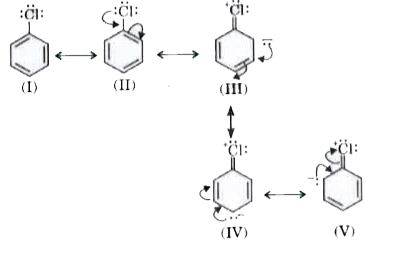
1. Resonance effect: In haloarenes, there is delocalisation of electrons due to resonance. For example, chlorobenzene is considered to be a resonance hybrid of the following structures:

It is evident that the contribution of structures III, IV and V imparts a partial double bond character to the carbon-chlorine bond. This is confirmed by X-ray analysis which shows that the C-Cl bond length in chlorobenzene is `1.69 overset(@)A` while the C-Cl bond length in ethyl chloride molecule is `1.82 overset(@)A`. The shortening of bond length imparts stability to aryl halides and the bond cleavage becomes rather difficult. The aryl halides are, thereforo, less reactive than alkyl halides.
In haloalkenes also, the filled p-orbital of halogen atom cannot overlap sidewise with the unhybridised p-orbital of C atom. Therefore, C-Cl bond is not very strong and can be easily cleaved.
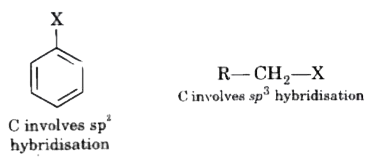
2. Different hybridisation states of carbon atom : In haloalkanes the carbon atom of the C-X bond is `sp^(3)` hybridised while in haloarene halides, the carbon atom is `sp^(2)` hybridised. The `sp^(2)` hybridised carbon atom with a greater s-character is more electronegative. It can hold the electron pair of the bond more tightly than the `sp^(3)` hybridised carbon atom in alkyl halides. Therefore, it has less tendency to release electrons to the halogen. As a result, the bond cleavage in aryl halides is some what more difficult than in alkyl halides.

Thus, haloarenes are less reactive towards the substitution reactions than haloalkanes.
Promotional Banner

Topper's Solved these Questions

  • HALOALKANES AND HALOARENES

    MODERN PUBLICATION|Exercise NCERT examplar Problems (Matching Type Questions)|6 Videos
  • HALOALKANES AND HALOARENES

    MODERN PUBLICATION|Exercise NCERT examplar Problems (Assertion and Reason Type Questions)|10 Videos
  • HALOALKANES AND HALOARENES

    MODERN PUBLICATION|Exercise NCERT examplar Problems (Multiple Choice Questions (Type-II))|12 Videos
  • GENERAL PRINCIPLES AND PROCESSES OF ISOLATION OF ELEMENTS

    MODERN PUBLICATION|Exercise COMPETION FILE (Integer Type Numerical Value Type Questions)|5 Videos
  • ORGANIC COMPOUNDS CONTAINING NITROGEN

    MODERN PUBLICATION|Exercise UNIT PRACTICE TEST|5 Videos

Similar Questions

Explore conceptually related problems

Haloarenes are less reactive than haloalkanes and haloalkenes. Explain.

Explain as to why haloarenes are much less reactive than halo-alkanes towards nucleophilic substitution reactions.

(a) Why are haloarenes less reactive than haloalkanes? (explain with resonance and hybridization). (b) Explain substitution nucleophilic bimolecular ( S_(N)2 ) reaction. (c) Define Optical activity.

Ketones are less reactive than aldehydes because

MODERN PUBLICATION-HALOALKANES AND HALOARENES-NCERT examplar Problems (Short Answer Type Questions)
  1. Out of o- and p-dibromobenzene which one has higher melting point and ...

    Text Solution

    |

  2. Which of the compounds will react faster in S(N)1 reaction with ""^(-)...

    Text Solution

    |

  3. Why iodoform has appreciable antiseptic property?

    Text Solution

    |

  4. Haloarenas are less reactive than haloalkanes and haloalkenes. Explain...

    Text Solution

    |

  5. Discuss the role of Lewiis acids in the preparation of aryl bromides a...

    Text Solution

    |

  6. Which of the following compounds (i) and (ii) will not react with a mi...

    Text Solution

    |

  7. Allyl chloride is hydrolysed more readily than n-propyl chloride. Why ...

    Text Solution

    |

  8. Why is it necessary to avoid even traces of moisture during the use of...

    Text Solution

    |

  9. How do polar solvents help in the first step in S(N)1 mechanism?

    Text Solution

    |

  10. Write a test to detect the presence of double bond in a molecule.

    Text Solution

    |

  11. Diphenyls are potential threat to the envioronment. How are these prod...

    Text Solution

    |

  12. What are the IUPAC names of the insecticide DDT and benzene hexachlori...

    Text Solution

    |

  13. Elimination reaction (especially beta - elimination) are as common as ...

    Text Solution

    |

  14. How will you obtain monobromobenzene from aniline ?

    Text Solution

    |

  15. Aryl halides are extremely less reactive towards nucleophilie substitu...

    Text Solution

    |

  16. tert-Butylbromide reacts with aq. NaOH by S(N)1 mechanism while n-buty...

    Text Solution

    |

  17. Predict the major product formed when HCl is added to isobutylene, Exp...

    Text Solution

    |

  18. Discuss the nature of C-X bond in the haloarenes.

    Text Solution

    |

  19. How can you obtain iodoethane from ethanol when no other iodine contai...

    Text Solution

    |

  20. Cyanide ion acts as an ambident nucleophille. From which end it acts a...

    Text Solution

    |