

Home
Class 12
PHYSICS
As a particle moves along the x-axis, it...

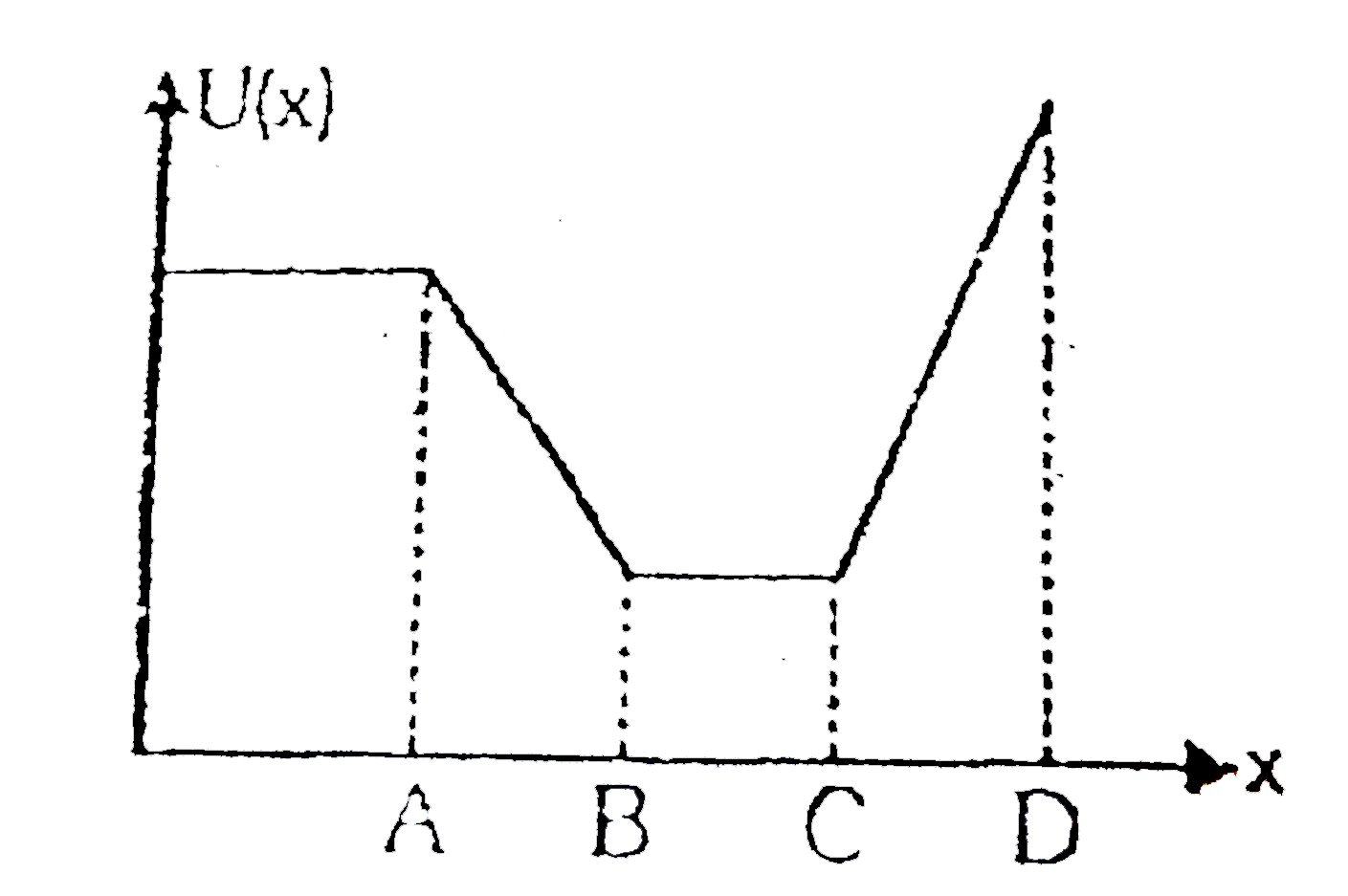
As a particle moves along the `x-`axis, it is acted upon by a conservative force. The potential energy is shown below as a function of the coordinate `x` of the particle. Rank the labelled regions accoeording to the magnitude of force, least to greatest.

Promotional Banner

Similar Questions

Explore conceptually related problems

A particle moves in one dimension in a conservation force field. The potential energy is depicted in the graph below. If the particle starts to move from rest from the point A , then

A particle moves in one dimension in a conservation force field. The potential energy is depicted in the graph below. If the particle starts to move from rest from the point A , then

A particle moves in one dimension in a conservation force field. The potential energy is depicted in the graph below. If the particle starts to move from rest from the point A , then

A particle slides on frictionless x - y plane. It is acted on by a conservative force described by the potential - energy function U(x, y) =(1)/(2)k(x^(2)+y^(2)) . Derive an expression for the force acting on the particle.

A particle slides on frictionless x - y plane. It is acted on by a conservative force described by the potential - energy function U(x, y) =(1)/(2)k(x^(2)+y^(2)) . Derive an expression for the force acting on the particle.

A particle is to move along the x- axis from x=0 to x=x_(1) while a conservative force, directed along the x- axis, acts on the particle. For each force defination presented in the figures the maximum magnitude of the force (F_(1)) is the same for all cases. Rank the forces according to the change in potential energy associated with the motion shown. from most positive to most negative :

A particle is to move along the x- axis from x=0 to x=x_(1) while a conservative force, directed along the x- axis, acts on the particle. For each force defination presented in the figures the maximum magnitude of the force (F_(1)) is the same for all cases. Rank the forces according to the change in potential energy associated with the motion shown. from most positive to most negative :

A particle is to move along the x- axis from x=0 to x=x_(1) while a conservative force, directed along the x- axis, acts on the particle. For each force defination presented in the figures the maximum magnitude of the force (F_(1)) is the same for all cases. Rank the forces according to the change in potential energy associated with the motion shown. from most positive to most negative :

A paticle is acted upon by a force of constant magnitude which always remains perpendicular to the velocity of the particle. If that particle moves in a horizontal plane, then