

Home
Class 12
PHYSICS
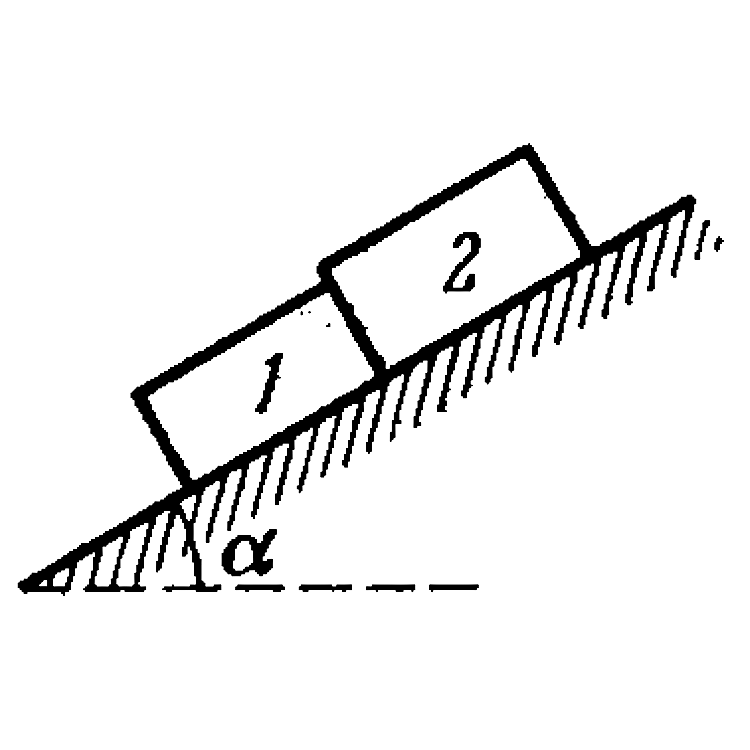
Two touching bars 1 and 2 are placed on ...

Two touching bars 1 and 2 are placed on an inclined plane forming an angle `alpha` with the horizontal (figure). The masses of the bars are equal to `m_1` and `m_2`, and the coefficients of friction between the inclined plane and these bars are equal to `k_1` and `k_2` respectively, with `k_1gtk_2`. Find:
(a) the force of interaction of the bars in the process of motion,
(b) the minimum value of the angle `alpha` at which at bars start sliding down.

Promotional Banner

Similar Questions

Explore conceptually related problems

A bar of mass m is pulled by means of a thread up an inclined plane forming an angle alpha with the horizontal (figure). The coefficient of friction is equal to k. Find the angle beta which is thread must form with the inclined plane for the tension of the thread to be minimum. What is it equal to?

Two blocks of masses m_(1) and m_(2) are kept touching each other on a rough fixed inclined plane of inclination alpha . Coefficients of kinetic friction between the inclined plane and the block m_(1) is k_(1) and between the inclined plane and block m_(2) is k_(2) . Find the force of interaction between the blocks in the process of motion.

The inclined plane of figure forms an angle alpha=30^@ with the horizontal. The mass ratio m_2//m_1=eta=2//3 . The coefficients of friction between the body m_1 and the inclined plane is equal to k=0.10 . The masses of the pulley and the threads are negligible. Find the magnitude and the direction of acceleration of the body m_2 when the formely stationary system of masses starts moving.

A bar of mass m is pulled by means of a thread up an inclined plane forming an angle theta with the horizontal as shown in figure-2.211. The coefficient of friction is mu . Prove that (a) alpha=tan^(-1)mu , where alpha is the angle which the thread must from with the inclined plane for the tension of the thread to be minimum.

What is the minimum acceleration with which bar A (figure) should be shifted horizontally to keep bodies 1 and 2 stationary relative to the bar? The masses of the bodies are equal, and the coefficient of friction between the bar and the bodies is equal to k. The masses of the pulley and the threads are negligible, the friction in the pulley is absent.

What is the minimum acceleration with which bar A (figure) should be shifted horizontally to keep bodies 1 and 2 stationary relative to the bar? The masses of the bodies are equal, and the coefficient of friction between the bar and the bodies is equal to k. The masses of the pulley and the threads are negligible, the friction in the pulley is absent.

Two bars of masses m_1 and m_2 connected by a non-deformed light spring rest on a horizontal plane. The coefficient of friction between the bars and the surface is equal to k. What minimum constant force has to be applied in the horizontal direction to the bar of mass m_1 in order to shift the other bar?

A bar of mass m_(1) is placed on a plank of mass m_(2) which rests on a smooth horizontal plane . The coefficient of friction between the surfaces of bar and plank is k . The plank is subjected to a horizontal force F depending on time t as F = at , where a is a constant . The moment of time t_(0) at which the plank starts sliding is :