

Home
Class 11
PHYSICS
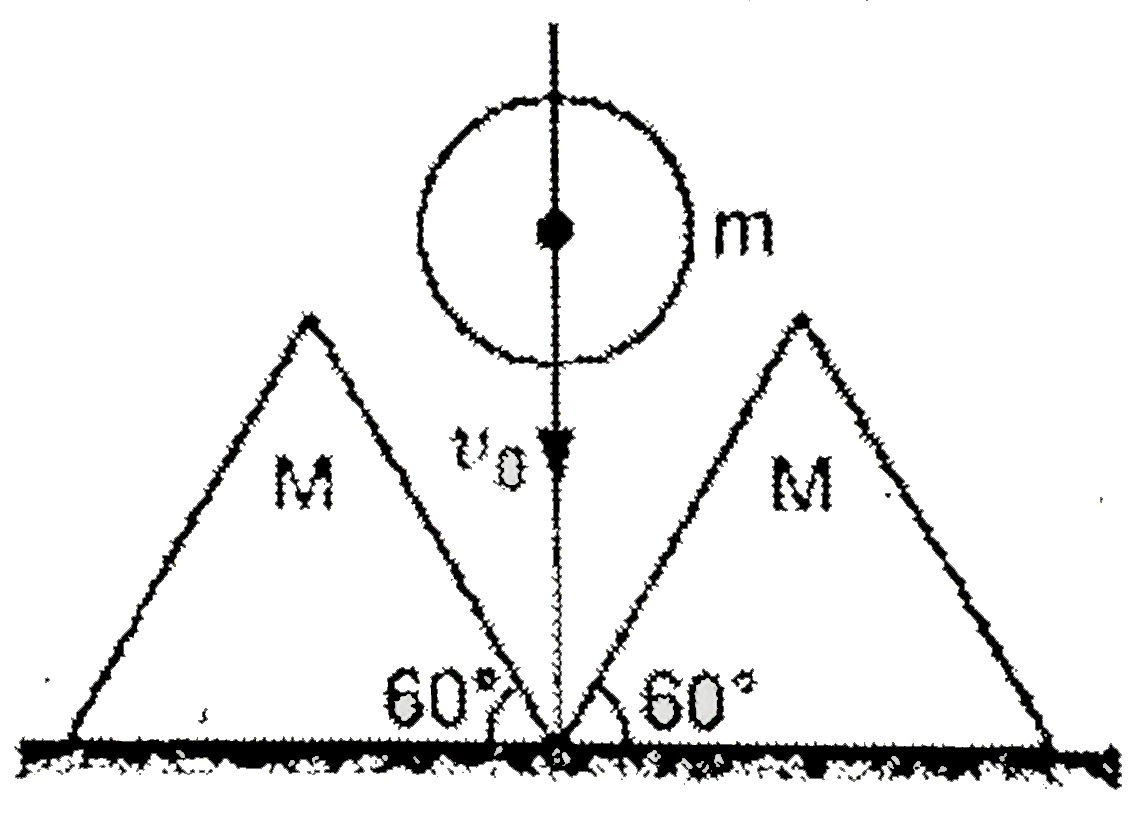
show a smooth spherical ball of mass m s...

show a smooth spherical ball of mass m striking two identical equilateral triangular wedges of mass M. At the instant of impact velocity of the ball is `upsilon_(0)`. Taking coefficient of restitution e, determine the velcities of the sphere and the wedges just after collision.

Promotional Banner

Similar Questions

Explore conceptually related problems

A sphere of mass m moving with a uniform velocity v hits another identical sphere at rest. If the coefficient of restitution is e, the ratio of the velocities of the two sphere after the collision is (e-1)/(e+1) .

A ball of mass m moving with a constant velocity strikes against a ball of same mass at rest. If e= coefficient of restitution, then what will the the ratio of the velocities of the two balls after collision?

A ball A moving with a certain velocity collides, with another ball B of the same mass at rest. If the coefficient of restitution is e, the ratio of the velocities of A and B just after the collision is

The first ball of mass m moving with the velocity upsilon collides head on with the second ball of mass m at rest. If the coefficient of restitution is e , then the ratio of the velocities of the first and the second ball after the collision is

The first ball of mass m moving with the velocity upsilon collides head on with the second ball of mass m at rest. If the coefficient of restitution is e , then the ratio of the velocities of the first and the second ball after the collision is

A glass ball collides with an identical ball at rest with v_(0)=2 m/sec. If the coefficient of restitution of collision is e = 0.5, find the velocities of the glass balls just after the collision.

A glass ball collides with an identical ball at rest with v_(0)=2 m/sec. If the coefficient of restitution of collision is e = 0.5, find the velocities of the glass balls just after the collision.

A particle of mass m moving with speed u hits a wedge of mass M as shown in figure. If coefficient of restitution is e and friciton can be neglected, then find the speed of the wedge with respect to ground just after the collision.