

Home
Class 11
PHYSICS
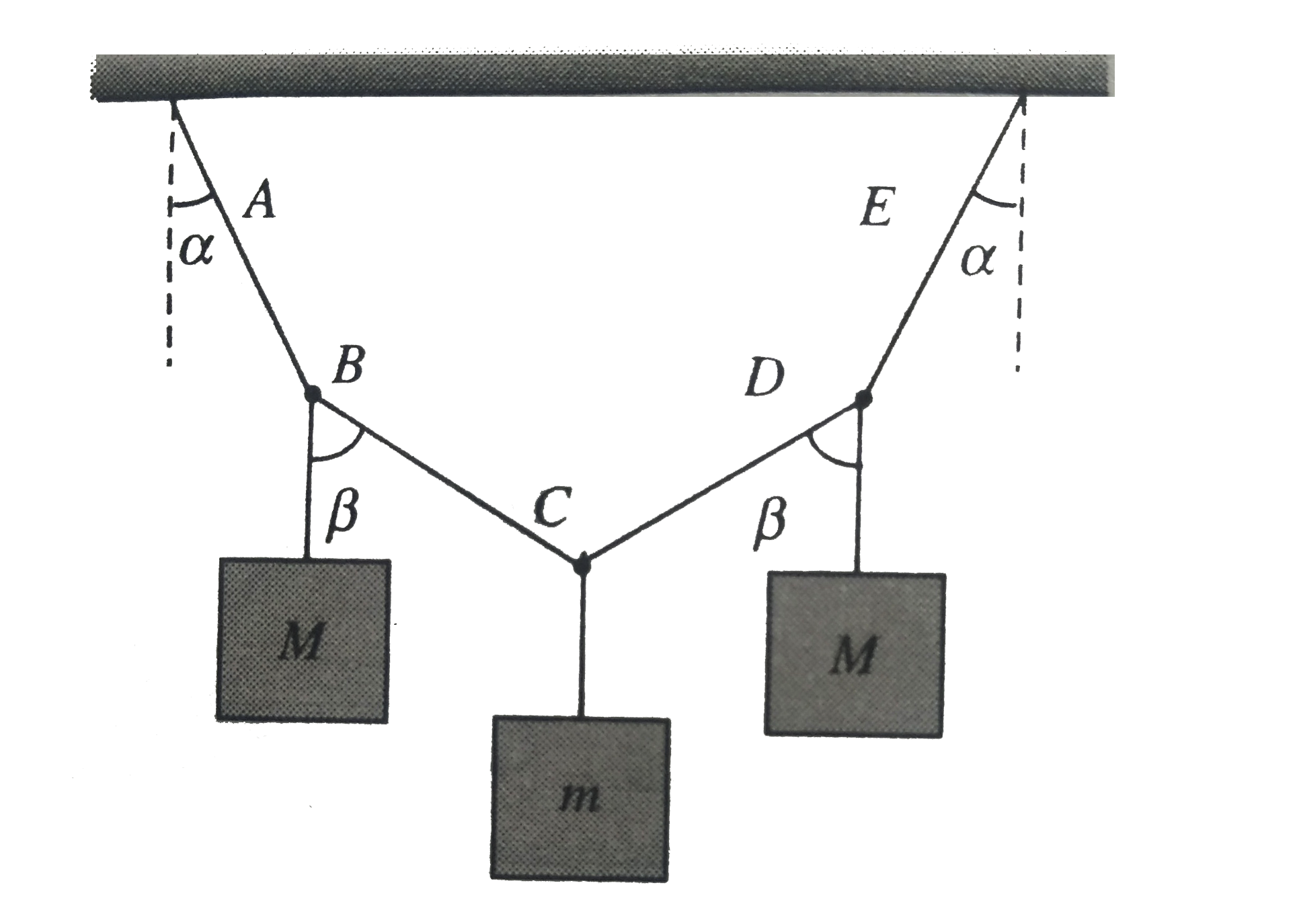
Figure, represents a light inextensible ...

Figure, represents a light inextensible string ABCDE in which `AB=BC=CD=DE` and to which are attached masses M,m, and M at the point B,C and D, respectively. The system hangs freely in equilibrium with ends A and E of the string fixed in the same horizontal line. it is given that `tan alpha=3//4` and `tan beta=12//5`. Then the tension in the string BC is

Promotional Banner

Similar Questions

Explore conceptually related problems

The blocks B and C in the figure have mass m each. The strings AB and BC are light, having tensions T_(1) and T_(2) respectively. The system is in equilibrium with a constant horizontal force mg acting on C.

The blocks B and C in the figure have mass m each. The strings AB and BC are light having tension T_(1) and T_(2) respectively. The system is in equilibrium with a constant horizontal forcemg acting on C. Then which one is incorrect.

Two masses M_(1) and M_(2) are attached to the ends of a light string which passes over a massless pulley attached to the top of a double inclined smooth plane of angles of inclination alpha and beta .The tension in the string is :

A ball of mass m is attached to a fixed point by a light inextensible string describe a circle in a verticle plane. The tension in the string has the values alpha mg and beta mg , respectively, when the particle is at the highest and the lowest point in the path. find the relation between alpha and beta .

In the figure the masses of the blocks A and B are same and each equal to m. The tensions in the strings OA and AB are T_(2) and T_(1) respectively. The system is in equilibrium with a constant horizontal force mg on B. The tension T_(1) is :-

Two particles each of mass m are connected by a light inextensible string and a particle of mass M is attached to the midpoint of the string. The system is at rest on a smooth horizontal table with string just taut and in a straight line. The particle M is given a velocity v along the table perpendicular to the string. Prove that when the two particles are about to collide : (i) The velocity of M is (Mv)/((M + 2m)) (ii) The speed of each of the other particles is ((sqrt2M (M + m))/((M + 2m)))v .

Two particles each of mass m are connected by a light inextensible string and a particle of mass M is attached to the midpoint of the string. The system is at rest on a smooth horizontal table with string just taut and in a straight line. The particle M is given a velocity v along the table perpendicular to the string. Prove that when the two particles are about to collide : (i) The velocity of M is (Mv)/((M + 2m)) (ii) The speed of each of the other particles is ((sqrt2M (M + m))/((M + 2m)))v .

Two particles each of mass m are connected by a light inextensible string and a particle of mass M is attached to the midpoint of the string. The system is at rest on a smooth horizontal table with string just taut and in a straight line. The particle M is given a velocity v along the table perpendicular to the string. Prove that when the two particles are about to collide : (i) The velocity of M is (Mv)/((M + 2m)) (ii) The speed of each of the other particles is ((sqrt2M (M + m))/((M + 2m)))v .

A body of mass m hangs at one end of a string of length l , the other end of which is fixed. It is given a horizontal velocity so that the string would just reach where it makes an angle of 60^(@) with the vertical. The tension in the string at mean position is

A body of mass m hangs at one end of a string of length l , the other end of which is fixed. It is given a horizontal velocity so that the string would just reach where it makes an angle of 60^(@) with the vertical. The tension in the string at mean position is