

Home
Class 11
PHYSICS
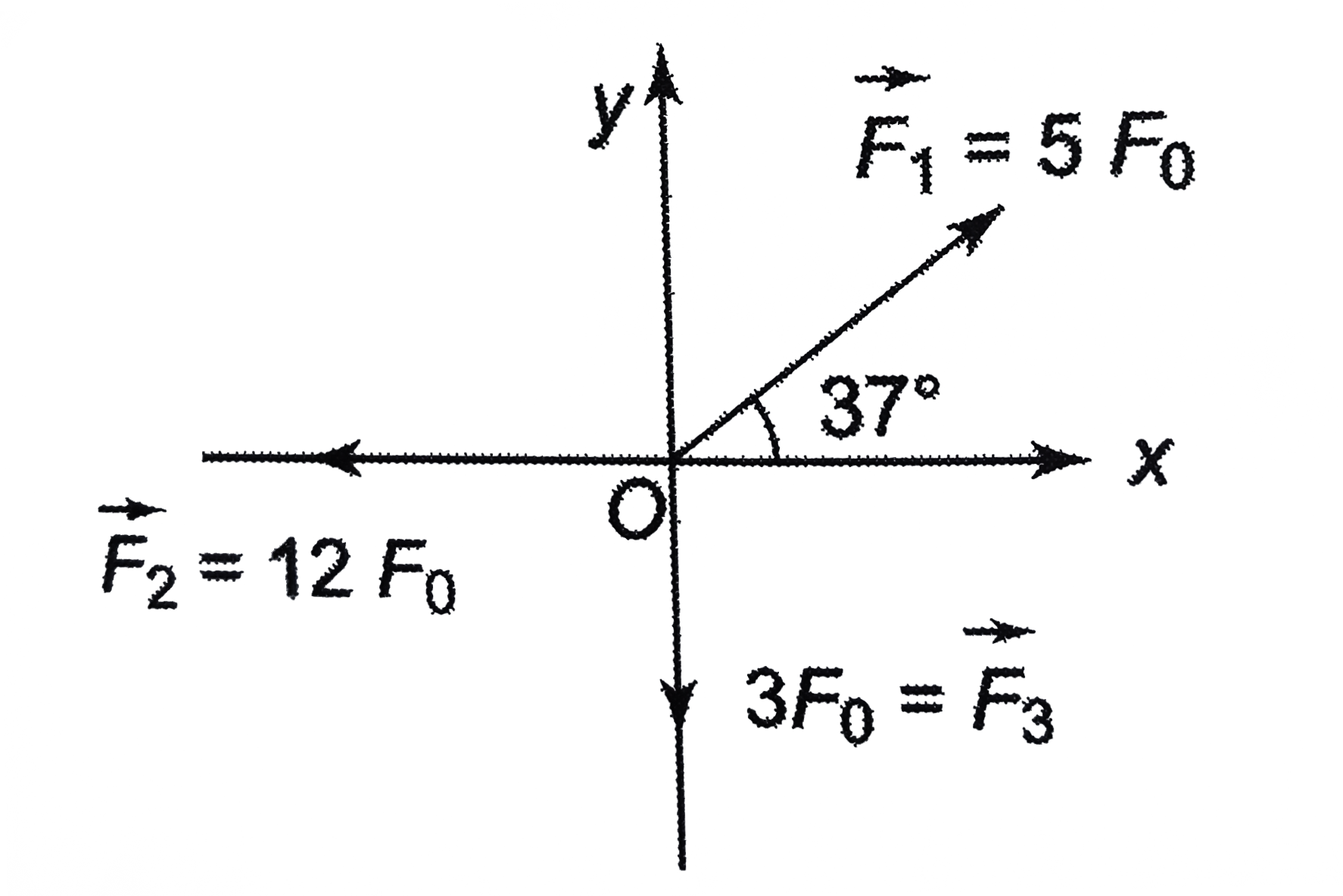
Find the resultant of vec(F(1)) + vec(F(...

Find the resultant of `vec(F_(1)) + vec(F_(2)) - vec(F_(3)) ( sin 37^(@) = (3)/(5) , cos 37^(@) = (4)/(5))`

Promotional Banner

Similar Questions

Explore conceptually related problems

Find the resultant of the following forces. [sin 37^(@) = (3)/(5) ,cos 37^(@) = (4)/(5) , sin 53^(@) = (4)/(5) , cos 53^(@) = (3)/(5)]

Find the resultant of the following forces. [sin 37^(@) = (3)/(5) ,cos 37^(@) = (4)/(5) , sin 53^(@) = (4)/(5) , cos 53^(@) = (3)/(5)]

How are vec(F_(12))and vec(F_(21)) related.

Five forces vec(F)_(1) ,vec(F)_(2) , vec(F)_(3) , vec(F)_(4) , and vec(F)_(5) , are acting on a particle of mass 2.0kg so that is moving with 4m//s^(2) in east direction. If vec(F)_(1) force is removed, then the acceleration becomes 7m//s^(2) in north, then the acceleration of the block if only vec(F)_(1) is action will be:

Find the moment of force vec(F) = 4vec(i) + 2vec(j) + vec(k) through the point 5vec(i) + 2vec(j) + 4vec(k) about the point 3vec(i) - vec(j) + 3vec(k) .

A body placed in free space, is simultaneously acted upon by three forces vec(F_(1)),vec(F_(2)) " and " vec(F_(3)) . The body is in equilibrium and the forces vec(F_(1)) " and "vec(F_(2)) are known ot be 36 N due north and 27 N due east respectively. Which of the following best describes the force vec(F_(3)) ?

A body placed in free space, is simultaneously acted upon by three forces vec(F_(1)),vec(F_(2)) " and " vec(F_(3)) . The body is in equilibrium and the forces vec(F_(1)) " and "vec(F_(2)) are known ot be 36 N due north and 27 N due east respectively. Which of the following best describes the force vec(F_(3)) ?

A body placed in free space, is simultaneously acted upon by three forces vec(F_(1)),vec(F_(2)) " and " vec(F_(3)) . The body is in equilibrium and the forces vec(F_(1)) " and "vec(F_(2)) are known ot be 36 N due north and 27 N due east respectively. Which of the following best describes the force vec(F_(3)) ?

Find 3 -dimensional vectors vec v_ (1), vec v_ (2), vec v_ (3) satisfying vec v_ (1) * vec v_ (1) = 4, vec v_ (1) * vec v_ (2) = - 2, vec v_ (1) * vec v_ (3) = 6, vec v_ (2) * vec v_ (2) = 2, vec v_ (2) * vec v_ (3) = - 5, vec v_ (3) * vec v_ (3)