

Home
Class 12
PHYSICS
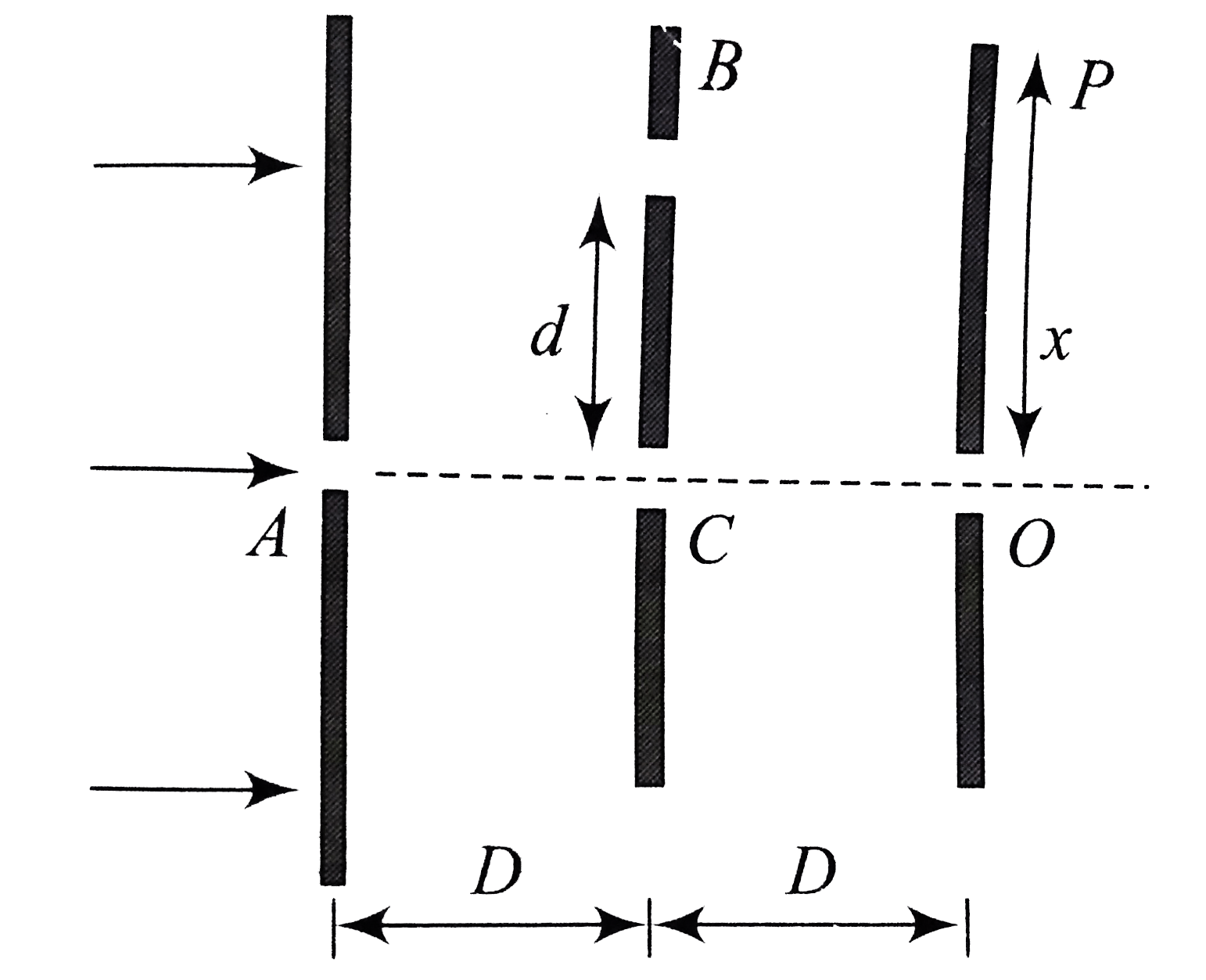
In the arrangment shown in fin. For...

In the arrangment shown in fin.

For what minimum value of d is there a dark bant at point O on the screen?

Promotional Banner

Similar Questions

Explore conceptually related problems

In the arrangment shown in fin. Find the fringe width.

In the arrangment shown in fin. Find the fringe width.

In the arrangement shown in Fig., slits S_(1) and S_(4) are having a variable separation Z. Point O on the screen is at the common perpendicular bisector of S_(1) S_(2) and S_(3) S_(4) . The minimum value of Z for which the intensity at O is zero is

In the arrangement shown in Fig., slits S_(1) and S_(4) are having a variable separation Z. Point O on the screen is at the common perpendicular bisector of S_(1) S_(2) and S_(3) S_(4) . The minimum value of Z for which the intensity at O is zero is

In the arrangement shown in Fig., slits S_(1) and S_(4) are having a variable separation Z. Point O on the screen is at the common perpendicular bisector of S_(1) S_(2) and S_(3) S_(4) . If a hole is made at O' on AO' O and the slit S_(4) is closed, then the ratio of the maximum to minimum observed on screen at O , if O' S_(3) is equal to (lambda D)/(4d) , is

In the arrangement shown in Fig., slits S_(1) and S_(4) are having a variable separation Z. Point O on the screen is at the common perpendicular bisector of S_(1) S_(2) and S_(3) S_(4) . If a hole is made at O' on AO' O and the slit S_(4) is closed, then the ratio of the maximum to minimum observed on screen at O , if O' S_(3) is equal to (lambda D)/(4d) , is

In the arrangement shown in Fig., slits S_(1) and S_(4) are having a variable separation Z. Point O on the screen is at the common perpendicular bisector of S_(1) S_(2) and S_(3) S_(4) . When Z = (lambda D)/(2d) , the intensity measured at O is I_(0) . The intensity at O When Z = (2 lambda D)/(d) is

In the arrangement shown in Fig., slits S_(1) and S_(4) are having a variable separation Z. Point O on the screen is at the common perpendicular bisector of S_(1) S_(2) and S_(3) S_(4) . When Z = (lambda D)/(2d) , the intensity measured at O is I_(0) . The intensity at O When Z = (2 lambda D)/(d) is

In the arrangment shown in fin. Find the distance x at which the next fringe is formed.