

Home
Class 12
PHYSICS
In a Young’s double slit experiment a mo...

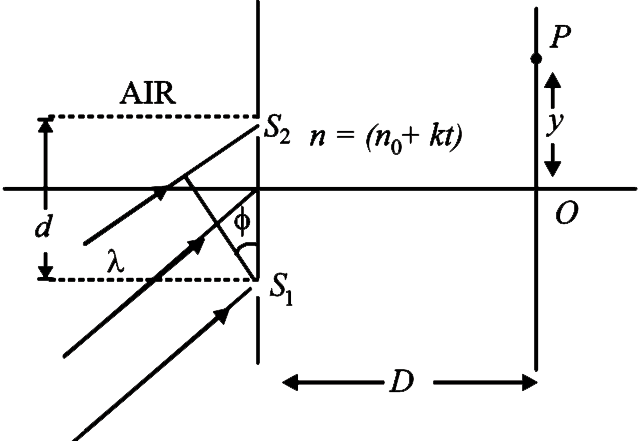
In a Young’s double slit experiment a monochromatic light whose wavelength is l strikes on the slits, separated by distance d, as shown in the figure. Refractive index of the medium between slits and screen varies with time t as n = n0 + kt. Here n0 and k are positive constants. Position of any point P on screen is measure by its y-coordinate as shown.

The velocity of central maxima at any time t as a function of time t is

Promotional Banner

Similar Questions

Explore conceptually related problems

In a Young’s double slit experiment a monochromatic light whose wavelength is l strikes on the slits, separated by distance d, as shown in the figure. Refractive index of the medium between slits and screen varies with time t as n = n0 + kt. Here n0 and k are positive constants. Position of any point P on screen is measure by its y-coordinate as shown. The y co-ordinate of central maxima at any time t is

In a Young’s double slit experiment a monochromatic light whose wavelength is l strikes on the slits, separated by distance d, as shown in the figure. Refractive index of the medium between slits and screen varies with time t as n = n0 + kt. Here n0 and k are positive constants. Position of any point P on screen is measure by its y-coordinate as shown. If a glass plate of small thickness b is placed in front of S1. How should its refractive index vary with time so that central maxima is formed at O.

In a Young’s double slit experiment a monochromatic light whose wavelength is l strikes on the slits, separated by distance d, as shown in the figure. Refractive index of the medium between slits and screen varies with time t as n = n0 + kt. Here n0 and k are positive constants. Position of any point P on screen is measure by its y-coordinate as shown. If a glass plate of small thickness b is placed in front of S1. How should its refractive index vary with time so that central maxima is formed at O.

In Young's double slit experiment parallel monochromatic light is incident on both the slits at an angle as shown in the figure. To obtain the central maxima at on the screen we can

In Young's double slit experiment with slit separation d, a monochromatic light of wavelength lamda is used. The angular separation of the fringes is

In a Young's double slit experiment (slit distance d) monochromatic light of wavelength lambda is used and the figure pattern observed at a distance L from the slits. The angular position of the bright fringes are

In Young's double-slit experiment, the separation of slits is doubled and the distance of the slits and screen is halved. How will its affect the fringe width?

In a Young’s double slit experiment, the separation of the two slits is doubled. To keep the same spacing of fringes, the distance D of the screen from the slits should be made

In a Young’s double slit experiment, the separation of the two slits is doubled. To keep the same spacing of fringes, the distance D of the screen from the slits should be made