

Home
Class 11
PHYSICS
A chain is lying on a smooth table with ...

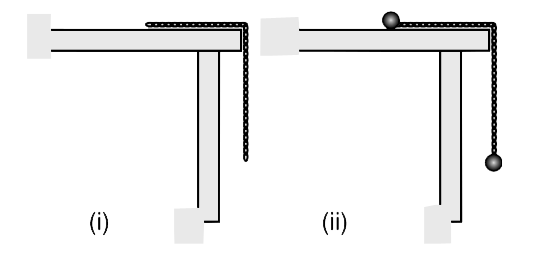
A chain is lying on a smooth table with half its length hanging over the edge of the table [fig(i)]. If the chain is released it slips off the table in time t1. Now, two identical small balls are attached to the two ends of the chain and the system is released [fig(ii)]. This time the chain took `t_(2)` time to slip off the table. Which time is larger, `t_(1)` or `t_(2)`?

Promotional Banner

Similar Questions

Explore conceptually related problems

A chain is lying on a rough table with a fraction 1/n of its length hanging down from the edge of the table. if it is just on the point of sliding down from the table, then the coefficient of friction between the table and the chain is -

A chain is lying on a rough table with a fraction 1/n of its length hanging down from the edge of the table. if it is just on the point of sliding down from the table, then the coefficient of friction between the table and the chain is -

A uniform chain of mass m and length l is lying on a horizontal table with one-third of its length hanging over the edge of the table. What is the speed of the chain, when it just loses contact with the table?

A uniform chain of mass m and length l is lying on a horizontal table with one-third of its length hanging over the edge of the table. What is the speed of the chain, when it just loses contact with the table?

A chain of mass M is placed on a smooth table with 1/n of its length L hanging over the edge. The work done in pulling the hanging portion of the chain back to the surface of the table is:

A chain of length L and mass M is held on a frictionless table with (1//n)th of its length hanging over the edge. When the chain is released, find the velocity of chain while leaving the table.

A chain of length L and mass M is held on a frictionless table with (1//n)th of its length hanging over the edge. When the chain is released, find the velocity of chain while leaving the table.

A uniform chain of length l is placed on rough table with length l//n (where n gt 1 ) , hanging over the edge. If the chain just begins to slide off the table by itself from this position, the coefficient of friction between the chain and the table is

A uniform chain of length l is placed on rough table with length l//n (where n gt 1 ) , hanging over the edge. If the chain just begins to slide off the table by itself from this position, the coefficient of friction between the chain and the table is