

Home
Class 11
PHYSICS
Two masses A and B of mass 15kg and 6kg ...

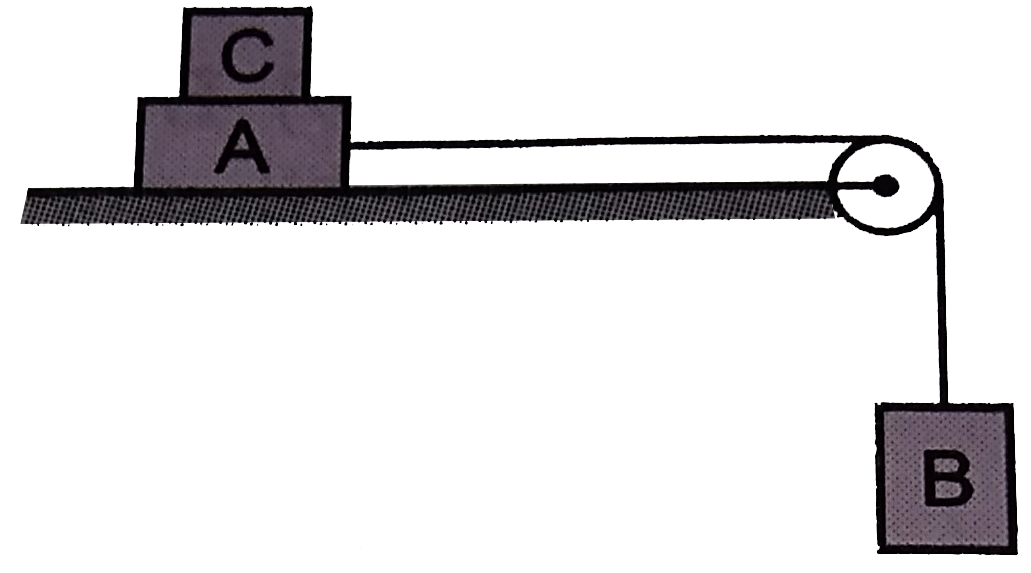
Two masses `A` and `B` of mass `15kg` and `6kg` are connected by a string passing over a friction pulley fixed at the corner of a table as shown in The coefficient of friction between `A` and table is `0.3` the minimum mass (in kg) of that must be placed on `A` to prevent it from moving is
.

Promotional Banner

Similar Questions

Explore conceptually related problems

Two mass A and B of 5 kg and 6 kg are connected by a string passing over a frictionless pulley fixed at the corner of table as shown in figure-2.179. The coefficient of friction between A and the table is 0.3. The minimum mass of C that must be placed on A to prevent it from moving is equal to : (Take g=10ms^(2) )

Two masses A and B of 15 kg and 10 kg are connected with a string passing over a frictionless pulley fixed at the corner of a table (as shown in figure). The coefficient of friction between the table and block is 0.4. The minimum mass of C, that may be placed on A to prevent it from moving is:

Two masses A and B of 15 kg and 10 kg are connected with a string passing over a frictionless pulley fixed at the corner of a table (as shown in figure). The coefficient of friction between the table and block is 0.4. The minimum mass of C, that may be placed on A to prevent it from moving is:

Two masses A and B of 10 kg and 5 kg , respectively , are connected with a string passing over a frictionless pulley fixed at the corner of a table as shown. The coefficient of static friction between A and the table is 0.2 . The minimum mass C that should be placed on A to prevent it from moving is equal to

Two masses A and B of 10 kg and 5 kg , respectively , are connected with a string passing over a frictionless pulley fixed at the corner of a table as shown. The coefficient of static friction between A and the table is 0.2 . The minimum mass C that should be placed on A to prevent it from moving is equal to

Two masses A and B of 10 kg and 5 kg , respectively , are connected with a string passing over a frictionless pulley fixed at the corner of a table as shown. The coefficient of static friction between A and the table is 0.2 . The minimum mass C that should be placed on A to prevent it from moving is equal to

Two masses A and B of 10 kg and 5 kg respectively are connected with a string passing over a frictionless pulley fixed at the corner of a table as shown in Fig. 15.4.1. The co-efficient of friction of A with the table is 0.2 The minimum mass of C that may by placed on A to prevent it from moving is equal to