

Home
Class 12
PHYSICS
A block A of mass m is give a velocity v...


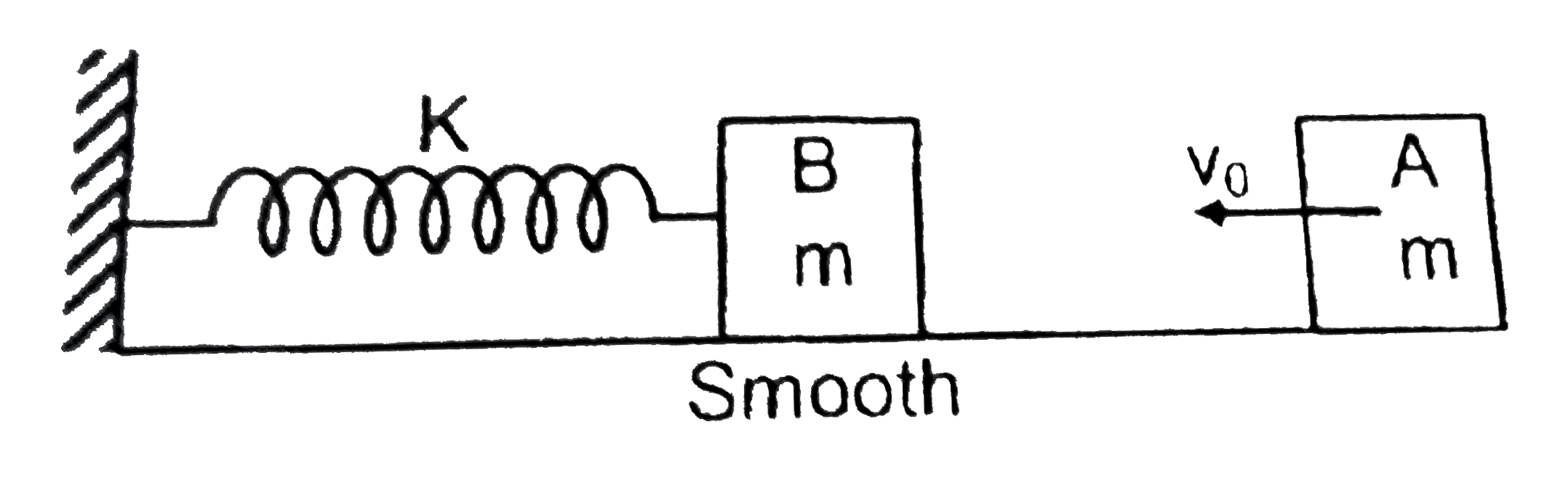
A block `A` of mass `m` is give a velocity `v_(0)` towards another block `B` of sae mass `B`. Is attached to an ideal spring of spring constant `K`. `A` makes a head on perfectly inelastic collision with `B`.
Answer the following two questions:
Q. Let the collision takes place at time `t=0` choose the instant (s), when the spring is in its natural length.

Promotional Banner

Similar Questions

Explore conceptually related problems

A block A of mass m is give a velocity v_(0) towards another block B of sae mass B . Is attached to an ideal spring of spring constant K . A makes a head on perfectly inelastic collision with B . Answer the following two questions: Q. Choose the correct option (s)

Block C of mass M is moving with velocity V_(0) and collides elastically with block A of mass M and connected to another block B of mass 2M through a spring of spring constant K. What is K if X_(0) is the compression of spring when velocity of A and B is same

A block C of mass m is moving with velocity v_(0) and collides elastically with block A of mass m and connected to another block B of mass 2m through spring constant k. What is k if x_(0) is compression of spring when velocity of A and B is same?

A block C of mass m is moving with velocity v_(0) and collides elastically with block A of mass m and connected to another block B of mass 2m through spring constant k. What is k if x_(0) is compression of spring when velocity of A and B is same?

Block of mass 2 m is given v_(0) towards the right. If L is the natural length of spring constant k , find the maximum elongation of the spring.

A block of mass 'm' is attached to a spring in natural length of spring constant 'k' . The other end A of the spring is moved with a constat velocity v away from the block . Find the maximum extension in the spring.

A block of mass m is moving with an initial velocity v_0 towards a stationary spring of stiffness k attached to the wall as shown in figure a. Find the maximum compression in the spring. b. Is the work done by the spring negative or positive?

A block of mass m is moving with an initial velocity v_0 towards a stationary spring of stiffness k attached to the wall as shown in figure a. Find the maximum compression in the spring. b. Is the work done by the spring negative or positive?

Two blocks A and B of mass m and 2m respectively are connected by a light spring of force constant k. They are placed on a smooth horizontal surface. Spring is stretched by a length x and then released. Find the relative velocity of the blocks when the spring comes to its natural length

Two blocks A and B of mass m and 2m respectively are connected by a light spring of force constant k. They are placed on a smooth horizontal surface. Spring is stretched by a length x and then released. Find the relative velocity of the blocks when the spring comes to its natural length