

Home
Class 11
PHYSICS
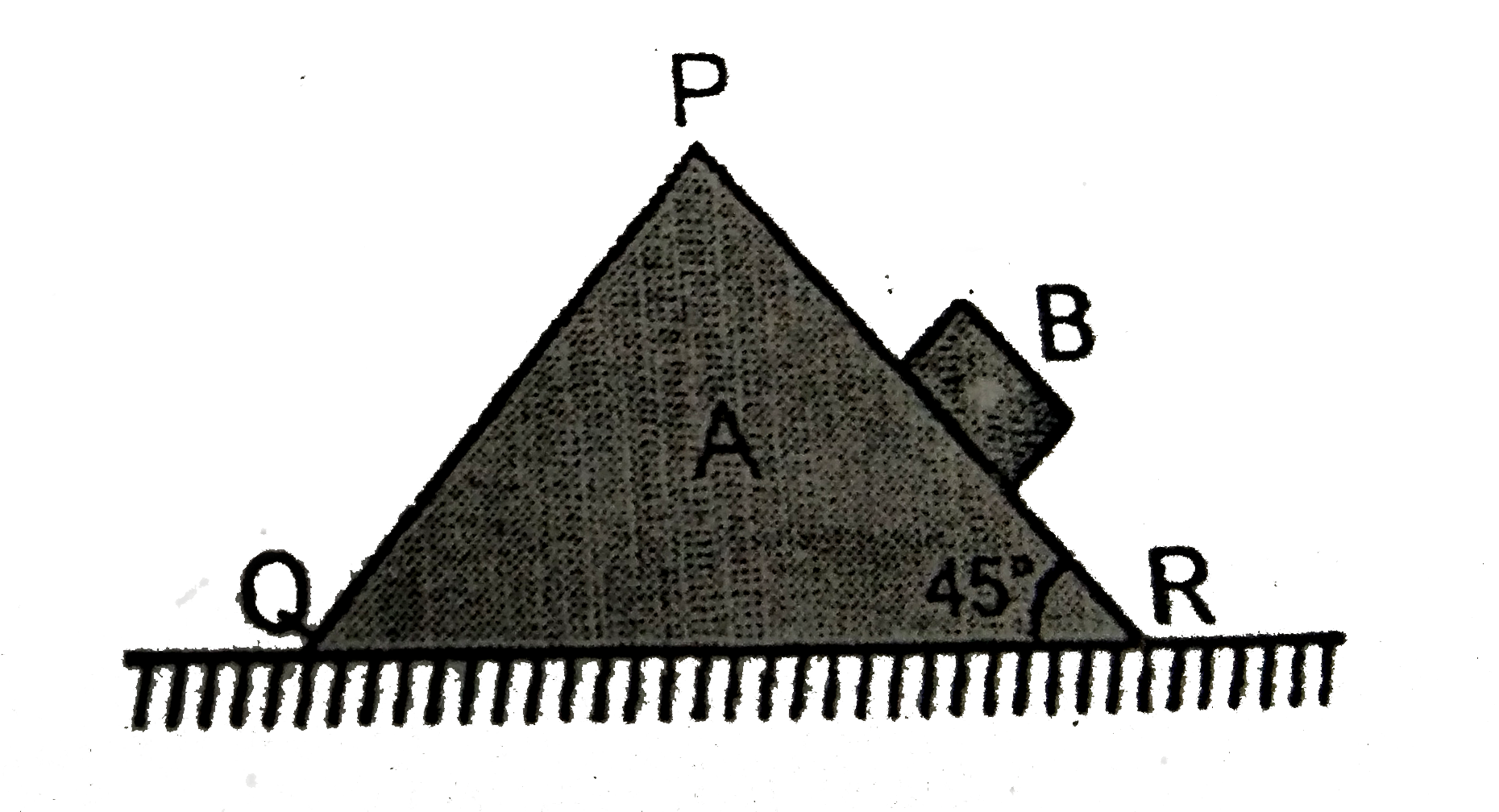
A block B of mass 0.6kg slides down the ...

A block `B` of mass `0.6kg` slides down the smooth face `PR` of a wedge `A` of mass `1.7kg` which can move freely on a smooth horizontal surface.
The inclination of the face `PR` to the horizontal is `45^(@)` . Then `:`

Promotional Banner

Similar Questions

Explore conceptually related problems

A block of mass m rests on a stationary wedge of mass M. The wedge can slide freely on a smooth horizontal surface as shown in figure. If the block starts from rest

A block of mass m rests on a stationary wedge of mass M. The wedge can slide freely on a smooth horizontal surface as shown in figure. If the block starts from rest

A block of mass 2kg slides down the face of a smooth 45^@ wedge of mass 9 kg as shown in the figure. The wedge is placed on a frictionless horizontal surface. Determine the acceleration of the wedge.

A block of mass 2kg slides down the face of a smooth 45^@ wedge of mass 9 kg as shown in the figure. The wedge is placed on a frictionless horizontal surface. Determine the acceleration of the wedge.

A block of mass m is placed at rest on a smooth wedge of mass M placed at rest on a smooth horizontal surface. As the system is released

A block of mass m is placed at rest on a smooth wedge of mass M placed at rest on a smooth horizontal surface. As the system is released

A small block of mass m is placed at rest on the top of a smooth wedge of mass M, which in turn is placed at rest on a smooth horizontal surface as shown in figure. If h be the height of wedge and theta is the inclination, then the distance moved by the wedge as the block reaches the foot of the wedge is

A small block of mass m is placed at rest on the top of a smooth wedge of mass M, which in turn is placed at rest on a smooth horizontal surface as shown in figure. It h be the height of wedge and theta is the inclination, then the distacne moved by the wedge as the block reaches the foot of the wedge is

A horizontal force F pushes wedge of mass M on a smooth horizontal surface. A block of mass m is stationary to the wedge, then: