Home
Class 12
CHEMISTRY
Explain depression in freezing point. Sh...

Explain depression in freezing point. Show that it is a colligative property.

Text Solution

Verified by Experts
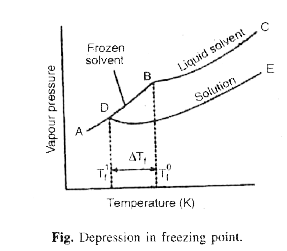
Depression in freezing point. The freezing point is the temperature at which the solid and liquid states of the substances have the same vapour pressure.
Since the addition of a non-volatile solute to the pure solvent lowers its vapour pressure, so the freezing point of a solution is expected to be less than that of the pure solvent. This is known as depression in freezing point. This has been represented graphically in Fig. The curves BC and DE represent the vapour pressure of the pure solvent and the solution respectively. The curve AB represents the vapour pressure of the solvent at different temperatures. At point B, the liquid solvent and the solid solvent meet, hence it corresponds to the freezing point of the pure liquid `(Delta T_(f)^(@))`. Since the vapour pressure of a solution is always less than that of the pure solvent, the vapour pressure curve for the solution runs parallel

but below the pure solvent curve. The vapour pressure curve for the solution meets the solid solvent curve at D which corresponds to the freezing point of the solution `T_f`. It is evident that `T_f` is less than `T_(f)^(@)` , indicating that there is depression in the freezing point of a solvent. Therefore, depression in freezing point,
`Delta T_f = T_(f)^(0)-T_(f).`
It has been experimentally found that depression in freezing point of a solution is proportional to the concentration of solute, i.e.
`Delta t_f prop m `
`or delta T_f = K_f m`
where `K_f` is the molal depression constant. It is also called molal cryoscopic constant.
Promotional Banner

Topper's Solved these Questions

  • SOLUTIONS

    MBD -HARYANA BOARD|Exercise SATQ (SHORT ANSWERS TYPE QUESTIONS )|16 Videos
  • SOLID STATE

    MBD -HARYANA BOARD|Exercise LONG ANSWER TYPE QUESTIONS|10 Videos
  • SURFACE CHEMISTRY

    MBD -HARYANA BOARD|Exercise LONG ANSWER TYPE QUESTIONS|4 Videos

Similar Questions

Explore conceptually related problems

Colligative properties

Depression Of Freezing Point

Colligative Properties

Colligative Properties

(i) Prove that depression in freezing point is a colligative property. (ii) 45 g of ethylene glycol (C_(2)H_(6)O_(2)) is mixed with 600g of water . Calculate the freezing point depression. ( K_(f) for water = 1.86 k kg mol^(-1) )

Depression in freezing point or cryoscopy

Miximum depression in freezing point is caused by

Assertion : Depression of freezing point is a colligative property Reason : The depression of freezing point for a solution is directly proportional to the molality of the solution.

MBD -HARYANA BOARD-SOLUTIONS-LATQ ( LONG ANSWER TYPE QUESTIONS )
  1. What are ideal and non-ideal solutions ? What types of non-idealities ...

    Text Solution

    |

  2. Show graphically that the freezing point of a liquid will be depressed...

    Text Solution

    |

  3. Explain depression in freezing point. Show that it is a colligative pr...

    Text Solution

    |

  4. Define the following: (i) Boiling point (ii) Molal, depression con...

    Text Solution

    |

  5. Define osmosis and osmotic pressure and show that osmotic pressure is ...

    Text Solution

    |

  6. Why do we get sometimes abnormal molecular masses of the substances by...

    Text Solution

    |

  7. State Raoult's law. Why is the vapour pressure of a solvent lowered by...

    Text Solution

    |

  8. Commercially available conc. HCl contains 38% HCl by mass and has a de...

    Text Solution

    |

  9. Define boiling point and find out expression for the molecular mass of...

    Text Solution

    |

  10. What is meant by positive and negative deviation from Raoult's law and...

    Text Solution

    |

  11. Give any four characteristics of a non-ideal solution showing positive...

    Text Solution

    |

  12. What are important characteristics of a non-ideal solution showing neg...

    Text Solution

    |

  13. At 298 K, 100 ml solution containing 3.002 g of solute gave an osmotic...

    Text Solution

    |

  14. Why is osmotic pressure technique preferred over other methods to find...

    Text Solution

    |

  15. Boiling point of water at 750 mm is 99.63^@ C. How much of sucrose is ...

    Text Solution

    |

  16. The boiling point of water (100^@ C) becomes, 100.52^@ C if 3 g of non...

    Text Solution

    |

  17. 27.75 g of CaCl2, dissolved in 250 ml of solutions. Find molarity of c...

    Text Solution

    |

  18. State Raoult's law for solutions containing non-volatile solutes in vo...

    Text Solution

    |

  19. Derive Raoult's law for non-volatile solutes.

    Text Solution

    |

  20. Mention three characteristics of ideal solutions. What cause deviation...

    Text Solution

    |

