Home
Class 12
CHEMISTRY
Why do we get sometimes abnormal molecul...

Why do we get sometimes abnormal molecular masses of the substances by using colligative properties of the solutions ? State the factors with suitable examples which bring abnormally in results thus obtained.

Text Solution

Verified by Experts
Abnormal molecular masses. The molecular masses of certain substances as determined experimentally by osmotic pressure, elevation in boiling points, depression in freezing points or relative lowering in vapour pressure are different from those calculated theoretically from their chemical formulae. In some cases, the determined molecular masses are high while in other they are less as compared to their normal values. This may be due to the association or the dissociation of the solute molecules in the solution. Therefore, the number of the molecules undergo a change. As the colligative properties depend only upon the number of the particles, they are expected to show certain deviations. These two changes are being discussed below:
1. Association of solute particles. There are certain substances whose molecules undergo association when dissolved in a solvent i.e., two, three or even more molecules exist in combination with each other to form bigger molecules. For example, suppose n simple molecules combine to form an associated molecule as :
` nA = A_n `
n single molecules Associated molecule
Therefore, the total number of molecules in solution become less than the number of molecules of the substances added and, therefore, colligative properties are inversely proportional to the molecular mass of the solute, the molecular masses in such cases will be greater than the theoretical values. For example, in benzene solvent, benzoic acid exists as dimer as:
`2C_6 H_5 COOH = (C_6 H_5 COOH)_2`
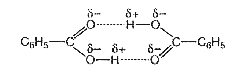
The molecular mass has been found to be nearly 244 which is about double than normal values is 122. The association of solute molecules in a solution is generally due to the hydrogen bonding between these molecules as shown below:

2. Dissociation of solute molecules. There are certain substances which dissociate in a solvent to give two or more particles. For example, KCl dissociates to give `K^+ and Cl^-` ions.
Consequently, the total number of particles increases in solution and therefore, the colligative properties of such solution will be large. Since colligative properties are inversely proportional to molecular mass, the observed molecular mass will be less than the theoretical value. The normal or theoretical molecular mass of KCI is 74.5. However, the depression in freezing point method has given the molecular mass of KCl as 40.5. Consequently, there is difference in the values of the molecular masses.
Promotional Banner

Topper's Solved these Questions

  • SOLUTIONS

    MBD -HARYANA BOARD|Exercise SATQ (SHORT ANSWERS TYPE QUESTIONS )|16 Videos
  • SOLID STATE

    MBD -HARYANA BOARD|Exercise LONG ANSWER TYPE QUESTIONS|10 Videos
  • SURFACE CHEMISTRY

    MBD -HARYANA BOARD|Exercise LONG ANSWER TYPE QUESTIONS|4 Videos

Similar Questions

Explore conceptually related problems

The molecular mass of sodium chloride obtained by using a colligative property is

Explain giving examples the term 'colligative molality'. Why do we sometimes get abnormal molecular masses of the substances using colligative properties of the solution? The freezing point depression of 0.1 molal solution of benzoic acid in benzene is 0.526K . For benzene K_(f) is 5.12K kg "mol"^(-1) . Calculate the value of van't Hoff factor for benzoic acid in benzene. What conclusion can you draw about the molecular state of benzoic acid in benzene?

How muCHM molecular mass of NaCl is obtained experimentally using colligative properties ?

Why is the molecular mass determined by measuring colligative property in case of some solutes is abnormal ?

Which of the following colligative properties of colloidal solutions is used to determine the molecular mass?

Why is the mass determined by measuring a colligative property in case of some solutes abnormal? Discuss it with the help of van't Hoff factor.

In the determination of molar mass of A^(+)B(-) using colligative property, what will be the Van't Hoff factor if the solute is 40% dissociated ?

MBD -HARYANA BOARD-SOLUTIONS-LATQ ( LONG ANSWER TYPE QUESTIONS )
  1. Define the following: (i) Boiling point (ii) Molal, depression con...

    Text Solution

    |

  2. Define osmosis and osmotic pressure and show that osmotic pressure is ...

    Text Solution

    |

  3. Why do we get sometimes abnormal molecular masses of the substances by...

    Text Solution

    |

  4. State Raoult's law. Why is the vapour pressure of a solvent lowered by...

    Text Solution

    |

  5. Commercially available conc. HCl contains 38% HCl by mass and has a de...

    Text Solution

    |

  6. Define boiling point and find out expression for the molecular mass of...

    Text Solution

    |

  7. What is meant by positive and negative deviation from Raoult's law and...

    Text Solution

    |

  8. Give any four characteristics of a non-ideal solution showing positive...

    Text Solution

    |

  9. What are important characteristics of a non-ideal solution showing neg...

    Text Solution

    |

  10. At 298 K, 100 ml solution containing 3.002 g of solute gave an osmotic...

    Text Solution

    |

  11. Why is osmotic pressure technique preferred over other methods to find...

    Text Solution

    |

  12. Boiling point of water at 750 mm is 99.63^@ C. How much of sucrose is ...

    Text Solution

    |

  13. The boiling point of water (100^@ C) becomes, 100.52^@ C if 3 g of non...

    Text Solution

    |

  14. 27.75 g of CaCl2, dissolved in 250 ml of solutions. Find molarity of c...

    Text Solution

    |

  15. State Raoult's law for solutions containing non-volatile solutes in vo...

    Text Solution

    |

  16. Derive Raoult's law for non-volatile solutes.

    Text Solution

    |

  17. Mention three characteristics of ideal solutions. What cause deviation...

    Text Solution

    |

  18. What are ideal and non-ideal solutions ? Explain non-ideal solution sh...

    Text Solution

    |

  19. (a) Define Ideal and Non-ideal solutions and give one example of each....

    Text Solution

    |

  20. Calculate the mole fraction of CH3 OH in a solution containing 30% by ...

    Text Solution

    |

