Home
Class 12
CHEMISTRY
Discuss the electrochemical theory of ru...

Discuss the electrochemical theory of rusting.

Text Solution

Verified by Experts
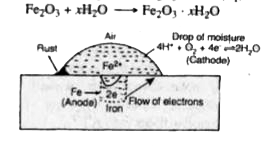
The rusting of iron can be explained on the basis of electrochemical theory which involves oxidation and reduction reaction. According to this theory, it is believed that non-uniform surface of metal or impurities present in iron behaves like small electric cells (called corrosion couples) in the presence of water containing dissolved oxygen or carbon dioxide. A film of moisture with dissolved `CO_(2)` acts as electrolytic solution covering the metal surface at various places.
In these small electrolytic cells, pure ion acts as anode while cathodes are impure portions. The overall rusting involves the following steps :
Oxidation occurs at the anodes of each electrochemical cell. Therefore, at each anode iron is oxidised to `Fe^(2+)` ions.
At anode
`Fe(s)toFe^(2+)(aq)+2e^(-)" "......(i)`
hus, the metal atoms in the lattice pass into the solution as ions, leaving electrons on the metal itself. These electrons move towards the cathode region through the metal.
At the cathode of each cell, the electrons are taken up by hydrogen ions (reduction takes place). The `H^(+)` ions are obtained either from water or from acidic substances in water :
`H_(2)OhArrH^(+)+OH^(-)" "......(ii)`
or `CO_(2)+H_(2)OtoH^(+)HCO_(3)^(-)" "......(iii)`
At cathode :
`H^(+)+e^(-)toH" "......(iv)`
The hydrogen atoms on the iron surface reduce dissolved oxygen.
`4H+O_(2)to2H_(2)O" "......(v)`
Therefore, the overall reaction at cathode of different electrochemical cells may be written as
`4H^(+)(aq)+O_(2)(g)+4e^(-)to2H_(2)O(l)" "......(vi)`
The overall redox reaction may be written by multiplying reaction at anode, Eq. (i) by 2 and adding reaction at cathode Eq. (iv) to equalise number of electrons lost and gained, i.e.,
Oxidation half reaction
`Fe(s)toFe^(2+)(aq)+2e]xx2`
Reduction half reaction
`4H^(+)(aq)+O_(2)(g)+4e^(-)to2H_(2)O(l)`
Overall cell reaction
`2Fe^(2+)+4H^(+)(aq)+O_(2)(g)to2Fe^(2+)(aq)+2H_(2)O(l)`
The ferrous ions are oxidized further by atmospheric oxygen to `Fe^(2+)` (as `Fe_(2)O_(3)` and form rust
`4Fe^(2+)+O_(2)(g)+4H_(2)Oto2Fe_(2)O_(3)+8H^(+)` and `underset("Rust")(Fe_(2)O_(3)+xH_(2)O)to2Fe_(2)O_(3).xH_(2)O`
The `H^(+)` ions produced above are also used for reaction (iv).
`4Fe^(2+)+O_(2)+4H_(2)Oto2Fe_(2)O_(3)+8H^(+)(aq)`
`Fe_(2)O_(3)+xH_(2)OtoFe_(2)O_(3).xH_(2)O`
Promotional Banner

Topper's Solved these Questions

  • ELECTROCHEMISTRY

    MBD -HARYANA BOARD|Exercise SHORT ANSWER TYPE QUESTIONS|37 Videos
  • CHEMISTRY IN EVERYDAY LIFE

    MBD -HARYANA BOARD|Exercise Long answer type questions|5 Videos
  • GENERAL PRINCIPLES AND PROCESSES OF ISOLATION OF ELEMENTS

    MBD -HARYANA BOARD|Exercise LONG ANSWER TYPE QUESTIONS|3 Videos

Similar Questions

Explore conceptually related problems

Electrochemical Series

Electrochemical Series

Electrochemical Series

Electrochemical Cells

On the basis of electrochemical theory of aqueous corrosion, the reaction occurring at the cathode is

