

Home
Class 12
PHYSICS
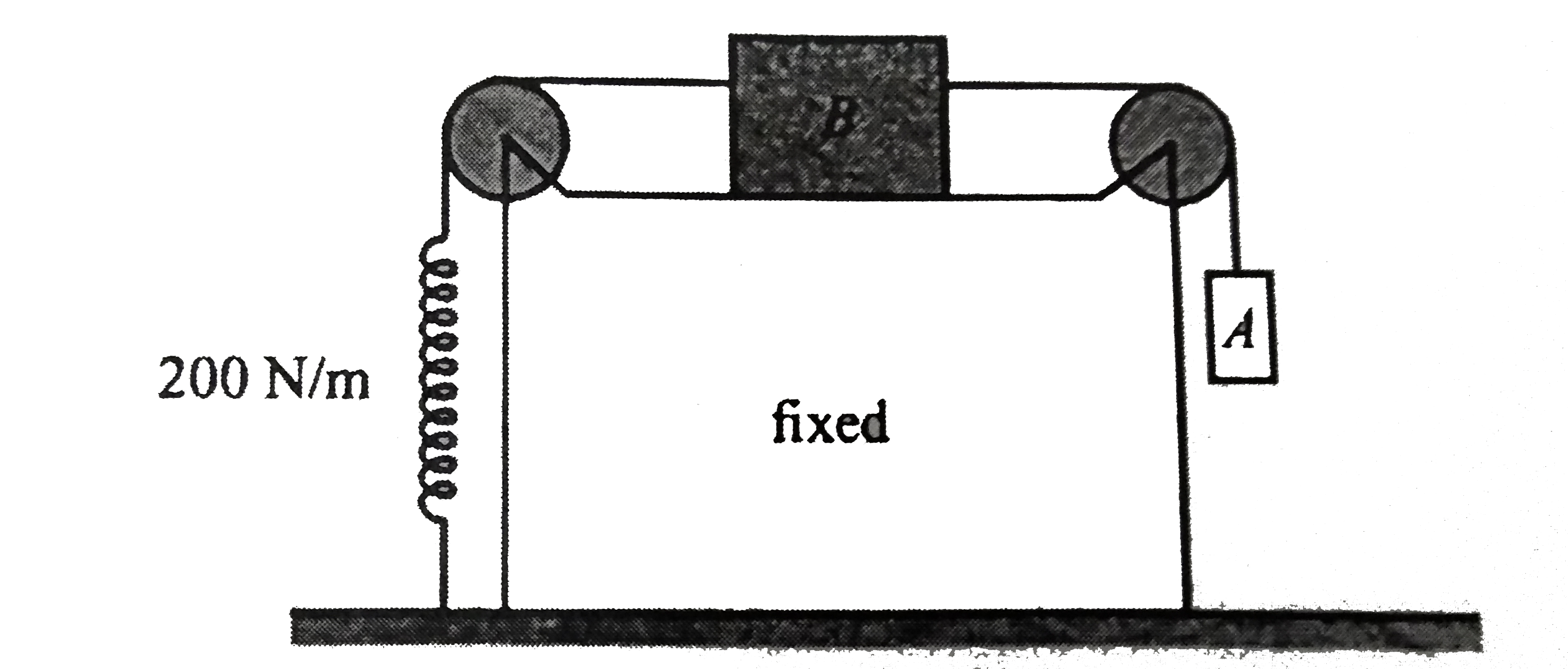
The figure shown blocks A and B are mass...

The figure shown blocks A and B are mass 2 kg and 8 kg and they are connected through strings to a spring connected to ground. The blocks are in equilbrium. `(g=10m//s^(2))`

The elongation of the spring is

Promotional Banner

Similar Questions

Explore conceptually related problems

The figure shown blocks A and B are mass 2 kg and 8 kg and they are connected through strings to a spring connected to ground. The blocks are in equilbrium. (g=10m//s^(2)) Now the block A is pulled downwards by a force gradually increasing to 20 N. The new elongation of spring is ,-

The figure shown blocks A and B are mass 2 kg and 8 kg and they are connected through strings to a spring connected to ground. The blocks are in equilbrium. (g=10m//s^(2)) Now the block A is pulled downwards by a force gradually increasing to 20 N. The new elongation of spring is ,-

The figure shown blocks A and B are mass 2 kg and 8 kg and they are connected through strings to a spring connected to ground. The blocks are in equilbrium. (g=10m//s^(2)) Now the block A is pulled downwards by a force gradually increasing to 20 N. The new elongation of spring is ,-

The figure shown blocks A and B are mass 2 kg and 8 kg and they are connected through strings to a spring connected to ground. The blocks are in equilbrium. (g=10m//s^(2)) Now the force on A is suddenly removed. The acceleration of block B becomes :-

Two Block A and B of masses 10 kg and 6 kg respectively are connected through pulley as shown in figure. Find acceleration of block A.

Two blocks of masses of 40 kg and 30 kg are connected by a weightless string passing over a frictionless pulley as shown in the figure.

Two blocks A and B of mass 10 kg and 40 kg are connected by an ideal string as shown in the figure. Neglect the masses of the pulleys and effect of friction. (g = 10 m/s2) А B 45° Fixed 45°

Two blocks A and B of mass 10 kg and 40 kg are connected by an ideal string as shown in the figure. Neglect the masses of the pulleys and effect of friction. (g = 10 m/s2) A B 45° Fixed 45°

Two rectangular blocks A and B of masses 2 kg and 3 gk respectively are connected by a spring of spring constant 10.8Nm^(-1) and are placed on a frictionless horizontal surface. The block A was given an initial velocity of 0.15 ms^(-1) in the direction shown in the figure. The maximum compression of the spring during the motion is