Home
Class 12
MATHS
If a in R and the equation -3(x-[x])^2+2...

If `a in R` and the equation `-3(x-[x])^2+2(x-[x])+a^2=0` (where [x] denotes the greatest integer `le x`) has no integral solution, then all possible values of a lie in the interval: (1) (-2,-1) (2) `(oo,-2) uu (2,oo)` (3) `(-1,0) uu (0,1)` (4) (1,2)

A

`(-1,0) cup (0,1)`

B

`(1,2)`

C

`(-2,-1)`

D

`(-oo,-2)cup (2,oo)`

Text Solution

Verified by Experts

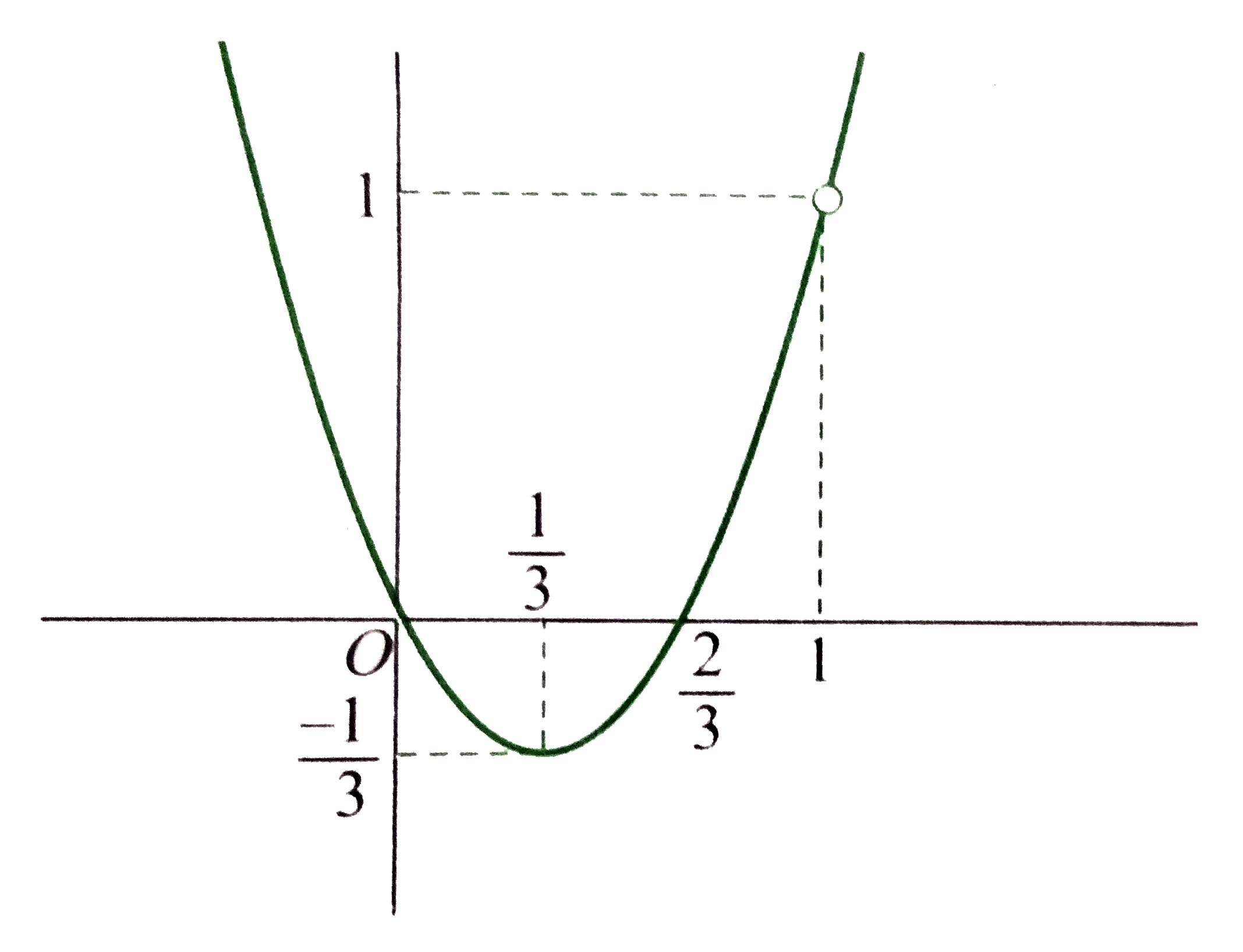
`a^(2)=3t^(2)-2t, " where " t={x} in [0,1)`
` :. a^(2) =3t(t-2//3)`
Graph of `f(t)=3t(t-2//3)` is as shown in the following figure.

Clearly, from graph
`0 lt a^(2) lt 1`
`or a in (-1,0) cup (0,1) `
Promotional Banner

Similar Questions

Explore conceptually related problems

If ainR and the equation -3(x-[x])^(2)+2(x-[x])+a^(2)=0 , (where [x] denotes the greatest integer le x) has no integral solution, then all possible values of a lie in the interval :

If ain RR and the equation -3(x-[x])^2+2(x-[x])+a^2=0 (where [x] denotes the greatest integer lex) has no integral solution, then all possible values of a lie in the interval____

If a in R and the equation -3(x-[x])^2+""2""(x-[x])""+a^2=""0 (where [x] denotes the greatest integer x) has no integral solution, then all possible values of a lie in the interval (1) (-1,""0)uu(0,""1) (2) (1, 2) (3) (-2,-1) (4) (-oo,-2)uu(2,oo)

If a in R and the equation -3(x-[x])^2+""2""(x-[x])""+a^2=""0 (where [x] denotes the greatest integer x) has no integral solution, then all possible values of a lie in the interval (1) (-1,""0)uu(0,""1) (2) (1, 2) (3) (-2,-1) (4) (-oo,-2)uu(2,oo)

If a in R and the equation (a-2) (x-[x])^(2) + 2(x-[x]) + a^(2) = 0 (where [x] denotes the greatest integer function) has no integral solution and has exactly one solution in (2, 3), then a lies in the interval

If a in R and the equation (a-2) (x-[x])^(2) + 2(x-[x]) + a^(2) = 0 (where [x] denotes the greatest integer function) has no integral solution and has exactly one solution in (2, 3), then a lies in the interval