

Home
Class 12
PHYSICS
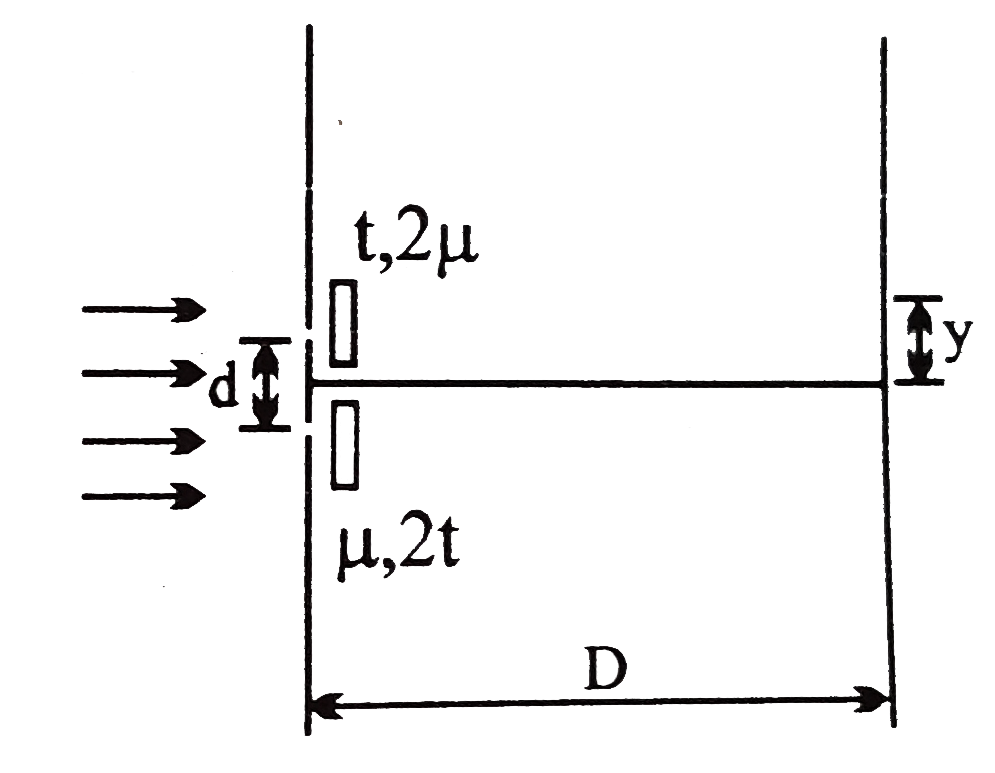
In the YDSE shown the two slits are cove...

In the `YDSE` shown the two slits are covered with thin sheets having thickness `t`&`2t` and refractive index `2mu`and `mu` .Find the position (y) of central maxima.

Promotional Banner

Similar Questions

Explore conceptually related problems

In the YDSE shown below, two slits are covered with thin sheets having a thickness t and 2t and refractive indices 2mu and mu respectively. The position of central maxima is shifted by a distance of N (in cm) from the central position of the screen. Find the value of N. [d=1 mm, D = 1 m, t = 2xx10^(-2)mm,mu=(3)/(2)]

In the YDSE shown below, two slits are covered with thin sheets having a thickness t and 2t and refractive indices 2mu and mu respectively. The position of central maxima is shifted by a distance of N (in cm) from the central position of the screen. Find the value of N. [d=1 mm, D = 1 m, t = 2xx10^(-2)mm,mu=(3)/(2)]

In a double slit experiment a parallel beam of light strikes the slit plane at an angle theta as shown in the figure. The two slits are covered with transparent plastic sheets of equal thickness t but of different refractive indices 1.2 and 1.5. The central maxima is formed at the centre of the screen at C. (a) Which sheet was used to cover the slit S1? (b) Find theta .

In a Young's double slit experiment let A and B be the two slits. A thin plate of thickness t and refractive index mu is placed in front of A. Let beta be the fringe width. The central maximum will shift

There is a Young's double-slit experiment set-up completely dipped in water. Assume that the refractive index of water is mu_1 . One of the slits is covered with a thin film of thickness t and refractive index mu_2 . What will be the optical path difference at the centre of screen ?

A Young's double slit apparatus is immersed in a liquid of refractive index mu_(1). The slit plame touches the liquid surface. A parallel beam of monochromatic light of wavelength lambda (in air) is incident normally on the slits. a. Find the fringe width. b. If one of the slits (say S_(2) ) is covered by a transparent slab of refrative index mu_(2) and thickless t as shown, find the new position of central maxima. c. Now, the other slit, S_(1) is also covered by a slab of same thickness and refractive index mu_(3) as shown in Fig. 2.49 due to which the central maxima recovers it positon, find the value of mu_(3) Find the ratio of intensities at O in the three conditions (a), (b), and (c).

A Young's double slit apparatus is immersed in a liquid of refractive index mu_(1). The slit plame touches the liquid surface. A parallel beam of monochromatic light of wavelength lambda (in air) is incident normally on the slits. a. Find the fringe width. b. If one of the slits (say S_(2) ) is covered by a transparent slab of refrative index mu_(2) and thickless t as shown, find the new position of central maxima. c. Now, the other slit, S_(1) is also covered by a slab of same thickness and refractive index mu_(3) as shown in Fig. 2.49 due to which the central maxima recovers it positon, find the value of mu_(3) Find the ratio of intensities at O in the three conditions (a), (b), and (c).

The figure shows a Young's double slit experimental setup. It is observed that when a thin transparent sheet of thickness t and refractive index mu is put front of one of the slits, the central maximum gets shifted by a distance equal to n fringe widths. If the wavelength of light used is lambda , t will be :

In Young's double-slit experiment, let A and B be the two slit. A thin film of thickness t and refractive index mu is placed in front of A. Let beta = fringe width. Then the central maxima will shift

In Young's double-slit experiment, let A and B be the two slit. A thin film of thickness t and refractive index mu is placed in front of A. Let beta = fringe width. Then the central maxima will shift