

Home
Class 11
PHYSICS
A particle is constrained to move along ...

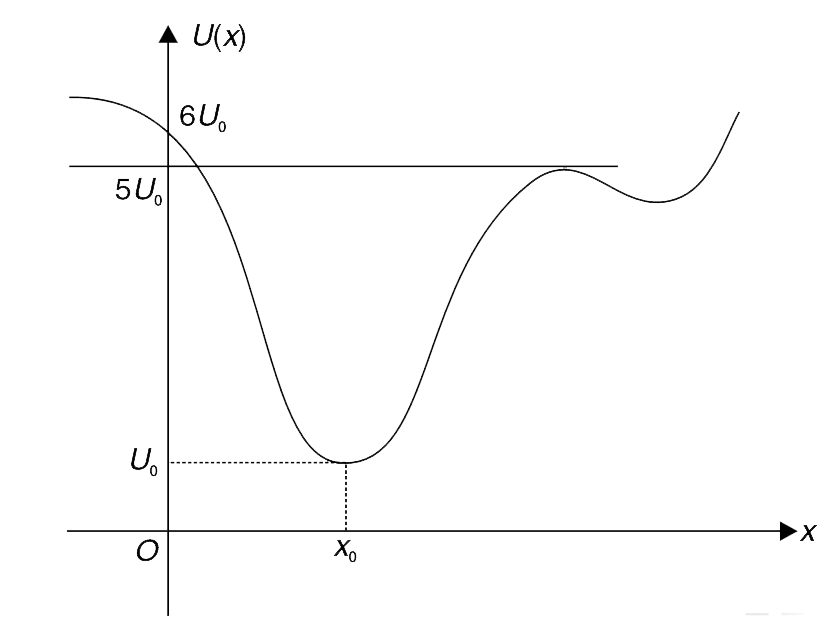
A particle is constrained to move along x axis under the action of a conservative force. The potential energy of the particle varies with position x as shown in the figure. When the particle is at x = x0, it is given a kinetic energy (k) such that 0 lt k lt 4U0 (a) Does the particle ever reach the origin? (b) Qualitatively describe the motion of the particle

Promotional Banner

Similar Questions

Explore conceptually related problems

A particle is acted upon by a force F which varies with position x is shown in figure .If the particle at x = 0 kinetic energy of 25J then the kinetic energy of the particle at x = 16 m is

A particle is acted upon by a force F which varies with position x is shown in figure .If the particle at x = 0 kinetic energy of 25J then the kinetic energy of the particle at x = 16 m is

The kinetic energy K of a particle moving along x - axis varies with its position (x) as shown in figure The magnitude of force acting on particle at x = 9 mis

The kinetic energy K of a particle moving along x - axis varies with its position (x) as shown in figure The magnitude of force acting on particle at x = 9 mis

The kinetic energy K of a particle moving along x - axis varies its position (x) as shown in figure. The magnitude of force acting on particle at x = 9m is

A particle can move along x axis under influence of a conservative force. The potential energy of the particle is given by U = 5x^2 – 20x + 2 joule where x is co-ordinate of the particle expressed in meter. The particle is released at x = –3 m (a) Find the maximum kinetic energy of the particle during subsequent motion. (b) Find the maximum x co-ordinate of the particle.

For a particle moving under the action of a variable force, kinetic energy (k) varsus position (x) graph is given, then