

Home
Class 11
PHYSICS
Two uniform ropes having linear mass den...


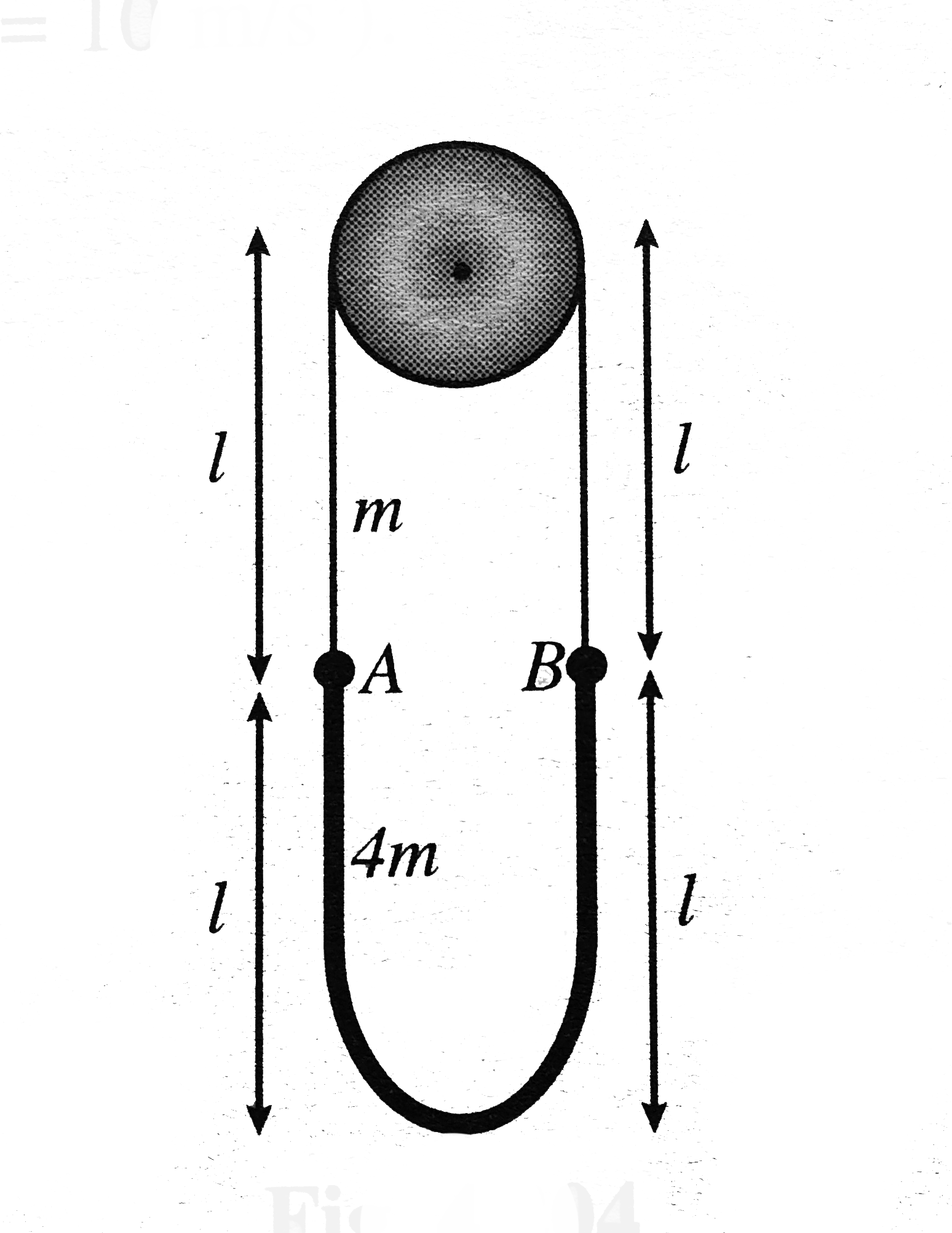
Two uniform ropes having linear mass densities `m` and `4m` are joined to form a closed loop. The loop is hanging over a fixed frictionless small pulley with the lighter rope above as shown in the fig. (in the figure equilibrium position is shown). Now if point `A` (joint) is slightly displaced in downward direction and released, it is found that the loop performs SHM with the period of oscillation equal to `N`. Find the value of `N` (take `l=(150m)/(4pi^2)`,`g=10(m)/(s^2)`).

Promotional Banner

Similar Questions

Explore conceptually related problems

A charged particle of mass m having charge q remains in equilibrium at height d above a fixed charge Q . Now the charged particle is slightly displaced along the line joining the charges, show that it will executes S.H.M. and find the time period of oscillation.

Three springs of each force constant k are connected as shown figure. Point mass m is slightly displaced to compress A and released. Time period of oscillation is

A uniform plank of length l and mass m is balanced on a fixed semi-circular plate of radius R as shown in the figure. If the plank is tilted slightly from its equilibrium position, and released, prove that it will execute S.H.M find the period of its oscillation.

Two masses M and M/ 2 are joint together by means of a light inextensible string passes over a frictionless pulley as shown in figure. When bigger mass is released the small one will ascend with an acceleration of

Two masses M and M/ 2 are joint together by means of a light inextensible string passes over a frictionless pulley as shown in figure. When bigger mass is released the small one will ascend with an acceleration of

Find the period of the oscillations of the devices shown in figure if m is displaced slightly.

A fixed straight wire is near a movable square loop as shown in the figure below. In which direction is the square loop supposed to move?

Find the time period of mass M when displaced from its equilibrium position and then released for the system shown in figure. .

Find the time period of mass M when displaced from its equilibrium position and then released for the system shown in figure.