Home
Class 11
BIOLOGY
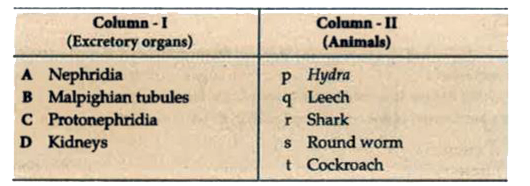
Match the excretory organs listed under ...

Match the excretory organs listed under column I with the animals given under column II. Choose the answer which gives the correct combination of alphabets of two columns.

A

`A=t,B=q,C=s,D=r`

B

`A=q,B=s,C=t,D=p`

C

`A=q,B=t,C=s,D=r`

D

`A=s,B=q,C=p,D=t`

Text Solution

Verified by Experts

The correct Answer is:

C
Promotional Banner

Topper's Solved these Questions

  • EXCRETORY PRODUCTS AND THEIR ELIMINATION

    MODERN PUBLICATION|Exercise Chapter Practice Test|12 Videos
  • EXCRETORY PRODUCTS AND THEIR ELIMINATION

    MODERN PUBLICATION|Exercise COMPETITION FILE (OBJECTIVE TYPE QUESTIONS)(D. ASSERTION TYPE QUESTIONS: )|12 Videos
  • DIGESTION AND ABSORPTION

    MODERN PUBLICATION|Exercise Chapter Practice Test|12 Videos
  • LOCOMOTION AND MOVEMENT

    MODERN PUBLICATION|Exercise OBJECTIVE TYPE QUESTIONS|2 Videos

Similar Questions

Explore conceptually related problems

Match the types of WBC listed in Column I with the shape of nucleus given under Column II. Choose the answer which gives the correct combination of alphabets of two columns.

Match the types of WBC listed in column I with the shape of nucleus given under column II . Choose the answer which gives the correct combination of alphabets of two columns . {:(,"Column I" ,, "Column II"), (,"Types of" WBC , , "Shape of Nucleas"), (a , "Neutrophils" , p , "Kidney-shaped"), (b , "Eosinophils" , q, "S- shaped"), (c , "Basophils" , r, 3-5 "lobes"), (d , "Monocytes" , s, 2 "lobes"), ( ,, t , "disc-shaped"):}

Match the names of diseases listed under Column I with the meaning given undre Column II. Choose the answer which gives the correct combination of alphabets of the two column: {:(underset(("Names of disease"))"Column-I",underset(("Meaning"))"Column-II"),(A" Jaundice", p" Allergic inflammation of nose"),(B" Stenosis", q" Loss of moter functions"),(C" Rhinitis", r" Heart valve defect"),(D" Paralysis", s" Increase in bile pigments in the blood"),(, t" Septal defect in heart"):}

Match the names of disease listed under column I when meaning given under column II, choose the answer which gives the correct combination of the alphabets of the columns

Match the structure listed under column -I with the functional names given under column - II , choose the answer which gives the correct combination of the alphabets of the two columns .

Match the generic name listed under Column I with the common name given under Column II. Choose the answer which givesthe correct combination of the alphabets of the two Columns.

MODERN PUBLICATION-EXCRETORY PRODUCTS AND THEIR ELIMINATION-COMPETITION FILE (OBJECTIVE TYPE QUESTIONS)(E. ADDITIONAL MULTIPLE CHOICE QUESTIONS: )
  1. Match the excretory organs listed under column I with the animals give...

    Text Solution

    |

  2. Uricotelism is found in

    Text Solution

    |

  3. A terrestrial animal must be able to

    Text Solution

    |

  4. Animal which exrete urea produced during metabolism of amino acid is

    Text Solution

    |

  5. Which of the following nephridia does not found in earthworm

    Text Solution

    |

  6. Excretory product of birds and reptiles is

    Text Solution

    |

  7. Liquid which collects in the cavity of Bowman's capsule is

    Text Solution

    |

  8. When a fresh-water protozoan possessing a contractile vacuole, is plac...

    Text Solution

    |

  9. The yellow color of urine is due to

    Text Solution

    |

  10. A condition in which body's internal enviroment remains relatively con...

    Text Solution

    |

  11. Occurrence of arginase confirms that

    Text Solution

    |

  12. Maximum absorption of Na(+) and K(+) occurs in:

    Text Solution

    |

  13. Glomerular filtrate is

    Text Solution

    |

  14. Which among the following is the onl vertebrate osmoconformer

    Text Solution

    |

  15. Removal of amino group of amino acid to transform it into keto acid is

    Text Solution

    |

  16. In micturition

    Text Solution

    |

  17. The main function of Henle's loop is

    Text Solution

    |

  18. Which of the following nitrogenous substance is highly toxic or If l...

    Text Solution

    |

  19. Which of the following amino acids is present in ornithine cycle?

    Text Solution

    |

  20. Osmoregulation is the function of:

    Text Solution

    |
