Home
Class 11
BIOLOGY
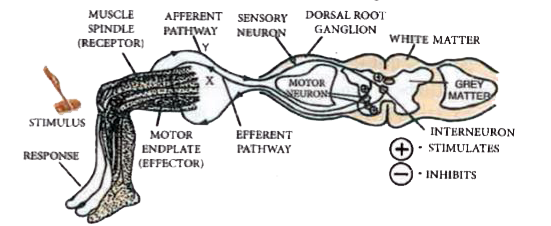
(i) What the the type of reflax action? ...

(i) What the the type of reflax action?
(ii) Give role of X and Y.
(iii) Identify wrong names and correct them.
(iv) In which part of body stimulus is given ?

Text Solution

Verified by Experts
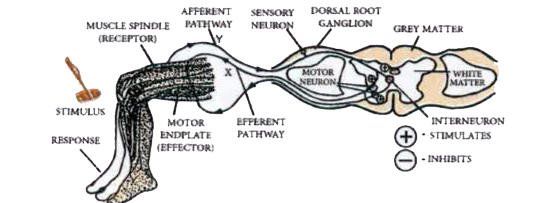
(i) Unconditioned Reflex - Knee - Jerk Reflex.
(ii) X - Efferent pathway - gives orders from spinal cord to the muscles (effector).
Y - Afferent pathway - bring message from receptror to the spinal cord.
(iii)
(iv) Knee
Promotional Banner

Topper's Solved these Questions

  • NEURAL CONTROL AND COORDINATION

    MODERN PUBLICATION|Exercise COMPETITION FILE (OBJECTIVE TYPE QUESTIONS)(C. MATCHING TYPE QUESTIONS: )|4 Videos
  • NEURAL CONTROL AND COORDINATION

    MODERN PUBLICATION|Exercise COMPETITION FILE (OBJECTIVE TYPE QUESTIONS)(D. ASSERTION TYPE QUESTIONS: )|15 Videos
  • NEURAL CONTROL AND COORDINATION

    MODERN PUBLICATION|Exercise COMPETITION FILE (OBJECTIVE TYPE QUESTIONS)(A. MULTIPLE CHOICE QUESTIONS)|131 Videos
  • MORPHOLOGY OF FLOWERING PLANTS

    MODERN PUBLICATION|Exercise CASE BASED SHORT ANSWER TYPE QUESTIONS|2 Videos
  • PHOTOSYNTHESIS IN HIGHER PLANTS

    MODERN PUBLICATION|Exercise CHAPTER PRACTICE TEST|9 Videos

Similar Questions

Explore conceptually related problems

Refer to the given outline of nitrogen cycle. Identify X and Y and select the correct statement regarding them.

Answer the questions based on the dinucleotide shown below : (i)Name the type of sugar guanine base is attached to ? (ii)Name the linkage connecting the two nucleotides (iii)Identify the 3' end of the dinucleotide. Given a reason for your answer.

Given below are the steps involved in the generation and conduction of nerve impulse. Arrange them in proper sequence and select the correct option. I. Rapid influx of Na^+ ions followed by reversal of polarity at the site of application of stimulus. II. Reversal of polarity and generation of action potential at a point ahead of the point of application of stimulus. III. Development of free permeability to Na^+ ions at the site of application of stimulus. IV. Arrival of the impulse generated at the first site to the second site. V. Rise in permeability of K^+ ions and restoration of the resting potential of the membrane.

The composition of two atomic particles is given below : {:(,"X","Y"),("Protons :",8,8),("Neutrons :",8,9),("Electrons :",8,8):} (i) What is the mass number of X ? (ii) What is the mass number of Y ? (iii) What is the relation between X and Y ? (iv) Which element/elements do they represent ?

Protective proteinous chemical compounds produed by the immune cells in response to antigens are called antibodies, also called immunoglobulins. There are five classes of antibodies: IgA, IgD, IgE, IgG and IgM. Following diagram is that of a specific class of antibodies. Observe the diagram and answer the questions listed below the diagram: (i) To which class of antibodies, this antibody belongs to ? (ii) Identify the parts of the diagram labelled as A and B. (iii) Give the name of the part of antibody which binds the antigen. (iv) Which type of immune system is formed by the antibodies?

Identify a, b and c in the schematic diagram of an antibody given here and answer the question : (i) Write the chemical nature of a antibody. (ii) Name the cells that produce antibodies in humans. (iii) Mention the type of immune response provided by an antibody.

