Home
Class 11
PHYSICS
A uniform rod of length L and mass M is ...

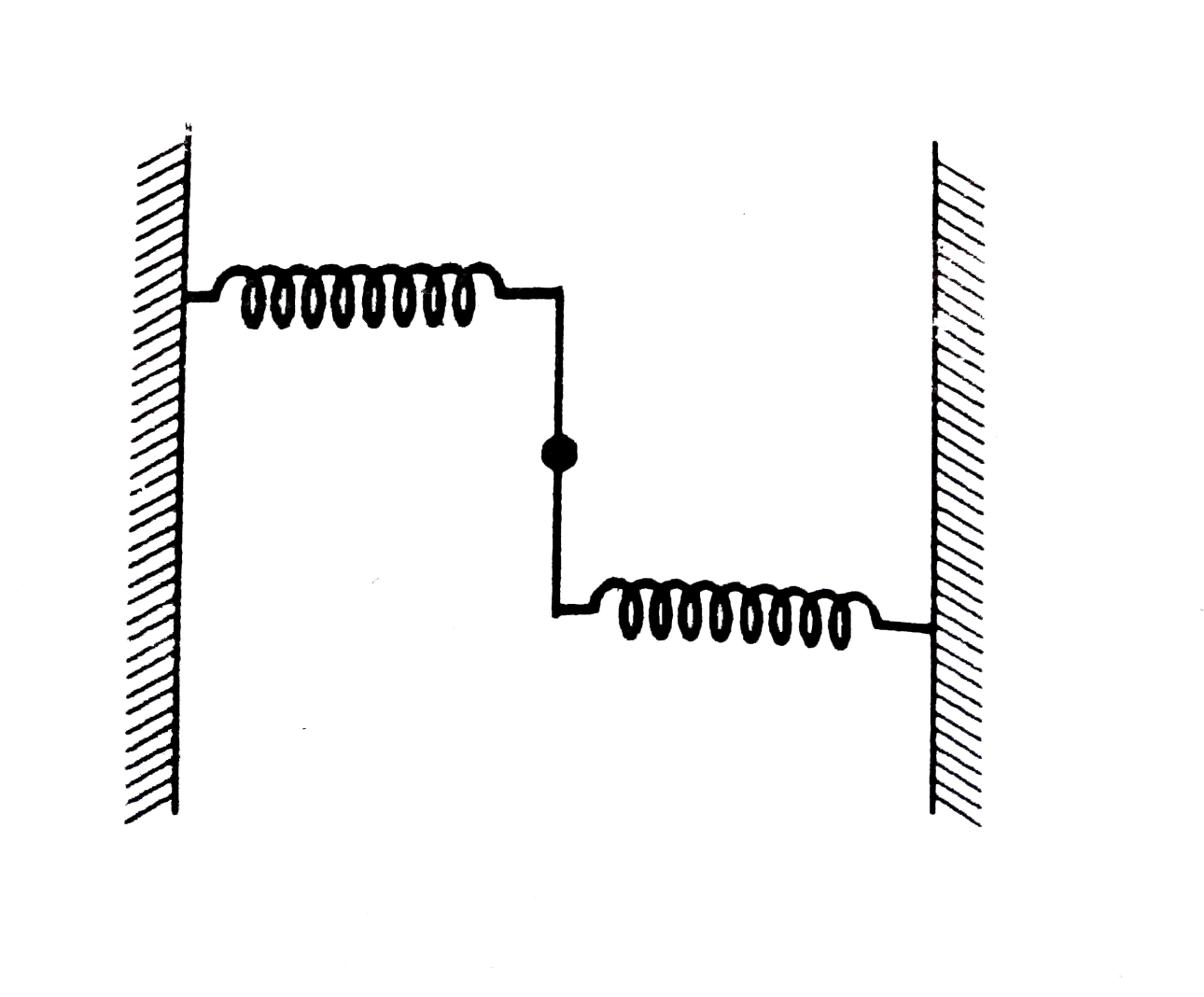
A uniform rod of length `L` and mass `M` is pivotedat the centre. Its two ends are attached to two springs of equal spring constants. `k`. The springs as shown in the figure, and the rod is free to oscillate in hte horizontal plane. the rod is gently pushed through a small angle `theta` in one direction and released. the frequency of oscilllation is-

Text Solution

Verified by Experts
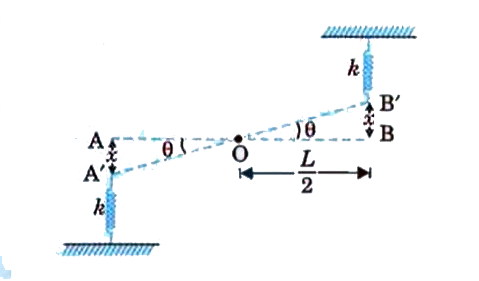
Let the rod be pushed downward by a small amount x.
Both the springs are compressed by the same amount x. When the rod is released, the restoring torque is given by
`tau = (k_(1)x) xx (L)/(2) + (k_(2)x) xx (L)/(2) = ((k_(1) + k_(2))xL)/(2)`

now, `sin theta = (x)(L//2) = (2x)/(L)`, in radians, Since `theta` is small,
`sin theta -~ theta`, Thus `theta = 2x//L or x = Ltheta//2`.
Hence, `tau = (k_(1) + k^(2))(thetaL^(2))/(4)`
Let I be the moment of inertia of the rod about P. Then
`I(d^(2)theta)/(dt^(2)) = [((k_(1) + k_(2))L^(2))/(4)]theta `
or `(d^(2)theta)/(dt^(2)) = [((k_(1) + k_(2))L^(2))/(4I)] theta`
SInce `(ed^(2)theta)/(dt^(2)) prop (theta)`, the motion is simple harmonic whose angular frequency is given by
`omega = sqrt(((k_(1) + k_(2))l^(2))/(4I))`
Now, `omega = (2pi)/(T) and I = (ML^(2))/(12)`. Therefore, we have
`(2pi)/(T) = sqrt(((k_(1) + k_(2))L^(2))/(4)) xx (12)/(ML^(2)) = sqrt((3(k_(1) + k_(2)))/(M))` < br> or `T = 2pi sqrt((M)/(3(k_(1) + k_(2)))`
Promotional Banner

Topper's Solved these Questions

  • OSCILLATIONS

    MODERN PUBLICATION|Exercise NCERT FILE (Textbook Exercises)|19 Videos
  • OSCILLATIONS

    MODERN PUBLICATION|Exercise NCERT (Additional Exercises)|6 Videos
  • OSCILLATIONS

    MODERN PUBLICATION|Exercise Conceptual Questions|18 Videos
  • MOTION IN A STRAIGHT LINE

    MODERN PUBLICATION|Exercise CHAPTER PRACTICE TEST|16 Videos
  • PHYSICAL WORLD

    MODERN PUBLICATION|Exercise Revision exercises (Long answer questions)|6 Videos

Similar Questions

Explore conceptually related problems

A uniform rod of length l and mass M is pivoted at the centre. Its two ends are attached to two ends are attached to two springs of equal spring constant k. the springs are fixed to rigid ruppot as shown in figure and the rod is free to oscillate in the horizontal plane. the rod is gently pushed through a small angle theta in one direction and relased. the frequency of oscillation is

The arrangement shown of a uniform rod of length l and mass m, pivoted at the centre and its two ends attached to two springs of spring constant K_(1) and K_(2) . The other end of springs are fixed to two rigid supports the rod which is free to rotate in the horizontal plane , is pushed by a small angle in one direction and released . Teh frequency of oscillation of the rod is

two light identical springs of spring constant K are attached horizontally at the two ends of a uniform horizontal rod AB of length l and mass m. the rod is pivoted at its centre 'o' and can rotate freely in horizontal plane . The other ends of the two springs are fixed to rigid supportss as shown in figure . the rod is gently pushed through a small angle and released , the frequency of resulting oscillation is :

Two identical springs of spring constant k are attached to a block of mass m and to fixed supports as shown in the figure. The time period of oscillation is

A rod of length l and mass m , pivoted at one end, is held by a spring at its mid - point and a spring at far end. The spring have spring constant k . Find the frequency of small oscillations about the equilibrium position.

A uniform stick of mass M and length L is pivoted its come its ands are fast to two spring each of the constant K . In the position shown in figure the same through a small length when spring is display through a small angle of and released. The stick :

A rigid rod of mass m with a ball of mass M attached to the free end is restrained to oscillate in a vertical plane as shown in the figure. Find the natural frequency of oscillation.

