Home
Class 11
PHYSICS
A particel which is simultaneously subje...

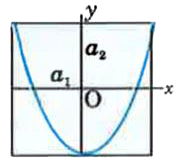
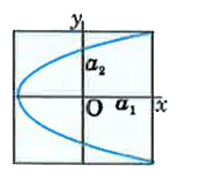
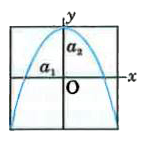
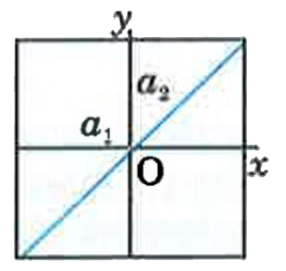
A particel which is simultaneously subjected to two perpendicular simple harmonic motions represented by `x=a_(1)cosomegat` and `y=a_(2)cos2omegat` traces a curve given by :

A

B

C

D

Text Solution

AI Generated Solution

The correct Answer is:

To solve the problem of finding the curve traced by a particle subjected to two perpendicular simple harmonic motions represented by \( x = a_1 \cos(\omega t) \) and \( y = a_2 \cos(2\omega t) \), we will follow these steps: ### Step 1: Understand the given equations We have two equations: - \( x = a_1 \cos(\omega t) \) - \( y = a_2 \cos(2\omega t) \) ### Step 2: Express \( \cos(2\omega t) \) in terms of \( \cos(\omega t) \) Using the double angle formula for cosine: \[ \cos(2\theta) = 2\cos^2(\theta) - 1 \] we can write: \[ \cos(2\omega t) = 2\cos^2(\omega t) - 1 \] ### Step 3: Substitute \( \cos(\omega t) \) in terms of \( x \) From the first equation, we can express \( \cos(\omega t) \): \[ \cos(\omega t) = \frac{x}{a_1} \] Now substituting this into the expression for \( \cos(2\omega t) \): \[ \cos(2\omega t) = 2\left(\frac{x}{a_1}\right)^2 - 1 = \frac{2x^2}{a_1^2} - 1 \] ### Step 4: Substitute into the equation for \( y \) Now we substitute this back into the equation for \( y \): \[ y = a_2 \left(2\left(\frac{x}{a_1}\right)^2 - 1\right) \] This simplifies to: \[ y = a_2 \left(2\frac{x^2}{a_1^2} - 1\right) = \frac{2a_2}{a_1^2} x^2 - a_2 \] ### Step 5: Rearrange the equation Rearranging gives us: \[ y + a_2 = \frac{2a_2}{a_1^2} x^2 \] This can be rewritten as: \[ \frac{2a_2}{a_1^2} x^2 = y + a_2 \] ### Step 6: Identify the type of curve The equation \( \frac{2a_2}{a_1^2} x^2 = y + a_2 \) is in the form of a parabola, specifically: \[ x^2 = \frac{a_1^2}{2a_2}(y + a_2) \] This shows that the curve is a parabola that opens upwards. ### Conclusion The curve traced by the particle is a parabola symmetric about the y-axis. ---

To solve the problem of finding the curve traced by a particle subjected to two perpendicular simple harmonic motions represented by \( x = a_1 \cos(\omega t) \) and \( y = a_2 \cos(2\omega t) \), we will follow these steps: ### Step 1: Understand the given equations We have two equations: - \( x = a_1 \cos(\omega t) \) - \( y = a_2 \cos(2\omega t) \) ### Step 2: Express \( \cos(2\omega t) \) in terms of \( \cos(\omega t) \) ...
Promotional Banner

Topper's Solved these Questions

  • OSCILLATIONS

    MODERN PUBLICATION|Exercise Competition File (JEE (Advanced) For IIT Entrance)|7 Videos
  • OSCILLATIONS

    MODERN PUBLICATION|Exercise Competition File (Multiple choice question)|11 Videos
  • OSCILLATIONS

    MODERN PUBLICATION|Exercise Competition File (Multiple choice questions) AIPMT/NEET other State Boards for Medical Entrance|14 Videos
  • MOTION IN A STRAIGHT LINE

    MODERN PUBLICATION|Exercise CHAPTER PRACTICE TEST|16 Videos
  • PHYSICAL WORLD

    MODERN PUBLICATION|Exercise Revision exercises (Long answer questions)|6 Videos

Similar Questions

Explore conceptually related problems

A particle which is simultaneously subjected to two perpendicular simple harmonic motions represented by , x = a_1 cos cot and y = a_2cos 2 cot traces a curve given by:

The epoch of a simple harmonic motion represented by x = sqrt(3)sin omegat + cos omega t m is

A particle is acted simultaneously by mutually perpendicular simple harmonic motions x=a cos omegat and y=asinomegat . The trajectory of motion of the particle will be

What is the phase difference between two simple harmonic motions represented by x_(1)=A"sin"(omegat+(pi)/(6)) and x_(2)=A "cos"omegat ?

A particle is acted simultaneously by mutally perpendicular simple harmonic motion x=acosomegat and y=asinomegat . The trajectory of motion of the particle will be

A particle is acted simultaneously by mutually perpendicular simple hormonic motions x=acos omegat and y =asinomegat. The trajectory of motion of the particle will be

A particle isolated simultaneously by mutually perpendicular simple harmonic motion x = a cos omegat and y = a sin omegat . The trajectory of motion of the particle will be:

What is the phase difference between two simple harmonic motions represented by X_(1)=Asin[omegat+(pi)/(3)]andX_(2)=Acosomegat ?

A particle is acted simultaneously by mutually perpendicular simple harmonic motion x = a cos omega t and y= a sin omega t . The frequency of motion of the particle will be

MODERN PUBLICATION-OSCILLATIONS -Competition file (Multiple choice question) JEE (Main) & Other State Boards for Engineering Entrance
  1. A massless spring (k = 800 N/m), attached with a mass (500 g) is compl...

    Text Solution

    |

  2. A wooden cube (density of wood 'd') of side 'l' flotes in a liquid of ...

    Text Solution

    |

  3. A particle of mass m is at rest at the origin at time t=0 It is subjec...

    Text Solution

    |

  4. If a simple pendulum has significant amplitude (up to a factor of1//e ...

    Text Solution

    |

  5. The displacement of a damped harmonic oscillator is given by x(t)=e^(-...

    Text Solution

    |

  6. An ideal gas enclosed in a cylindrical container supports a freely mov...

    Text Solution

    |

  7. A particle moves with simple harmonic motion in a straight line. In fi...

    Text Solution

    |

  8. For a simple pendulum, a graph is plotted its kinetic energy (KE) and ...

    Text Solution

    |

  9. A particle performs simple harmonic mition with amplitude A. Its speed...

    Text Solution

    |

  10. If x, v and a denote the displacement, the velocity and the accelerati...

    Text Solution

    |

  11. A pendulum with time period of 1s is losing energy due to damping. At ...

    Text Solution

    |

  12. Two particles are executing SHM in a straight line. Amplitude A and th...

    Text Solution

    |

  13. A 1 kg block attached to a spring vibrates with a frequency of 1 Hz on...

    Text Solution

    |

  14. The ratio of maximum acceleration to maximum velocity in a simple harm...

    Text Solution

    |

  15. If an experiment to determine the period of a simple pendulum of lengt...

    Text Solution

    |

  16. A particle is executing simple harmonic motion with a time period T. A...

    Text Solution

    |

  17. A particel which is simultaneously subjected to two perpendicular simp...

    Text Solution

    |

  18. The angular frequency of the damped oscillator is given by omega=sqrt(...

    Text Solution

    |

  19. Which of the following expressions corresponds to simple harmonic moti...

    Text Solution

    |

  20. A silver atom in a solid oscillates in simple harmonic motion in some ...

    Text Solution

    |
